


 hi
hi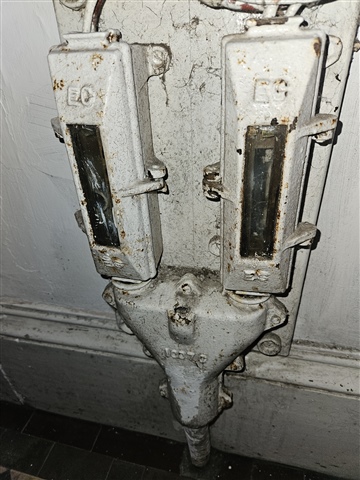
Hi
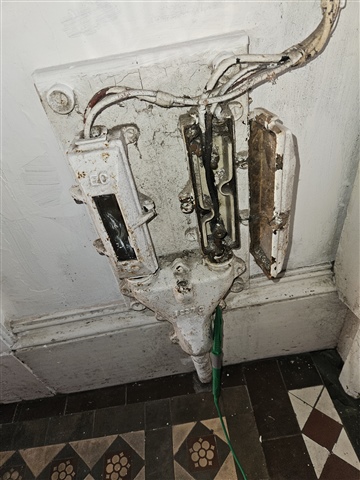
Can anyone tell me how old this is? Been asked to do and eicr in the property. Its an old listed building and its now empty. It was rewired around 20 years ago. Im get a ze of 22.5 ohms. Fused board it the old type asbestos flash fuses?
hi
Hi
Can anyone tell me how old this is? Been asked to do and eicr in the property. Its an old listed building and its now empty. It was rewired around 20 years ago. Im get a ze of 22.5 ohms. Fused board it the old type asbestos flash fuses?
1940 or earlier. If you can identify where you are in the country, and when that area changed from DC to AC it may be possible to be more precise, but no promises.
The long thin fuse holders and the 2 pole fusing suggest to me a centre earthed DC supply converted to AC, and that may be pre or post WW2 depending on the location.
The lower box is probably full of tar.
In any case, send a pic to the DNO for comment and perhaps imply you'd like it changed pronto please as it is very much over the hill and potentially dangerous for modern fault current levels. This is the sort of thing that was already being taken out as not very safe by the 1970s.
I appreciate it's too late and you have already seen it open, but these hot wire fuse designs often had hairy asbestos arc pads in the opening lid, and the dust from these is now known to be very bad for you. Don't open it again, and if there is any dusty deposit, collect onto wet tissue or wet disposable cloth and then bag it up for disposal. Brushing or the house vacuum cleaner spread the problem, and are really bad ideas. See the RH side of the flow chart on page 3 of this doc
https://www.hse.gov.uk/pubns/guidance/em1.pdf
Realise that earthing for power in the UK was not really a thing much before the mid 1930s, and in smaller houses 2 wire lighting only supplies were common - and 2 pin sockets were for the wealthy only. The house earth may have been added, perhaps as a clamp on the lead water pipes or something, and it is really a kind of TT, and even with a 5A supply a pretty useless one, until the invention of the RCD.
If the incomer is like that, what state is the metering ? It may have had an electrolytic meter originally if it was DC.
Good luck.
Mike
If you realty want to know how old, it may be worth checking when the house was built and if it was electric from the outset. Looking at the floor tiles, possibly.
Similar but not identical things are on page 15 of this document
https://www.enwl.co.uk/globalassets/get-connected/cic/icpsidnos/g81-policy/policy-library-documents/cables/cp411-pt1n/section-2---standard-techniques/13.8-identification-and-rectification-of-fused-neutral-cut-outs-issue-1.pdf
note "Inspection and Rectification Procedure:
• There is no easy solution to fit a solid link
• This Cut-Out cannot be worked on safely to insert a Neutral link
• Consider for a live Cut-Out change"
Mike.
PS
similar things for AC only (shorter fuses) were still being installed post war, but the combined cable incomer and fuseholder designs were more common than separates.
(and by then most new build was connected to the national grid & 50Hz as it had been running for a decade or so by then. )
Image of a 1936 advert for the AC version, copied from page 2 of this thread 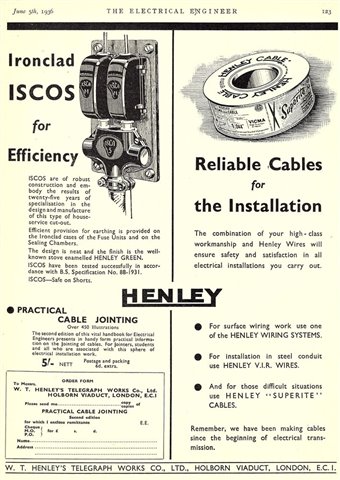

Realise that earthing for power in the UK was not really a thing much before the mid 1930s
Given that the building is listed, the date of its construction ought to be known. Electricity at home was pretty rare before the First World war.
Google has not been much help with those fairly distinctive floor tiles, but they appear to have been laid after the electricity cable was put in. They were popular between about 1850 and 1930. One difficulty as I see it, is that there is not much slack for the DNO to replace the service head.

One difficulty as I see it, is that there is not much slack for the DNO to replace the service head.
Though here at least, (SSE) they tend to just put a new cable joint a metre or two outdoors and run a new incomer to a new head in situations like that.
Assuming an accessible lawn or a flower bed, live working cable jointers can be pretty fast, and for something with a metal case and failing insulation that may go bang on opening, or may shower the workers with asbestos dust, for the DNO team that is sometimes the more attractive approach. Once dead, the old thing can be levered off the wall as a single lump and dropped into the asbestos bag unopened.
Mike.
Though here at least, (SSE) they tend to just put a new cable joint a metre or two outdoors and run a new incomer to a new head in situations like that.
That in a sense was my point. If the service cable has to be replaced, at least some tiles will have to come up.
Alternatively, there may be a better location for the intake, in which case the old service cable could be disconnected upstream and cut off at ground level.
Though here at least, (SSE) they tend to just put a new cable joint a metre or two outdoors and run a new incomer to a new head in situations like that.
That in a sense was my point. If the service cable has to be replaced, at least some tiles will have to come up.
Alternatively, there may be a better location for the intake, in which case the old service cable could be disconnected upstream and cut off at ground level.
We're about to take you to the IET registration website. Don't worry though, you'll be sent straight back to the community after completing the registration.
Continue to the IET registration site