Re BS Standards for Distribution boards and Enclosures

Hi there 

I've recently been involved in a project to look at replacing old Distribution Boards and there Enclosures but we have been asked a number of questions in regards this these being as follows:-

Question 1 - Determine the impact to using the present array of MCB's within the current Distribution boards which are some 30-40 years old in line with what the current standards BS EN 61439-3 compared to the old Standards BS EN 60439-3?

Question  2 - What criteria determines if we do or don't need to use RCD's/RCBO's?

Question 3 - Can you swap the actual MCB's that are used in the current Distribution boards which are 30-40 years old with the latest new standard MCBs without changing the entire board?.

Parents

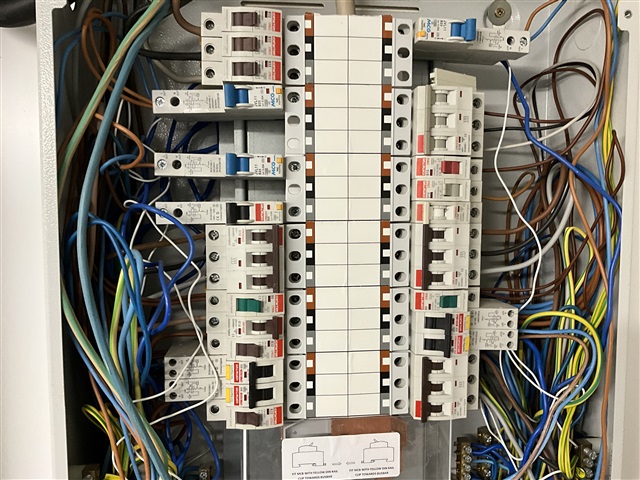
  • Mixed manufacturers but even when the same, the operating handle is sometimes opposite in direction. An untidy board but those RCBO flying leads do little to assist! 
    I wonder if there is any case where a contractor has been held to account for mixing devices or inadvertently taking on the role of the manufacturer. There are certainly scare tactics being employed, but I am not sure just how serious the consequences might be.

    During my life as a contractor, I installed replacement pan assemblies into existing old enclosures of different manufacturers on many occasions. Usually done because of the logistical difficulty in replacing the enclosure, due for example to connections of old pyro cables or steel conduit. If the same situation arose now, I don’t think I would worry one jot about being the manufacturer, providing I was as confident as I could be that the arrangement was safe and, importantly, better than it was before.

  • an untidy board

    But think of all the de-rating from  awkward grouping factors if it had been made up into a harness/loom assembly, surely a C2 safely side-stepped.

    Sarcasm aside, the risk from mix and match in that situation is mainly that the bus prongs are short or in the wrong plane and a feeble contact goes un-noticed. To be fair I'd expect skilled hands to be able to spot that when selecting a compatible replacement . and if all the breakers were changed and the bus bar, then again if it all fits properly, then the real risk is low.

    M

Reply
  • an untidy board

    But think of all the de-rating from  awkward grouping factors if it had been made up into a harness/loom assembly, surely a C2 safely side-stepped.

    Sarcasm aside, the risk from mix and match in that situation is mainly that the bus prongs are short or in the wrong plane and a feeble contact goes un-noticed. To be fair I'd expect skilled hands to be able to spot that when selecting a compatible replacement . and if all the breakers were changed and the bus bar, then again if it all fits properly, then the real risk is low.

    M

Children
  • I have installed a bus bar extension to a new din rail device in the past. I have used a flexible wire to allow for this from the next device. This avoids having to fit a new device onto a mis-matched bus bar. I have never had any problems with this if I use a suitably sized wire. This is a quick fix when I need an instant solution. I normally fit the new device at the end of an existing bus bar.

    Alf.

  • It might be a bit untidy, but who cares. You can't see the cables when the cover is on. As long as it is correctly wired and safe all is good. It ain't an art project. Plus over beautifying the wires costs more in time and labour.

    Alf.