


"Ed Throws Trade Bodies Into Chaos Over DIY Solar!" (efixx) :-) lol
Cue another early amendment and Section in BS7671 and another 'membership' level in the brilliant CPSs for the trade to do DIY Solar installs.
:-)
"Ed Throws Trade Bodies Into Chaos Over DIY Solar!" (efixx) :-) lol
Cue another early amendment and Section in BS7671 and another 'membership' level in the brilliant CPSs for the trade to do DIY Solar installs.
:-)
New Efixx video: https://youtu.be/hvtihZMB-GM?si=P69MhNuegryMAS2a
They test several scenarios that have got people in a flap. This includes plugging 2 balcony solar systems into a circuit protected by an old non-bidirectional RCD, then deliberately tripping it using the RCD test button on a socket tester. The RCD tripped and the power went off. The RCD continued to function fine afterwards. Everything worked as it was supposed to.

Everything worked as it was supposed to.
As of course it would - this is carefully designed and thoroughly tested kit, working as the manufacturers intended.
Mike
PS
Realise that the original analysis that underpins the German safety case for running 800W into a 1.5mm2 radial on a 16A breaker as the worst case was finalised in the 4th of July 2016 an released in 2019 - not quite a decade ago, but equally not exactly new either.
Figure 10 considers the marginal overload condition for example. (orange)
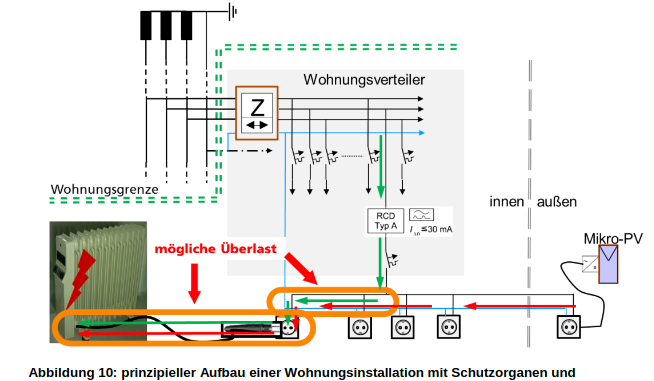
Everything worked as it was supposed to.
As of course it would - this is carefully designed and thoroughly tested kit, working as the manufacturers intended.
Mike
PS
Realise that the original analysis that underpins the German safety case for running 800W into a 1.5mm2 radial on a 16A breaker as the worst case was finalised in the 4th of July 2016 an released in 2019 - not quite a decade ago, but equally not exactly new either.
Figure 10 considers the marginal overload condition for example. (orange)

This may well work in Germany fine, but they stopped using RCBO type AC in the very late 1980's. Some massive UK home build companies where still installing type AC RCBO a year or 2 ago and some are probably still installing split load RCD consumer units.
Now on the flip side of that we have the average UK 3 bed semi circa 1920/30 with a 15/16/17th edition CU which may or may not have questionable Earth at the source of origin. If you are luck/Unlucky you may even have VIR cable as well.
Don't assume Germany is some electrical Nirvana.
Their regs changed in 1990, and introduced a requirement for 30mA RCDs type A for new sockets. (and removed a 10mA RCD requirement for some bathroom kit)
There remain plenty of old sockets on the historical Diazed (small bottle) fuses and little else, especially in large 'altbau' (Old Build) blocks where these sort of solar installations will go, being aimed at the poorer quarters, not those who own their own place and can afford a hard wired system, and expect to be there long enough to get it to pay back.
Arguably the UK missed a trick with the AC vs A RCD thing but the point remains, like the UK, there will be many pre-RCD installations in Germany, much as there are here.
I worked in Berlin in the early 2000s, and at that point, in a lot of the former East, there were plenty of buildings with the old Russian 2 pin sockets (from memory type GOST 7396 with various letters defining the current rating.), and no earth on power circuits at all. A common upgrade, given the 2 core cable was cemented into the fabric of the building, was to generate a local earth from the neutral, by linking behind the socket, to allow a new Shucko socket to be put on the front. This was never regs correct approved practice of course, but still well known and common in some styles of buildings.
Plug into one of those and a shiny new type A RCD at the origin won't do very much for you ! Mind you on the upside, nuisance tripping will be quite rare....
I'd like to hope that a lot of that has now been fixed over the intervening 20 odd years, but I bet that some is still in service, the joke always was (much like the UK actually ) that the tattiest end of the rented sector moves quite slowly, and for a certain type of maintenance company no opportunity to skimp or delay on essential maintenance is knowingly missed.
My point ?
Either compare the best of ours with the best of theirs, or the worst with the worst, but don't be misled by an illusion of the grass looking greener over there ! The risks, and the accident rates, are actually quite comparable.
Also do be aware of what the differences really are - such as domestic 3 phase being common, and used for cookers and larger water heaters. Also generally final circuits are combined lights and power. And like here, most accidents involve equipment that is plugged in, including extension leads and adaptors, not the building wiring per-se.
Late edited PS Germany is not the whole of the EU, or even the whole of the German speaking EU - Austria apparently permits AC type RCDs on new installs even in 2026 .... but it is under review.
Mike
Maybe BS7671 AMD 5 or 19th edition should ban the use or install of new or replacement Type AC RCD/RCBO forthwith and specify that all older type AC should be replaced with a type A minimum

and specify that all older type AC should be replaced with a type A minimum
Why? Are type AC RCBOs dangerous?
BS 7671 does not provide its own standalone definition of "dangerous" in its definitions section. Instead, it adopts the statutory definition from the Electricity at Work Regulations 1989 (EAWR), which defines danger as "risk of injury
RCD/RCBO type AC MAY be blinded by DC (Direct Current). Not ALL type AC get blinded by DC. Thus specifying a type A as a minimum would avoid any confusion. Imagine the scenario in your average UK 3 bed semi. RCD type AC blinded by DC and there is no longer functional 30mA RCD, at best someone or an animal could get a shock, at worst it could be electricution.
Caveat time type A is ONLY upto 6mA pulsating DC residual currents superimposed on a smooth direct current. Therefore with the time it takes for a new BS7671 edition or amendment to be published what we should probably start preparing for is recommending a minimum of type F or B RCD/RCBO
Whilst there may be a case for specifying Type A as a minimum, that does not mean that type AC RCDs must be replaced any more than BS 7671 requires them to be fitted in an existing installation which does not have them.
Note 2 to 651.2: Existing installations may have been designed and installed to conform to previous editions of BS 7671, applicable at the time of their design and erection. This does not necessarily mean that they are unsafe. [My emphasis]
Am I safe when I drive a vintage car? Yes, but if I have a collision, I am less likely to survive than if I am driving a modern car full of air-bags, etc. That does not mean that I should fit seatbelts, but it does mean that I leave a bigger stopping distance.

BS7671 already states type A rcd if DC might be present, which covers most household use with leds and switch mode power supplies, i dont recall the regs ever being retrospective.
We're about to take you to the IET registration website. Don't worry though, you'll be sent straight back to the community after completing the registration.
Continue to the IET registration site