


Hi all,
Does anyone know why there are no current-carrying capacities listed for cables below 25mm² for Reference method F in Table 4E1A?
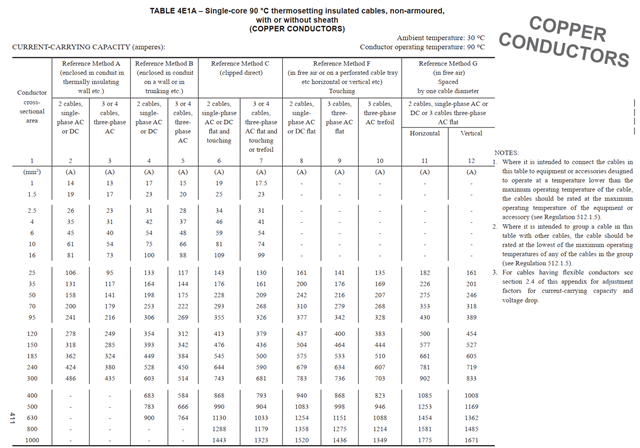
I can only assume it is related to mechanical protection, however cannot find a regulation stipulating this.
The closest I can find is reg 522.6.1 - ' Wiring systems shall be selected and erected so as to minimize the damage arising from mechanical stress, e.g. by impact, abrasion, penetration, tension or compression during installation, use or maintenance' or Reg 522.8.4 - ' Where conductors or cables are not supported continuously due to the method of installation, they shall be supported by suitable means at appropriate intervals in such a manner that the conductors or cables do not suffer damage by their own weight.' however none of these specify a minimum cable size.
The reason I'm interested is I'm designing -48Vdc systems where the prospective fault level of the batteries can be relatively large, typically 6-8kA at source but for some applications up to 18kA. The charger systems are feeding telecoms racks which occasionally have dual fed PDUs, however the maximum rated short circuit capacity of the circuit breakers is 1kA which can easily be exceeded in these systems. One solution would be to reduce the cable CSA below 25mm² hence reducing the prospective fault level below 1kA at the load end. However, I'm unsure if this would be acceptable as no CCC is provided. I have suggested using the CCC for Reference method C, as the airflow and thermal dissipation around the cables installed in basket would theoretically increase the CCC above the Ref. C value.
The installation is within a controlled environment where only trained personnel are permitted un supervised; hence the risk of mechanical damage is minimal. I've suggested that the reduced cable size is the pragmatic solution based on the trade off between risk of mechanical damage vs. failure of the MCBs in the event of said damage.
Any insights or recommendations would be appreciated.
Thanks,
Calum Doherty


