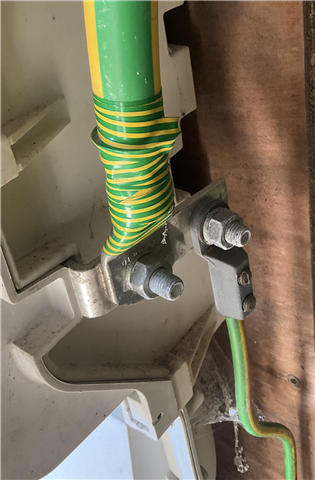
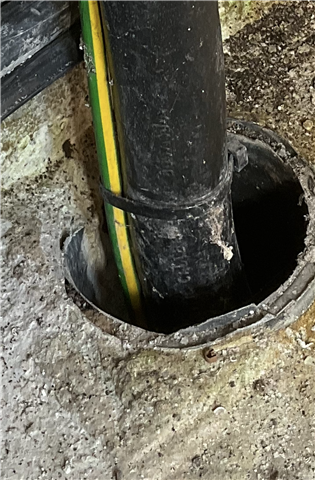
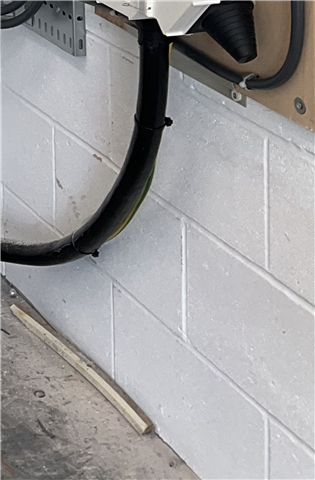
How good are you at telling the difference?
How good are you at telling the difference?
Two different DNO intakes, both are the only connections to a transformer and both have a DNO earth electrode at the intake with the DNO earth electrode conductor cable tied to the DNO supply cable, but one has an internal earth electrode connection and the other has an external connection.
From looking at them, how would you tell the difference between these, if there is a difference?
Also, how would you tell the difference between these and the picture of the TT earth installed by a DNO that I posted a picture of earlier in the discussion?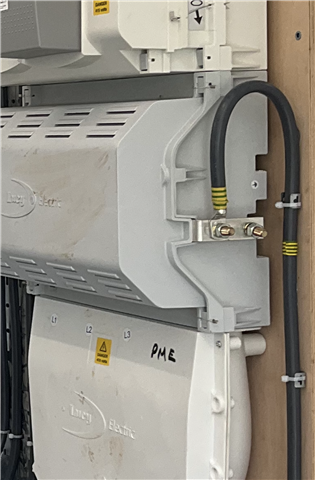

TT earth installed by a DNO
As far as I'm aware UK DNOs never supply TT earthing facilities - if it's TT the electrode is part of the consumer's installation, if the DNO supply an earthing terminal then it's connected to their PEN or PE.
An extra G/Y at the intake might just be the final additional electrode of a PME system (seems to be more common on 3-phase supplies or where the service cable is >40m long), or it could be the only electrode on a PNB system (although that usually comes with some very obvious warning notices about not disconnecting it).
- Andy.

Never say never, just when you think you know something, someone changes it.

As far as I'm aware UK DNOs never supply TT earthing facilities - if it's TT the electrode is part of the consumer's installation, if the DNO supply an earthing terminal then it's connected to their PEN or PE.
That doesn't mean:
(a) the original DNO earth electrode is still maintained by the DNO after privatisation (whether there are other electrodes elsewhere for the PBN is not clear); and
(b) the installation hasn't been converted to TT by someone else.
On some of the multi-customer PNB systems I've seen, which incidentally had "PME" stickers, the PE from the service head goes to a Henley block that originally had a service seal on it. Also connected to this are the protective conductor from the earth electrode, and the PE to the consumer unit. So they can easily be modified to TT by removing the PE from the service head (I understand these are sometimes chopped off at both ends when the installation is converted to TT).

That doesn't mean:
(a) the original DNO earth electrode is still maintained by the DNO
ESQCR:
3.—(1) Generators, distributors and meter operators shall ensure that their equipment is—
...
(b) so constructed, installed, protected (both electrically and mechanically), used and maintained as to prevent danger, interference with or interruption of supply, so far as is reasonably practicable. [my emphasis]
However, checking all of their earthing, especially on private premises, may not be reasonably practicable.
Best we seem to be able to hope for (domestically) is that every 20 years or so when meters are renewed, the Ze remains satisfactory.
That doesn't mean:
(a) the original DNO earth electrode is still maintained by the DNO
ESQCR:
3.—(1) Generators, distributors and meter operators shall ensure that their equipment is—
...
(b) so constructed, installed, protected (both electrically and mechanically), used and maintained as to prevent danger, interference with or interruption of supply, so far as is reasonably practicable. [my emphasis]
However, checking all of their earthing, especially on private premises, may not be reasonably practicable.
Best we seem to be able to hope for (domestically) is that every 20 years or so when meters are renewed, the Ze remains satisfactory.
Chris Pearson ownership of some assets (e.g. move from DNO to BNO) moved during privatisation also.
In some installations, it's really not that clear for the installer (ans sometimes building operator/owner) what happened when, and who is responsible for what.
We're about to take you to the IET registration website. Don't worry though, you'll be sent straight back to the community after completing the registration.
Continue to the IET registration site