Is there an error in 312.2.1.1?

There appears to be an error in 312.2.1.1 Single-source systems.

Note 4(b): "Regulation 8(4) of the Electricity Safety, Quality and Continuity Regulations (ESQCR) prohibits the use of a public distribution network neutral as a protective conductor in consumers' installations."

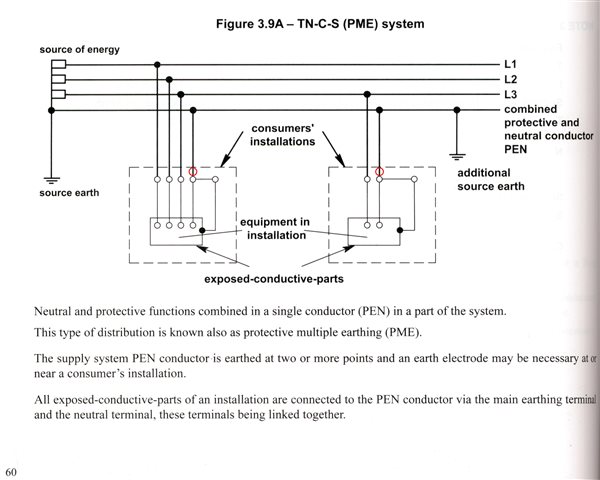
So why is a short length shown in Figure 3.9A, circled in red below? (I realise that the figure is not new.)

I appreciate that the aim may be to show the distinction between the TN-S and TN-C-S (PNB) systems where there is no link on the consumer's premises on the one hand, and TN-C-S (PME) where there is a link in each of them on the other hand.

The fact is that the service head, which contains the link, is part of the network, so the links in Figure 3.9A ought to be shown outside the dashed box. Alternatively, the boxes could be re-labelled as "consumers' premises".

As a point of interest, an electricity meter is normally to be situated on a customer's premises (Paragraph 1(3) of Schedule 7 to the Electricity Act 1989), so the adjacent service head will be situated on the same premises.

ESQCR defines “consumer’s installation” as "the electric lines situated upon the consumer’s side of the supply terminals together with any equipment permanently connected or intended to be permanently connected thereto on that side", and “supply terminals” as "the ends of the electric lines at which the supply is delivered to a consumer’s installation" (Reg 1(5)). “Supply neutral conductor” is "the neutral conductor of a low voltage network which is or is intended to be connected with earth, but does not include any part of the neutral conductor on the consumer’s side of the supply terminals".

Given that the network and consumer's installation are unambiguously demarcated at the supply terminals, it follows that Note 4(b) cannot be correct. Whether the supply terminals are the output of the service head or the output of the meter does not change the argument.

What R.8(4) of ESQCR states is "A consumer shall not combine the neutral and protective functions in a single conductor in his consumer’s installation." In other words, it prohibits a consumer from using any of his own neutral conductors as a protective conductor rather than a public one. I suggest that the distinction is more than trivial.
Parents
  • Note 4(b): "Regulation 8(4) of the Electricity Safety, Quality and Continuity Regulations (ESQCR) prohibits the use of a public distribution network neutral as a protective conductor in consumers' installations." 

    I noticed that too - and with some unease. We're always being told that JPEL/64 members can't offer interpretations of BS 7671 but rather such matters sit ultimately with the courts, so it feels rather odd for them to be offering an interpretation on some regulations with higher legal status - especially when that interpretation differs perhaps significantly from common understanding of the printed words.

       - Andy.

  • I noticed that too - and with some unease. We're always being told that JPEL/64 members can't offer interpretations of BS 7671 but rather such matters sit ultimately with the courts, so it feels rather odd for them to be offering an interpretation on some regulations with higher legal status - especially when that interpretation differs perhaps significantly from common understanding of the printed words.

    The notes of the standard are not normative, so there's no need to conform to them to conform to the standard.

    The court is at liberty to take into account the notes of the standard (or not) when deciding to interpret the standard, but the legislation says what it says.

    The issue is, that by considering PNB, island mode configurations, backup generators, multiple parallel supplies,for example the considerations posted in this thread: TN-C-S (PNB) versus TN-C-S (PME)., we are, unfortunately, where we are ...

  • It still seems a bit of a leap to suggest that "A consumer shall not combine the neutral and protective functions in a single conductor in his consumer’s installation." applies only to the distributor's N .. I can see that the general context is that a consumer is someone who receives a supply from a supplier/distributor, but it doesn't take much imagination to think the ESQCR's prohibition applies to all of the consumer's installation, even if it's fed through a local transformer or similar. The physics, and therefore the dangers, are surely the same regardless of ownership.

    To me it seems the whole problem arises from the mistake of calling the connection between the earthing point and the star point a PEN conductor (which isn't justified by any of the definitions I can find) - get that right and the ESQCR doesn't look like a problem any more.

       - Andy.

  • More importantly, that new paragraph in '7671 is not actually what the ESCQR says, or anything like it actually ! 
    If the law  did say that, all PME would be illegal as we very much rely on the public neutral to be a conductor  for the protective earth to work in those  customer installations... What the law actually says is far simpler and might as well have been quoted verbatim.

    Mike

    PS
    And if it did not rely on the public neutral, then all the worries about open circuit neutrals on the street network, from 'the killing ground' onwards would be moot.

    (side note as far as I know the hazard of the interrupted neutral on TNC-x was first seriously brought to public attention in the article The Killing Ground by Peter Chadwick, G3RZP in 1987   part 2  there was  also similar article in Electronics World.  Some of the advice in that article is no longer applicable. 
    The reason being that long before EV cars, amateur radio people have been 'exporting' mains earth to their antennas outside, in many cases simple wires, but some have masts and towers to rival the professionals - indeed some actually are the professionals, just on their days off - and problems with diverted earth current are well known to many in those circles. Hams tend to do odd things and may serve as the canaries in the coal mine by having problems no one else does. Fortunately there are not enough of us to trouble the accident stats or require special electrical legislation.)

Reply
  • More importantly, that new paragraph in '7671 is not actually what the ESCQR says, or anything like it actually ! 
    If the law  did say that, all PME would be illegal as we very much rely on the public neutral to be a conductor  for the protective earth to work in those  customer installations... What the law actually says is far simpler and might as well have been quoted verbatim.

    Mike

    PS
    And if it did not rely on the public neutral, then all the worries about open circuit neutrals on the street network, from 'the killing ground' onwards would be moot.

    (side note as far as I know the hazard of the interrupted neutral on TNC-x was first seriously brought to public attention in the article The Killing Ground by Peter Chadwick, G3RZP in 1987   part 2  there was  also similar article in Electronics World.  Some of the advice in that article is no longer applicable. 
    The reason being that long before EV cars, amateur radio people have been 'exporting' mains earth to their antennas outside, in many cases simple wires, but some have masts and towers to rival the professionals - indeed some actually are the professionals, just on their days off - and problems with diverted earth current are well known to many in those circles. Hams tend to do odd things and may serve as the canaries in the coal mine by having problems no one else does. Fortunately there are not enough of us to trouble the accident stats or require special electrical legislation.)

Children
No Data