Who from the IET is working with the government to allow <800W inverters to be 'plugged in'?

The UK government made the following announcement at the end of March (www.gov.uk/.../government-to-make-plug-in-solar-available-within-months) regarding Balcony Solar/Plug-in Solar. The following section features in the 'Notes To Editors' at the end of the announcement.

"The government will work with the Energy Networks Association, DNOs and Ofgem to update the G98 distribution code and wiring regulations BS 7671 to allow UK households to connect <800W plug-in solar panels to domestic mains sockets, without the need for an electrician and with tailored safety standards."

So who is the government working with at the IET/JPEL64 to make these changes to BS7671? Or is the government simply going to bypass the IET and make amendments willy nilly?

Parents
  • In respect of BSI committee work (BS 7671 is developed by a committee jointly managed by the IET and BSI, but that follows the BSI rules for developing standards) specific discussions in committees cannot be shared. Similarly, content of standards and draft standards can only be discussed when they are published, or made available as drafts for public comment.

    Would those rules prevent someone confirming whether a committee (or indeed which sub committee) had been asked to consider a particular request or requirement?

    The comments on RCD operation seem somewhat unclear to me. Mark started off taking about a certain type of RCD that the Germans had the foresight to drop many years ago (which I take to be AC types) - but the article says "But some older RCDs were never designed for electricity flowing back into the circuit" - but bi-directionality is a completely different feature - and not one universally found even in the latest RCDs. I suppose we should add in single pole switching RCDs (mostly RCBOs) where the local generation isn't separated from Earth when the RCD trips, so the shock hazard persists until inverter shutdown - again a problem that isn't mitigated by ensuring your installation is up to current standards.

       - Andy.

  • Why shouldn't it see the fault just the same? With a N-PE link only on the grid side a L-earth fault on the load/local-gen side there will be an imbalance just the same - only difference is that the N coil will carry the "extra" rather than the L.
    The 'bidirectional vs unidirectional' is far more recent, and itself has further complexities.

    I don't know, but Amendment 3 was made for a reason.

    If an RCD is unidirectional, it may well trip in both directions, but it is not certified to do so.

    In an all RCBO board, all the other circuits will be fine irrespective of whether the source is the mains or solar, but that does not apply to the circuit to which the solar is plugged in.

    I wonder how HMG will deal with this issue. Perhaps they will simply say that balcony solar is out of scope of BS 7671 because it is not part of the fixed wiring?

  • If an RCD is unidirectional, it may well trip in both directions, but it is not certified to do so.

    Agreed, and because protective devices have been marked for many years (started with older British Standards prior to the ENs we use today), isn't it the installer's 'fault' if the connection is incorrect, or an inappropriate device is selected for a particular application?

    However, if there's confusion in the industry, we need to address that.

    I wonder how HMG will deal with this issue. Perhaps they will simply say that balcony solar is out of scope of BS 7671 because it is not part of the fixed wiring?

    Well, that's my personal perspective on this pretty much summed up. BS 7671 doesn't tell consumers what they can plug into a socket-outlet. That's what the Electrical Equipment (Safety) Regulations is for.

    At present, there isn't a designated standard for the products, so we can't really develop a 'use case' in BS 7671 with any additional provisions that may be necessary.

    And any designated standard would have to address the fact that the products must meet the essential requirements of the Electrical Equipment (Safety) Regulations, including items (b) and (d) on that list, i.e. not generate unsuitable temperatures and consider the prevailing conditions (i.e. existing wiring practices in the UK).

  • So, if we will not be able to rely upon the presence of bi-directional RCDs (or any at all) in the fixed wiring, the balcony system will need one in its output.

  • But it won't have one.

    What it will do is shut off immediately if the mains supply is disconnected. Which means that a non-bidirectional RCD won't burn out.

    The whole bidirectional RCD thing is trying to solve a problem that in practice doesn't actually exist.

  • the balcony system will need one in its output.

    But without a N-PE link at the balcony system (which would be prohibited for parallel operation with the mains) - an RCD at that end would never "see" the imbalance - so never trip.

       - Andy.

  • The whole bidirectional RCD thing is trying to solve a problem that in practice doesn't actually exist.
    But without a N-PE link at the balcony system (which would be prohibited for parallel operation with the mains) - an RCD at that end would never "see" the imbalance - so never trip.

    What about island mode arrangements, where the inverter is self-commutating and is re-energized once the grid has been disconnected by the island mode isolator (now termed switching device for islanding, SDFI) and a system referencing connection made by the system referencing switch (now called SRCSD or system referencing conductor switching device)? 

  • At present, there isn't a designated standard for the products, so we can't really develop a 'use case' in BS 7671 with any additional provisions that may be necessary.

    I guess JPEL/64 might be in a good position to anticipate likely problems and so feed into a suitable BS for such systems? (i.e. look at the problem the other way around).

    One thought - the issue of several inverters fooling each other into thinking the mains is still present might be addresses by the inverters monitoring they output current? In the case of 4-inverters plugged into a 4-way extension lead which is then unplugged from the wall the output currents must surely drop to practically zero - so the inverters could use that as an additional signal that something was amiss and shutdown (perhaps until voltage had disappeared and then reappeared). In other situation where some loads might still be connected on the inverter side of the break, the output currents wouldn't drop to zero but in almost all cases would alter from what would normally be expected - so possibly still detectable by the same means?

    The case of RCDs being potentially compromised by new types of "appliances" isn't new of course - we've had that a few times over with AC vs A vs F vs B vs B-EV types - yet BS 7671 hasn't seeked to prohibit such devices - it's merely updated the regs for new work to better handle the situation. I guess we'll end up in a similar situation with this one.

       - Andy.

  • What about island mode arrangements

    I don't think anyone's suggesting an 800W plug-in balcony system should be capable of island operation (at least not when feeding back into the main "plug" - it would need upstream isolation from the grid - which would defat the easy plug & play aspect).

       - Andy.

  • I don't think anyone's suggesting an 800W plug-in balcony system should be capable of island operation (at least not when feeding back into the main "plug" - it would need upstream isolation from the grid - which would defat the easy plug & play aspect).

    If we are keeping this purely to even if there are no other inverters, and we are looking at the plug-in solar debate, the power to the final circuit might be disconnected by the operation of the RCD because of a faulty appliance on that circuit ... mains loss protection is not instantaneous, as in 'zero time'.

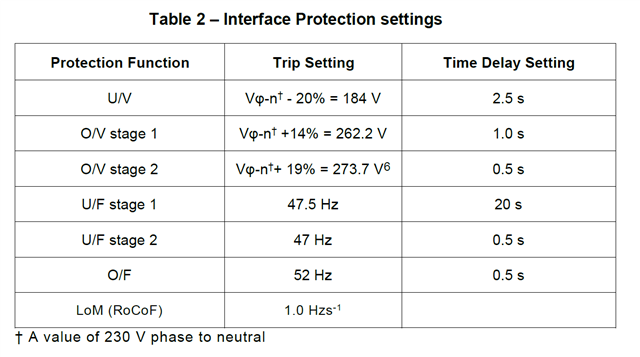
    G98/G99 has time delays for under-voltage and under-frequency, that are at least 500 ms (longer ... nearly twice as long ... as the disconnection time of the RCD). RoCoF doesn't have a time delay, but would still need some time to detect the phenomenon (somewhere between 100 and 500 ms).


    So, I believe it still leaves the unidirectional vs bidirectional to be considered; I'd be happy for testing to demonstrate to me it's not an issue.

    I accept that, if the RCD disconnects the neutral, the shock risk isn't increased as the disconnection time of the RCD isn't increased.

    BUT

    Many RCBOs are single-pole with unswitched neutral, so the presence of plug-in PV has effectively increased the RCBO disconnection time from 40 ms to at least 140 ms.

    So ... split-load boards may well be safer for plug-in PV than single-pole RCBO boards !

    Below from G98 Issue 2 2025:

  • In the case of 4-inverters plugged into a 4-way extension lead which is then unplugged from the wall the output currents must surely drop to practically zero

    Surely, the two without battery storage will be charging the batteries of the two that have battery storage.. (now that such things exist) Grimacing.

    The joys of globalisation. Man the barricades, the heathens with their two pin flat bladed plugs are coming. Stuck out tongue winking eye (just saying)

Reply
  • In the case of 4-inverters plugged into a 4-way extension lead which is then unplugged from the wall the output currents must surely drop to practically zero

    Surely, the two without battery storage will be charging the batteries of the two that have battery storage.. (now that such things exist) Grimacing.

    The joys of globalisation. Man the barricades, the heathens with their two pin flat bladed plugs are coming. Stuck out tongue winking eye (just saying)

Children
No Data