Simultaenous Contact

Good afternoon all, 

I am seeking the collective views of the group regarding the issues we are currently encountering within the EV installation environment in relation to simultaneous contact.

In simple terms, we are seeing a significant number of installations where customers have lamp posts located within their driveways. In many of these cases, it is not possible to achieve the recommended 2.5‑metre separation distance.

My position is that, where physical separation cannot be achieved, the application of layered protection at the EV charge point and associated switchgear would leave the customer in no worse position than prior to the installation. It is accepted that the proposal only outlines protection on the vehicle, but there are no other solutions for industry, are we with the protection detailed taking enough measures to carry out an install and in affect leave the install without a subsantial increase in risk?

My proposed approach to managing simultaneous contact risk would follow a structured hierarchy as set out below:

  • Can the maximum separation distance be achieved?
  • Can barriers or enclosures be installed to prevent simultaneous contact?
  • If neither of the above options are achievable, can layered protection provide an acceptable level of risk mitigation?

With layered protection, the proposed measures would include:

  • Installation of a compliant open‑PEN (O‑PEN) protective device
  • Provision of a double‑pole 30 mA Type A RCBO
  • Use of a charge point - M3 21 mA protection

Based on the above, the assumption is that, if all protective measures are correctly installed and verified, the installation would incorporate:

  • Automatic disconnection within the required times
  • Residual current protection
  • Open‑PEN fault detection

This combination of protections would significantly reduce the likelihood of a fault condition persisting for any meaningful duration.

On this basis, the key question for consideration is:

Where physical separation and barriers are not achievable, would it be considered acceptable to proceed with installation relying on this layered protection approach?

Parents
  • BS 7671 won't let you just bond two separate earthing systems together, see Regulation 542.1.3.3.

    It doesn't quite say you can't - rather applies conditions. In reality it's probably very common - bonding to shared water and gas mains (where they're still metallic) almost certainly crosses sub-station boundaries in many places - with very few apparent problems. It might be reasonable to conclude that complying with table 54.8 (for the larger of the two supplies) would be sufficient for the interconnecting bonding conductor. (Whether the 6mm² in the lamp-post would be sufficient is perhaps a problem for the owner of the lamp-post, and there's always the possibility they would object or refuse permission for such a connection to their equipment, which might make the approach untenable anyway, but at least the principle is there.)

    The problem is that the departure undermines a basic premise of BS 7671, and also introduces risks that BS 7671 (and OPDDs) are not designed to handle. I'm not sure, therefore, it's a logical step to say 'no less safe' as required by Regulation 120.3.

    BS 7671's stance isn't entirely consistent though - a Class 1 outdoor light within 2.5m of next door's gas pipe wouldn't trouble the words of 411.3.1.1 as the gas pipe is clearly an extraneous-conductive-part rather than an exposed-conductive-part - yet next door's gas pipe is very likely bonded to their earthing system which could be entirely separate to yours. Likewise there's no consideration of any other random bits of metalwork that could be stuck into the ground within reach of the light (handrails, fences etc. etc.) which too could have hazardous potential differences from your Earthing system. It might be an EV is riskier than an outside light (people grab hold of cars more often), but that's hardly a consideration for a general principle that 411.3.1.1 is meant to be dealing with.

    I wonder if a testing could shed a plausible light on the earthing arrangements - testing between some accessible point on the lampost and the EVSE installation's MET - a significant voltage difference (without a significant load in the house) might suggest different earthing systems - and if that didn't suggest a problem a low-Ohms test might give an idea of the length of cable between the two (perhaps on the basis of 25mm² is around 0.727mΩ/m and 16mm² is around 1.15mΩ/m) if that approximately fits the likely cable lengths from house & post into the street, it seems unlikely they'd be on different systems. (Take readings both ways around, in case any standing voltages skew the results).

       - Andy.

  • In reality it's probably very common - bonding to shared water and gas mains (where they're still metallic) almost certainly crosses sub-station boundaries in many places - with very few apparent problems. It might be reasonable to conclude that complying with table 54.8 (for the larger of the two supplies) would be sufficient for the interconnecting bonding conductor.

    Bonding something that goes back into the ground for some distance, like common pipework, is not the same as simply linking the earthing arrangement of two electrical installations. Shared metallic pipework improves earthing performance.

    Linking two installations without shared extraneous-conductive-parts is something very different!


    wonder if a testing could shed a plausible light on the earthing arrangements

    I'd be very careful with that ... even a CAT IV test instrument might struggle with HV faults, if you were to be unlucky enough to be conducting the test during one!

  • Linking two installations without shared extraneous-conductive-parts is something very different!

    I'm not sure how much contact with terra firma could be relied upon to reduce currents flowing between the two earthing systems - in any case a 5" diameter steel pole sunk half a metre into the ground may well provide something of a true earth connection.

    even a CAT IV test instrument might struggle with HV faults, if you were to be unlucky enough to be conducting the test during one!

    If there's a HV fault in progress you're probably on dodgy ground just touching the lighting column at all. Presumably a similar risk overall to loop testing on a TT system? (where the local Earth wouldn't be pulled up by the HV faut even though the live conductors would).

       - Andy.

  • I'm not sure how much contact with terra firma could be relied upon to reduce currents flowing between the two earthing systems

    More importantly, it helps with touch-voltages.

    in any case a 5" diameter steel pole sunk half a metre into the ground may well provide something of a true earth connection

    Not necessarily, and we have to discard the first 450 mm due to the effects of frost and drying out.

  • Of course the electrons neither know or care about the assumptions the regs writers made to allow an analytical solution to a problem that otherwise rapidly becomes practically intractable.
    But we have to do something that works out reasonable in most cases.
    There will be times of year when the top 450mm is sopping wet, and there will be driveways where the surface is concrete over membrane or tarmac, and the surface voltages have almost nothing to do with the ground beneath. 

    Bonding something that goes back into the ground for some distance, like common pipework, is not the same as simply linking the earthing arrangement of two electrical installations. Shared metallic pipework improves earthing performance.

    Only sometimes (!) If it was that simple a buried length of old gas pipe bonded at  house and lamp-post ought to solve the OPs problem.   I fear it does not.  
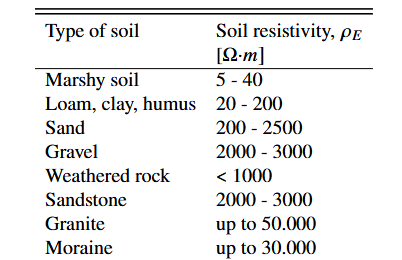
    You actually need a very long length of linear electrode to create a better connection to terra-firma, than the metallic connection between the ends, which is what you are asking for. The equivalent conductor cross section of a typical old iron gas main is massive, 1 inch bore pipe (smallest common house branch) has a 33mm OD, so the sidewall is ~ 4mm thick and 95mm mean circumference, so a touch under 400mm square mm of iron, so could be about 40mm2 copper equivalent resistance (400 micro ohms per metre ). Substations in a built up area may be say 200m apart so  the same length as 0.1 ohms of gas pipe. Terra-firma electrical  resistance  to the plate at the end of the universe, which needs to be many times 200m away to escape the near field effects,  could be a some tens of ohms to perhaps an ohm, so probably at least ten times the pipe resistance.

    rgds Mike.
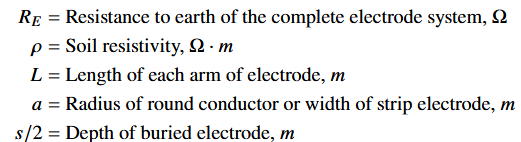
    PS analysis ...


    where (latter terms vanish when element is much  longer than burial depth)


Reply
  • Of course the electrons neither know or care about the assumptions the regs writers made to allow an analytical solution to a problem that otherwise rapidly becomes practically intractable.
    But we have to do something that works out reasonable in most cases.
    There will be times of year when the top 450mm is sopping wet, and there will be driveways where the surface is concrete over membrane or tarmac, and the surface voltages have almost nothing to do with the ground beneath. 

    Bonding something that goes back into the ground for some distance, like common pipework, is not the same as simply linking the earthing arrangement of two electrical installations. Shared metallic pipework improves earthing performance.

    Only sometimes (!) If it was that simple a buried length of old gas pipe bonded at  house and lamp-post ought to solve the OPs problem.   I fear it does not.  
    You actually need a very long length of linear electrode to create a better connection to terra-firma, than the metallic connection between the ends, which is what you are asking for. The equivalent conductor cross section of a typical old iron gas main is massive, 1 inch bore pipe (smallest common house branch) has a 33mm OD, so the sidewall is ~ 4mm thick and 95mm mean circumference, so a touch under 400mm square mm of iron, so could be about 40mm2 copper equivalent resistance (400 micro ohms per metre ). Substations in a built up area may be say 200m apart so  the same length as 0.1 ohms of gas pipe. Terra-firma electrical  resistance  to the plate at the end of the universe, which needs to be many times 200m away to escape the near field effects,  could be a some tens of ohms to perhaps an ohm, so probably at least ten times the pipe resistance.

    rgds Mike.
    PS analysis ...


    where (latter terms vanish when element is much  longer than burial depth)


Children
No Data