Simultaenous Contact

Good afternoon all, 

I am seeking the collective views of the group regarding the issues we are currently encountering within the EV installation environment in relation to simultaneous contact.

In simple terms, we are seeing a significant number of installations where customers have lamp posts located within their driveways. In many of these cases, it is not possible to achieve the recommended 2.5‑metre separation distance.

My position is that, where physical separation cannot be achieved, the application of layered protection at the EV charge point and associated switchgear would leave the customer in no worse position than prior to the installation. It is accepted that the proposal only outlines protection on the vehicle, but there are no other solutions for industry, are we with the protection detailed taking enough measures to carry out an install and in affect leave the install without a subsantial increase in risk?

My proposed approach to managing simultaneous contact risk would follow a structured hierarchy as set out below:

  • Can the maximum separation distance be achieved?
  • Can barriers or enclosures be installed to prevent simultaneous contact?
  • If neither of the above options are achievable, can layered protection provide an acceptable level of risk mitigation?

With layered protection, the proposed measures would include:

  • Installation of a compliant open‑PEN (O‑PEN) protective device
  • Provision of a double‑pole 30 mA Type A RCBO
  • Use of a charge point - M3 21 mA protection

Based on the above, the assumption is that, if all protective measures are correctly installed and verified, the installation would incorporate:

  • Automatic disconnection within the required times
  • Residual current protection
  • Open‑PEN fault detection

This combination of protections would significantly reduce the likelihood of a fault condition persisting for any meaningful duration.

On this basis, the key question for consideration is:

Where physical separation and barriers are not achievable, would it be considered acceptable to proceed with installation relying on this layered protection approach?

  • Finally, if the charging point is being installed according to Part S of the Building Regulations, or the particular provisions of the Scottish Technical Handbooks, tethered charging equipment doesn't appear to be permitted.

    Have you any idea why?

  • haha 12m is ther upper bound for box lorries and similar and is the same as  a normal bus or coach,though a large bus may be up to 13,5m or even 15 m if it has a double back axle. - which might in principle be pulling  a trailer of up to the same length.

    More commonly for the general public, those of us with the pre-millenium car licence can drive a 7.5 Tonne lorry (12m max ) towing a trailer to a maximum train weight of just under 13 tonnes but there is a total train limit, for a Motor vehicle drawing one trailer (which is not a semi-trailer) of  18.75m, and the longest common trailer for a car is 7m, or 12m behind a heavier vehicle... 
    see https://www.gov.uk/government/publications/maximum-length-of-vehicles-used-in-great-britain/maximum-length-of-vehicles-used-in-great-britain 

    But that is a silly argument, if the driveway is shorter, that becomes the limiting factor for a vehicle charging on the drive.  There are mercifully few of these maximum length cars on the road actually. (Acknowledgement to "top gear" for actually making a 12m car out of a Fiat Panda, even if it never survived its first outing. )

    Mike

  • Of course the electrons neither know or care about the assumptions the regs writers made to allow an analytical solution to a problem that otherwise rapidly becomes practically intractable.
    But we have to do something that works out reasonably safe in most cases.
    There will be times of year when the top 450mm is sopping wet, and there will be driveways where the surface is concrete over membrane or tarmac, and the surface voltages have almost nothing to do with the ground beneath. 

    Bonding something that goes back into the ground for some distance, like common pipework, is not the same as simply linking the earthing arrangement of two electrical installations. Shared metallic pipework improves earthing performance.

    Only sometimes (!) If it was that simple a buried length of old gas pipe bonded at  house and lamp-post ought to solve the OPs problem.   I fear it does not.  
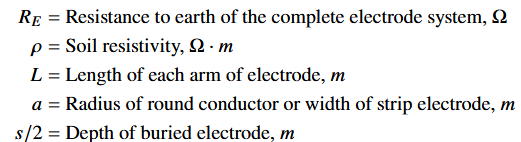
    You actually need a very long length of linear electrode to create a better connection to terra-firma, than the metallic connection between the ends, which is what you are asking for. The equivalent conductor cross section of a typical old iron gas main is massive, 1 inch bore pipe (smallest common house branch) has a 33mm OD, so the sidewall is ~ 4mm thick and 95mm mean circumference, so a touch under 400mm square mm of iron, so could be about 40mm2 copper equivalent resistance (400 micro ohms per metre ). Substations in a built up area may be say 200m apart so  the same length as 0.1 ohms of that thinnest gas pipe In practice most of the run will be larger pipe diameter.. Terra-firma electrical  resistance  to the plate at the end of the universe, which needs to be many times 200m away to escape the near field effects,  could easily be a some tens of ohms to perhaps an ohm, so probably at least ten times the pipe resistance, and could be a hundred times..

    rgds Mike.
    PS analysis ...


    where (latter terms vanish when element is much  longer than burial depth)


  • Not necessarily, and we have to discard the first 450 mm due to the effects of frost and drying out.

    So not unlike many a gas pipe - especially the 1970s ones that had a plastic sheath over the steel pipe.

       - Andy.

  •  

    My view is that the hierarchy you have outlined is sensible and follows a reasonable risk-based approach.

    Where the recommended 2.5 m separation distance cannot be achieved, the first consideration should always be whether the risk can be eliminated through relocation, increased separation, or the installation of suitable barriers to prevent simultaneous contact. If these options are not reasonably practicable, then layered protection appears to be the next most appropriate measure.

    Provided the installation includes a compliant O-PEN device, a double-pole 30 mA Type A RCBO, and the charge point’s integrated 6 mA DC protection (or equivalent), the risk of electric shock is significantly reduced through multiple protective measures operating together. In these circumstances, I would agree that the installation is unlikely to place the customer in a substantially worse position than existed prior to the EV charger installation.

    That said, each installation should still be assessed individually, with the rationale for proceeding clearly documented within the risk assessment and design records. Particular consideration should be given to the accessibility of conductive parts, the condition and ownership of the lamp post, and any site-specific factors that could increase the likelihood of simultaneous contact.

    Based on the information provided, I believe the proposed hierarchy and layered protection approach represents a pragmatic solution where physical separation cannot be achieved.

  • Have you any idea why?

    Approved Document S gives us a clue by telling us that we can only select a tethered charge point if the type of vehicle is known.

    Adaptors are readily available for the Type 2 socket-outlet to convert to other types. I'm not sure the same is true of the Type 2 Vehicle Connector.

  • Provided the installation includes a compliant O-PEN device, a double-pole 30 mA Type A RCBO, and the charge point’s integrated 6 mA DC protection (or equivalent), the risk of electric shock is significantly reduced through multiple protective measures operating together. In these circumstances, I would agree that the installation is unlikely to place the customer in a substantially worse position than existed prior to the EV charger installation.
    Based on the information provided, I believe the proposed hierarchy and layered protection approach represents a pragmatic solution where physical separation cannot be achieved.

    I don't agree with these statements for the following principle reasons:

    • OPDDs are not intended to provide protection in the event of simultaneous contact risks.

    • In the OPDD, Method M3 to IET 01:2024 is not permitted to be the sole detection measure, yet for simultaneous contact risk, it is exactly that. Hence the product is being used outside the scope of its product standard, which is in itself a departure according to BS 7671.

    • On the whole, it does not meet the bar of "no less safe" that BS 7671 has for a departure, because BS 7671 does not permit simultaneously-accessible exposed-conductive-parts from different earthing systems.

    • The product standard for EV charging equipment and EVs assumes the installer will conform to IEC 60364 series (BS 7671 in the UK).

    At the end of the day, other solutions are available according to BS 7671:

    • Electrical separation for the supply to the vehicle
    • Class II or equivalent at either the vehicle and/or the other item of Class I equipment.

    The standard is not deficient ... but there are a number of assumptions about the EV charging system that don't align with BS 7671 (or, for that matter, IEC 60364 series in general) in the real world.

    This potentially means the EV infrastructure products are not always able to meet the essential requirements of the Electrical Equipment (Safety) Regulations ... although to be honest, they can meet the essential requirements if installed in accordance with BS 7671 and the manufacturer's instructions.

  • Question.  What if a PEN (Protective Earth and Neutral) fault or diverted neutral fault occurs on the local network, would the earth reference for the street furniture/LampPost be lost?  Would the metal body of a connected EV and the adjacent lamp post become energised up to full mains voltage (230V or 400v), posing a severe, potentially fatal electric shock risk if touched simultaneously?  I guess the question is really what if the fault is on the street rather than the dwelling?

  • Certainly 230v is  entirely possible - it was one of the early arguments for not using PME supplies to things like bus shelters and lamp posts. although for a long time now, this has become the accepted  thing. Phone boxes (remember the old red ones) were always wired as double insulated in cases where they had a mains supply for lights or anything, as the old GPO standards were written by folk very nervous of introducing stray currents onto the phone network, and earth problems were considered a probable risk.

    Arguably in the UK, a PEN fault can only occur on the network outside the customers control, as the NE bond is not on the consumers side of meters
    mike

  • Certainly 230v is  entirely possible

    Actually more than that ... possibly up to over 350 V ... if you take into account that the loads on the phases are not unity power factor. The chances of real-world conditions that might create such an unbalance are quite slim ... but possible nonetheless.