EN50618 Solar DC Cables

Hi everyone,

                     Looking for any advice on a cabling solution that has been proposed for a project and I just wanted to understand compliance with the EN 50618 standard for solar PV DC cabling.

The solution proposed, is for  a 6 core cable, 'compliant' with the above standard. However, as I understand it, EN 50618 applies to single core cables only. So, it looks like, from the tech. sub I have seen, that the individual cores themselves are certified to this standard but the entire assembly, cannot be, although the cable is marketed as such. 

Has anyone come across this before? I would normally approve cables that are BASEC approved and manufactured to a recognised British or EN standard but in this case, the multicore assembly has no standard (although, the individual cores within do).

Any advice appreciated!

David

  • EN 50618 applies to single core cables only. So, it looks like, from the tech. sub I have seen, that the individual cores themselves are certified to this standard but the entire assembly, cannot be,

    Correct in terms of what BS 7671 is looking for, see NOTE 1 to Regulation 511.1, and also in terms of the constructional requirements of BS EN 50618 which at this time only covers single core cross-linked polymer insulated and cross-linked polymer sheathed cables H1Z2Z2-K.

    Basically, for cables, the appropriate constructional standard is needed. (See also Regulation 133.1.1)

    How to deal with this if, you really need to use a non-standard cable? See Regulation 511.2 and 133.1.2. Basically, the designer or person certifying the installation needs to conform the use of such a product is 'no less safe than that afforded by conforming to BS 7671, and record this in the relevant certification for the installation.


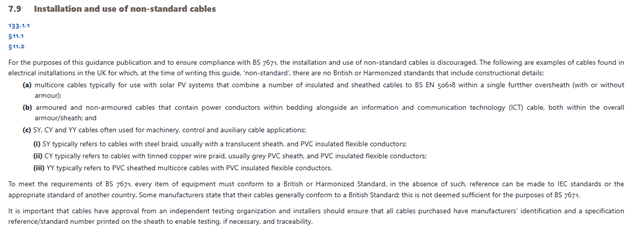
    What does that mean in practice? See Section 7.9 of the On-Site Guide (below clipped from latest 8th Ed OSG, electronic version):

    In terms of current-carrying capacity, grouping ought to be taken into account.

    Many of the current-carrying capacity tables for BS EN 50618 cables (even when not grouped) assume high conductor operating temperatures well over 70 deg C ... this should be considered in terms of compatibility of products in which the cable is to be terminated, especially at  combined boxes, DC isolators, etc.

  • Thanks Graham. This has put more 'meat to the bone' alongside my thinking. I'll take this away and review. As an aside, I was offered this solution, as a 'standard offering' , so assume this may start to become a bigger issue, depending on the type of solution offerred! 

  • Agreed, this is why the OSG now refers to the arrangement in 7.9(a), because it's becoming quite common

    It's not always easy to get constructional standards for cables agreed.

    The debate about SY, CY and YY cables has been long-running in the industry, It is my understanding from colleagues that sit on or chair committees for cables, that there have been attempts to standardise these cable types, but because of constructional differences between different manufacturers' offerings, and perhaps with some intellectual property issues thrown in for good measure, it's not been possible to get an industry consensus.

    However, that does tell us that there are in fact differences between SY, CY and YY cables on offer to us, and we must therefore be very careful about:

    • how we specify these cables in contracts, procurement specifications etc; and
    • whether the actuial installed cable is what was intended, and more importantly, safe (or in the case of CY and SY suitable for the required EMC performance in specific applications)
    • whether there has been a change of source of supply (and hence specification) part way through a large job.

    Similar considerations can apply to other 'non-standard' constructional arrangements when differentiating between manufacturer's products for the 'bundled solar' or 'combined power and comms' solutions.

    With the combined power and comms solutions, it's also worth noting that, for installation inside buildings, BS 6701 requires a minimum physical separation distance of at least 50 mm between power and data, regardless of whether there is metallic separation. Hence the combined power & data cable is not generally suitable for installation indoors (BS 7671 refers to BS 6701 for ICT cable installations - ICT includes, communications, datacomms and control applications). There is no such restriction outdoors.

  • Again, thanks Graham. I can now review the offering and ask the supplier to look at alternatives. Eg. Use of the single core cable.