


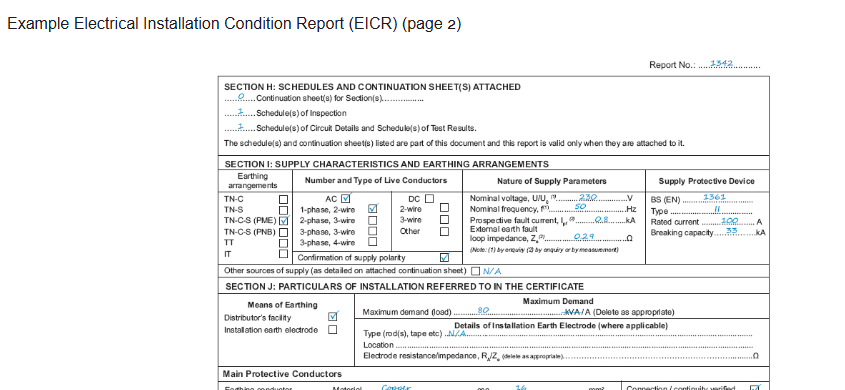
I have just noticed this change requiring the maximum demand to be stated on the new EICR template. Is this possibly a copy and paste mistake or is there a rationale behind it?
I have just noticed this change requiring the maximum demand to be stated on the new EICR template. Is this possibly a copy and paste mistake or is there a rationale behind it?

We had some trips when the washing machine, dish washer and kettle all ran at the same time on a B16 breaker (all the dirties saved up for the cheap rate period). Similar 'mis-design' issue made worse by external changes.
I might expect that the kettle's contribution would be covered by diversity.
The dishwasher and clothes washer aren't exactly heating the water for a sustained period.
However, let's say 2 kW each = 26 A. Figure 3A4 suggests that you might get between 200 s and 400 s before tripping.
I must say that with less than 50 p savings per Sunday, I found that the inconvenience was not worth it.

I must say that with less than 50 p savings per Sunday, I found that the inconvenience was not worth it.
Yes, but, as the financial controller says "we're doing it anyway"..
You are right that the savings don't count to much, though it will matter to some, and it can lead toward overload.
I was mainly pointing out that the trick of "you could always ask" can give clues as to changes in usage for maximum demand (overall and per circuit). And the possibility of useful extra work.

The dishwasher and clothes washer aren't exactly heating the water for a sustained period.
They wouldn't need to be, especially with the kettle.
Most UK washing machine heating elements are indeed around 2 kW, many kettles 3 kW, but the washing machine motor and dishwasher recirculation pump are often going at the same time ... potentially looking at over 7 kW there if everything is heating at the same time.
16 A circuits for white goods should be a single appliance per breaker really. 20 A, perhaps two appliances per circuit, but I wouldn't do that if one of the appliances were a tumble dryer.
16 A circuits for white goods should be a single appliance per breaker really.
Agreed, although your double socket-outlet in the scullery is just crying out for a washing machine and tumble drier. Even on a 32 A breaker, the socket may be overloaded at times.
That's the joy of old houses! Historic ring circuits no longer being complete after kitchen remodelling maybe 20 years ago..

I've been taking part in a 'use more power betwen....' events and come to the conclusion that they have better weather forecasting than I do. It is always timed when my solar is producing maximum power. Result - I put on dishwasher, washing machine etc and consumption from the grid? Zero!
David
NICEIC Technical Helpline have replied, probably quite rightly, that they cannot make comment other than to say the maximum demand box now appears in section J of the EICR in BS7671 A4.
I have 24 candidates going through the 2391. I rarely offer my opinion to candidates, preferring instead to give only guidance on the relevant requirements of BS7671 and GN3. However, since I have not been able to establish the rationale for including a box for maximum demand, I have suggested that for the purposes of their practical assessment, during which an EICR is to be completed, they simply insert “not verified” in that box. I have also suggested that as they move out into the real world, they keep their eye on any developments in that regard.
Noteworthy that the example EICR in GN3 indicates a figure of 80A but does not indicate how this was arrived at.
As an exercise in my 2396 class, we used all available resources we could find, including the EIDG and data logger information, to assess the maximum demand for the circuit arrangements in my own house. At least I know it sits somewhere between 27A and 118A.
Noteworthy that the example EICR in GN3 indicates a figure of 80A but does not indicate how this was arrived at.
Nor the 50 A in the three-phase installation on page 148 of 10th Edn.
Here in SSEN territory, I understand that the usual agreed (i.e. imposed) after diversity maximum demand for a new single-phase installation is 18 kVA, which is about 80 A.
Frankly, with socket-outlets, it is impossible to know what the maximum load might be.

Frankly, with socket-outlets, it is impossible to know what the maximum load might be.
But you need to have some working assumption - otherwise it would be impossible to design a circuit to supply the sockets.
The traditional UK approach was floor area served - 30A per 1000ft² (or 32A per 100m²) as an upper bound for most domestic and small commercial seems to have stood the test of time, and of course the size of the protective device sets an upper limit too. The trick of course with MD is to view the installation in terms of the minimum circuits that could have been provided, rather than the usually much larger number of circuits that have been installed.
- Andy.
The other way of tackling this problem is to use actual maximum demand data for the installation - get the customer to obtain their half-hourly import metering data from their supplier, then you can use that to determine the actual highest average demand over a half-hour period, which might be a reasonable representation of the demand in thermal terms.
Potential weakness of that approach is it doesn't tell you the maximum instantaneous demand, or MD over shorter periods, or what the maximum demand might be under a different occupier (more people in household, different habits/routines affecting diversity etc).
But at least it is based on real, accurate data - settlement metering is accurate to within a couple of percent. Only fly-in-the-ointment is where there's solar/battery installed which then needs some more difficult analysis adjusting for solar/battery energy flows.
I'm surprised there's not a more formal, defined process for how Maximum Demand should be determined because with it being inherently probabilistic, rather than purely deterministic, it opens up the space for significant differences in how different people might determine the value, the electrical equivalent of 'how long is a piece of string?'.
We're about to take you to the IET registration website. Don't worry though, you'll be sent straight back to the community after completing the registration.
Continue to the IET registration site
