


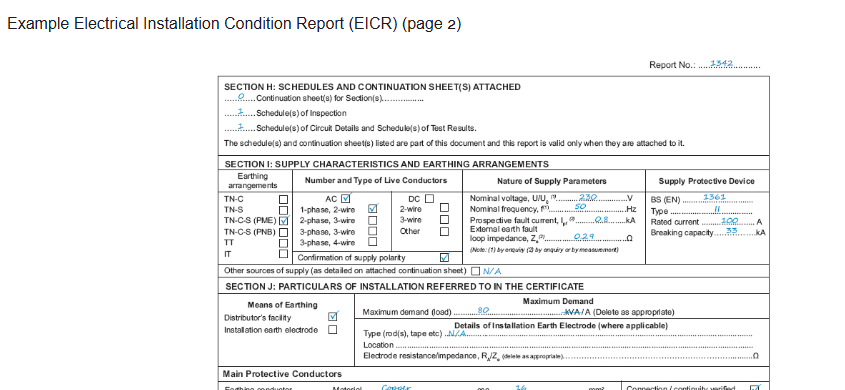
I have just noticed this change requiring the maximum demand to be stated on the new EICR template. Is this possibly a copy and paste mistake or is there a rationale behind it?
I have just noticed this change requiring the maximum demand to be stated on the new EICR template. Is this possibly a copy and paste mistake or is there a rationale behind it?
Hey, this is nothing new, the maximum demand on EICR.

Hey, this is nothing new, the maximum demand on EICR
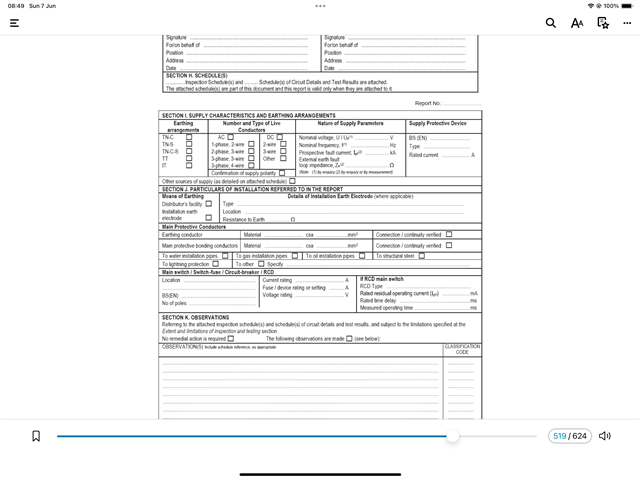
Have a look at the template in the brown book, pages 519 and 520. However, it is interesting that you appear confident that it is on the EICR. Are you using a template by NICEIC perhaps? I have asked their technical helpline if they know why it has appeared on the EICR template in A4. Personally, I cannot fathom why.
It's been on EICs for ages ... presumably to demonstrate that the supply is suitable for the installation - I suppose it makes sense to re-validate that assumption on an EICR as extra loads may have been added over time?
- Andy.

I suppose it makes sense to re-validate that assumption on an EICR as extra loads may have been added over time?
Surely determining MD for the installation is the purvey of the Designer?
During an EICR, especially for non-domestic or a complex installation, how can the MD actually be 're-validated' ?
as extra loads may have been added over time?
It's necessary for the designer to do this as part of additions and alterations.
Yes it has been on the NICEIC EICR template for some time.
Gary

In reality, does anyone do anything other than write down the rating of the supply fuse?

I doubt it, but how do you know its rating without having a look?
Even if there is a 100 A fuse, the agreed after diversity maximum demand may well be lower than 23 kVA.

It's necessary for the designer to do this as part of additions and alterations.
But isn't half the point of a periodic inspection to catch the things that perhaps haven't been done properly - we don't just look for degradations due to the passage of time, but simple non-compliances too?
During an EICR, especially for non-domestic or a complex installation, how can the MD actually be 're-validated' ?
The forms are only intended for simple 100A and below installations, and are only models at that, so people are free to omit that section on large/complex installations if they feel it serves no purpose. For a domestic a nudge to check that three 10kW instantaneous showers on a 60A DNO fuse might not be a good idea is worth consideration I would have thought. As for the mechanics, tot up the loads (circuits/floor areas for small plug in loads), apply diversity and a bit of common sense - same as the designer should have done in the first place. Significant new loads are becoming if anything more common (EV, Heatpumps, instantaneous showers) and the DIY community certainly hasn't gone away.
- Andy.
The forms are only intended for simple 100A and below installations, and are only models at that, so people are free to omit that section on large/complex installations if they feel it serves no purpose. For a domestic a nudge to check that three 10kW instantaneous showers on a 60A DNO fuse might not be a good idea is worth consideration I would have thought.
Agreed, although that doesn't mean the person carrying out the EICR has to re-assess the MD - just note that the rating of the fuse is going to be exceeded, or question the overall MD?

For a domestic a nudge to check that three 10kW instantaneous showers on a 60A DNO fuse might not be a good idea is worth consideration I would have thought.
And ask the home owner if they've had any nuisance trips, perhaps recently. E.g. Those half price electric Sunday afternoons from Scottish/British Gas (avoids reductions in gas use..).
We had some trips when the washing machine, dish washer and kettle all ran at the same time on a B16 breaker (all the dirties saved up for the cheap rate period). Similar 'mis-design' issue made worse by external changes.
The circuit has now been split and the washing machine leg is on a lower likely consumption circuit.
We're about to take you to the IET registration website. Don't worry though, you'll be sent straight back to the community after completing the registration.
Continue to the IET registration site
