Clarification on section 536.4.202

Hi All,

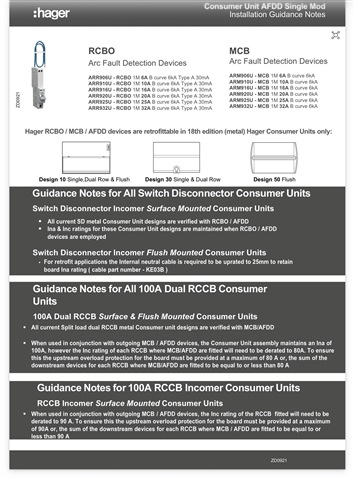
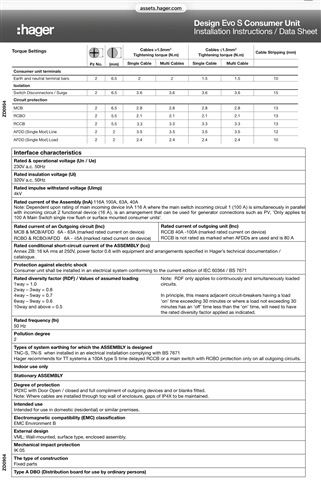
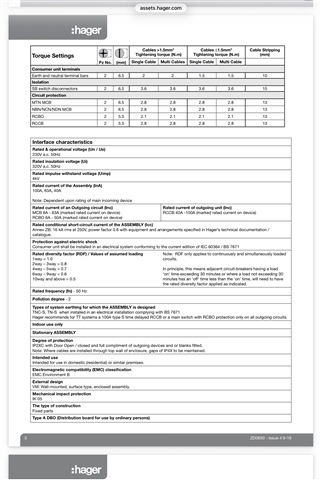
Reviewing the latest document, Section 536.4.202 has raised a lot of concern in terms of the practical implications on projects. My understanding is that if diversity is heavily restricted or not allowed, it means switchgear will need to become significantly larger, or multiple panels will be required to achieve compliance.

I am keen to understand the wider IET community's view on this. Does this rigid calculation apply strictly to all downstream distribution boards? Can compliance be achieved if only the main building panel is sized without diversity, while the downstream DBs include diversity factors?

For example: If I have a 100A distribution board, would this requirement mean I can only supply 10No. lighting circuits of 10A each? Or would a standard configuration such as 2No. 32A socket circuits and 1No. 40A cooker/oven circuit fail to meet this requirement because the sum of the breakers (104A) exceeds the panel rating (100A), even though the actual simultaneous demand is far lower?

This approach could result in vastly oversized breakers, cables, and panels, which is causing quite a bit of confusion during design stages.

Any insights or experiences on how you are handling this would be greatly appreciated.

Many thanks,

Gabriela

  • Agreed!

  • Where do we gain the necessary confidence that load curtailment arrangements can be used as a means of overload protection?

    I don't think that they are, because they are not used on their own. They are there to stop the main fuse blowing.

    If the householder starts cooking, showering, heating the house, etc. whilst charging the EV, the charging is reduced, or even stopped. Now we are back to relying upon diversity as if the EVCP was not there at all.

  • Is there a standard for load curtailment arrangements?  I note that G100 doesn't specify any particular integrity (and only specifies reliability requirements for communications media) and some of the G100 arrangements I have seen do not appear to be of an integrity anywhere near that of a fuse or circuit breaker. 

    Indeed - but then BS 7671's demands for overload protection aren't entirely bullet-proof - we can omit overload protection devices entirely as long as the load "is not likely" to cause an overload.  Not impossible, not highly unlikely, just more unlikely than likely. (433.3.1 (b))

      - Andy.

  • Not impossible, not highly unlikely, just more unlikely than likely. (433.3.1 (b))

    So, on the balance of probabilities?

    I would say that "not likely" means a small chance, say 5%.

    For "likely", OED has, "having a high chance of occurring; probable".

  • Hi,

    So, going back to regulation 536.4.202, the reference to load curtailment is not intended in the domestic EVSE sense?

    A series of examples:

    1. A simple RCBO CU with the RCBOs totalling 120A (3x32A+4x6A) and the CU 100A rated.  This is OK providing that the DNO fuse is 100A or less which it will be in the domestic case.
    2. As above but now we know the DNO fuse is 100A and someone has added 16A of solar by splitting the tails with Henley blocks.  This is not OK because the CU could be subject to overload - we can't use diversity here. 
    3. As (2) above but one of the 32A RCBOs is replaced by a 40A RCBO feeding a 32A EVSE with load curtailment set to 100A or less, monitoring the tails feeding the CU Total sum of breakers is now 128A, potential supply is 116A so CU can be overloaded.  Can we rely on the EVSE load curtailment to prevent overload and render the overall design compliant / safe?
  • A simple RCBO CU with the RCBOs totalling 120A (3x32A+4x6A) and the CU 100A rated.  This is OK providing that the DNO fuse is 100A or less which it will be in the domestic case.

    Agreed.

    As above but now we know the DNO fuse is 100A and someone has added 16A of solar by splitting the tails with Henley blocks.  This is not OK because the CU could be subject to overload - we can't use diversity here. 

    Agreed. However, this is where 551.7.2 applies - last paragraph of 536.4.202

    Can we rely on the EVSE load curtailment to prevent overload and render the overall design compliant / safe?

    No.

  • For "likely", OED has, "having a high chance of occurring; probable".

    So unlikely, is not likely, so not a high chance - doesn't necessarily mean a low chance though - a medium chance would also be not a high chance.

       - Andy.