2 x 3 amp appliances on unfused 32 amp cooker spur - safety issue?

Can a 3 amp gas hob and a 3 amp gas oven be hardwired into an 32 amp electric oven spur with the 3 amp fuses removed? 

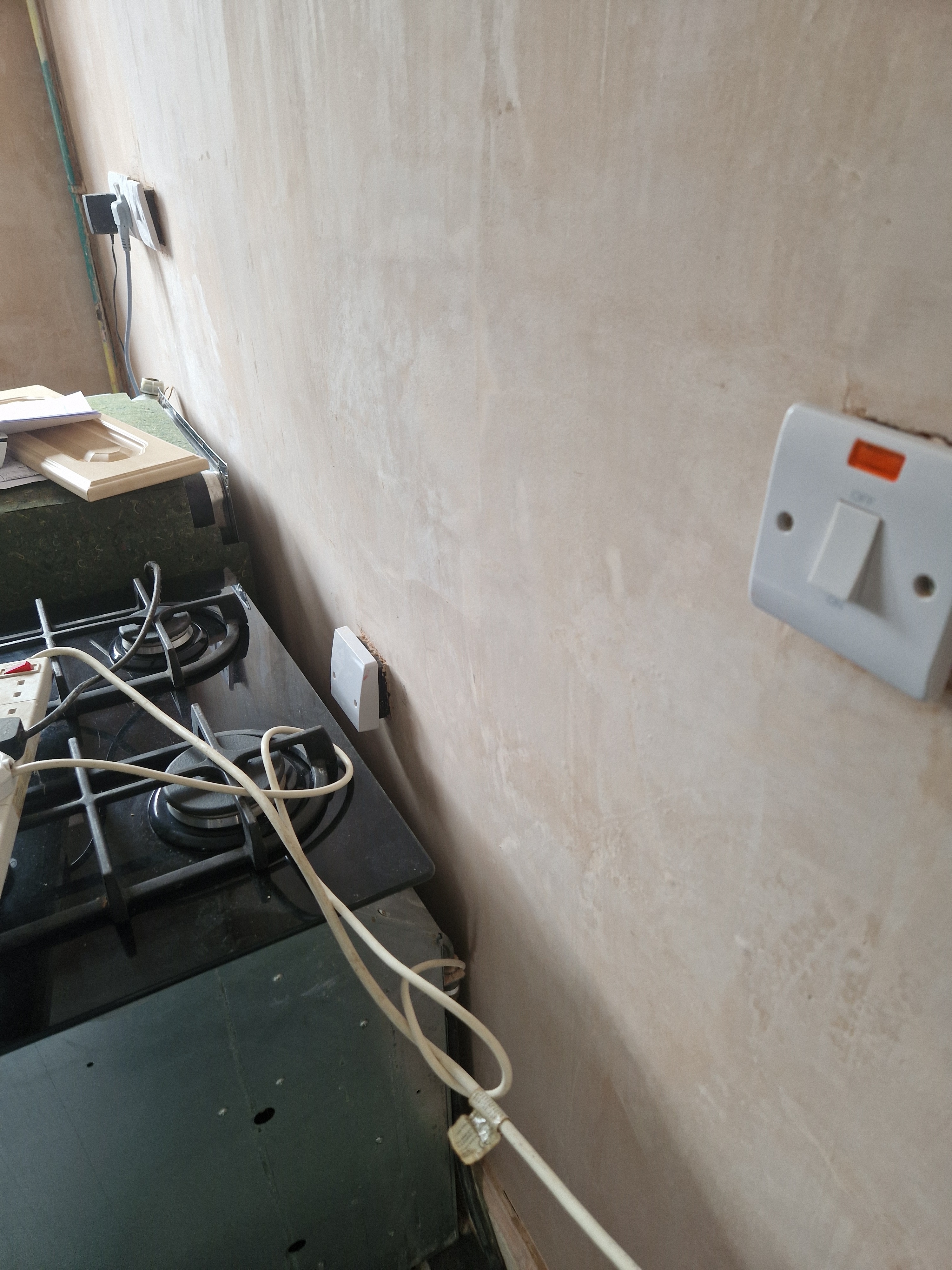
Also, the electric cooker spur will be directly behind the fan inlet/outlet of the fitted gas oven when it sits in its cabinet. 

This is what I've been told is safe, but alarm bells are ringing here.

  • Can a 3 amp gas hob and a 3 amp gas oven be hardwired into an 32 amp electric oven spur with the 3 amp fuses removed? 

    Probably not.

    The correct answer is 'follow manufacturer's instructions' in terms of what they require for overcurrent protection/fusing.

    Since a BS 1363 FCU can be supplied via a 32 A circuit, could you provide an FCU with 3 A fuse for each?

  • Do you mean DIRECTLY connected to the 32 amp cooker circuit, without any intervening fused connection unit  or similar, then I would say NO.Small loading appliances are normally intended for use on 16 amp OCPD or smaller. NOT 32 amps unless the supplier specifically state other wise.

    Or do you mean connected via fused connection units, with the fuses temporarily removed for replacement or inspection, then subject the usual caveats, fine.

  • As the others have said, you need to have the fuses somewhere.

    Did these appliances come with a moulded BS 1363 plug, which has been chopped off?

    I agree that FCUs are the answer.

    As to the risk of overheating the cooker outlet, again it is a matter of following manufacturer's instructions. Presumably, the ambient temperature behind an average oven is more than the normal room temperature, but there should be (thermal) insulation.

  • In my eyes you are changing cable CSA 6mm or 10mm (Cross Sectional Area) for the 32 cooker spur to a 1mm - 1.5mm flex for the hob ignition thus a fuse is required.  So you could install a FCU for each cable required for the 3amp.  I would also make sure that the isolation of FCU or double socket if the appliance came with plugs fitted is accessable easily for maintenance.  Imagine having to pull out the oven to turn off the hob, worst still you have just cooked a Sunday roast for 2 hours.  Some people will put the FCU in ajoining cupboard with it clearly labeled.  The other thing I find questionable is people putting a socket under the kitchen sink.  At some point that sink will leak or get blocked which means possibly the plumber may have to remove the trap and be in direct contact with water/waste water.

  • 1mm - 1.5mm flex

    I would have guesses even smaller than that - 0.75mm² or even 0.5mm² feels more likely to me. Definitely questionable for fault protection on a 32A MCB/RCBO. Using BS 7671's adiabatic (perhaps not 100% applicable to appliance leads, but the physics will be the same), k=115 and S=0.75 say so k²S² (cable withstand) is under 7440 A²s - compared with the generic energy let-through of a B32 of 45,000 A²s for the usual 6kA devices it doesn't look at all good to me. (Some manufacturers do offer lower energy let-through figures for their devices, but I've be very surprised to find anything that low). Fault protection can be omitted in some cases, and the arrangement may well comply with the 3m part of the requirements - I doubt it would meet the rest though (inherently short-circuit proof and minimising the risk of fire & danger).

      - Andy.

  • I agree Andy some of the flex sizes could be as small as 0.5mm CSA.  What I was trying to bring to the forefront was the change in size of the cable.  

  • its not really just the cable size, as a cable damage giving a dead short will probably trip something without starting a fire,  and the damaged cable would need changing then anyway, if overheated or not,  but more about what protection is inside the hob and cooker hood. They may well be internally fused, but equally may not. I assume its a supply to a clock and a spark ignition unit, so probably only a few watts for the hob, and perhaps a few hundred watts of lights and fan for the cooker hood. They would be better on spur or plugged into  a socket circuit and could probably share a 3A fuse at a push.  If there is no electric cooker or other heavy loads on that radial, fitting a smaller breaker may be the fast fix.

    Mike.

  • Because this is a council rental, I don't have any say who does the work, but I did expect it to be safe. I think they forgot that the built in oven was gas, hence why they put a new electric oven socket and forgot to refit sockets for the gas oven and separate gas hob.

    I don't want them cutting off the existing 3 amp plugs, either. I put a stop to the work for a few days, but I can't put them off forever.

    Thank you for your answers, I have spoken to the supervisor, who says that he knows what he is doing and it's safe to butcher my appliances by simply cutting off the plugs and hardwiring them in. He was not interested in using any lower amp fuses, such as two sockets or even Fused Connection Units (he didn't even know what one was) and just gave me a lot of 'word salad'.

    I have attached a picture so you can see the problem. This is how it is at the moment, awaiting fitting

  • Viv, you have my sympathies.

    Until last year, in England, privately rented property had to comply with The Wiring Regulations, BS 7671 under the law: The Electrical Safety Standards in the Private Rented Sector (England) Regulations 2020. 

    Last year, the Regulations were amended to include the social rented sector. It would appear that your home falls into that category. If it does, the wiring must comply with BS 7671.

    I think that we are all agreed in here that what you describe does not comply.

    I wouldn't argue with the supervisor - deal with your landlord direct. At some stage, the electricians should issue a minor works certificate. It will be interesting to see how they demonstrate compliance.

    Of course, if you are not in England, the legal situation may be different.

    Good luck!

  • I agree that FCUs are the answer.
    I don't want them cutting off the existing 3 amp plugs, either.

    I have changed my mind. If the plugs are still there, keep them - all you need is a double socket.

    If they remove the plugs, they may invalidate the CE marking, etc.