Department for Energy Security and Net Zero, Survey on Plug-in solar

The Department for Energy Security and Net Zero has left a very short window (!) to reply to their consultation/survey on-line.

Rather than extend our already multiple tangled technical threads on the topic and lose responses in between other matters

here is a new thread specifically about the product standard  

https://assets.publishing.service.gov.uk/media/6a31167d15f2a70fac7e6026/plug-in-solar-interim-product-specification.pdf

and the actual consultation

https://energygovuk.citizenspace.com/energy-security/plug-in-solar/

The topics of interest in the survey are divided into sections.

Consultation questions

A. PSSR Amendments

1. Do you agree with the proposed approach of amending the PSSR to allow plug-in solar to connect via a BS 1363 plug as a transitional measure pending any future changes to BS 1363?

2. In your view, is the proposed approach sufficiently clear that this update would only apply to plug-in solar products which meet the Interim Product Specification? If not, please set out any potential amendments that could provide further clarity.

3. In your view, does allowing connection via a standard plug raise any specific safety concerns that are not addressed by the Interim Product Specification? If yes, please outline the potential concern(s).

4. Are you aware of risks that this update could be misinterpreted or misused (e.g. applied to other types of equipment)? If yes, please set out the potential risk(s) and how they might be mitigated.

5. Do you consider the proposed approach clear and enforceable for manufacturers, retailers, and regulators?

B. Interim Product Specification

  1. Do you agree with the proposal to require manufacturer compliance with an interim product specification before a plug-in solar product can be placed on the market?

  2. Do you agree with the proposal to use the same broad approach as the German standard (DIN VDE 0126-95) as a baseline, with amendments for the UK context, to support future international harmonisation?

  3. Are the engineering controls in the interim product specification proportionate to the risks in deploying plug-in solar in the UK? If not, please outline anything that is missing or over-specified.

  4. Does the Interim Product Specification address all the points in the safety study commissioned by DESNZ? Please refer to the safety study results published alongside this consultation.

  5. Are there elements of existing technical standards quoted in the Interim Product Specification that are unsuitable for the UK context or not applicable to plug-in solar products? If yes, please set out any potential modifications.

  6. The electrical safety study showed plug-in solar was safe at a circuit level. Should the Interim Product Specification limit the number of microinverters to one per household or one per household circuit?

  7. What risks or unintended consequences, if any, should be considered in implementing the Interim Specification?

    C. Consumer Protection and Market Issues

    This section seeks to identify how else the government can support robust consumer protections.

  8. What information should be provided to consumers at the point of sale and prior to installation, including on safety, suitability of existing electrical circuits and protective devices, suitability of dwellings, and limitations of the product?

  9. Are there risks of misuse, misunderstanding, or unsafe adaptation that should be mitigated? If yes, please set out the settings in which these risks would be most relevant e.g. types of dwellings.

    D. Implementation and Timing

    1. Is the proposed timeline for introducing the Interim Product Specification feasible? If not, why not?

    2. What support or guidance would help ensure timely and effective implementation of the Interim Product Specification?

    E. General

    1. Are there any additional comments or evidence you would like to provide to inform the development of this framework?

  • Personally
    I will be suggesting that for semi-permanent wiring outdoors a 13A plug is not a good choice, so allow for or even encourage  more waterproof alternatives. and a 5A fuse is not a recommended value - if a 5A fuse is really needed because a 13A one is too big, it should be in the equipment.

    I'll be pro 'one per circuit' so you can have more than one per house, but only if there is a strong recommendation to take the advice of a suitably skilled or competent person about the suitability of the wiring and the division of final circuits.

    Perhaps adding an in/outlet socket for plug in solar outdoors can be added to the list of exempt work for part P in Wales, where it would still be currently notifiable.

    Registration and de-registration, needs to be very simple indeed so that when folk pack it away and take it with them on their self-catering holiday or to the new place when they move out, the system can keep up. Or there  needs to be a decision made that you can't, and its not worth it.

    But most importantly I think this deserves more than a few well-considered responses, and not just mine (!) as the short consultation time to me smacks of someone trying to be a bit too clever for their own good.

    Opened 16 Jun 2026

    Closes 30 Jun 2026

    Is I presume a legal minimum to say 'oh yes, we consulted' 
    Mike.

  • There is also an Analytical Annex  https://assets.publishing.service.gov.uk/media/6a301067d95ffddb05d4b08c/plug-in-solar-consultation-analytical-annex.pdf, which gives some of the background.

    I'll be pro 'one per circuit' so you can have more than one per house, but only if there is a strong recommendation to take the advice of a suitably skilled or competent person about the suitability of the wiring and the division of final circuits.

    The Analytical Annex acknowledges that a minority of households may need some professional support, but one per household is my preference, at least for now, given that the product standard is interim. Keep it simple.

    The alternative is that you start getting into EICR territory. That said, it might not be a bad idea to add suitable/unsuitable for plug-in solar to the existing list in Appendix 6 and the model form.

    I agree that it is a very short consultation period, but the amendment to PSSR could be achieved in 40 days or less, potentially even before the parliamentary recess, which begins in about 3 weeks from now.

  • For components that are only intended to be used internal to a property, they should have
    ingress protection of better than IP44 to avoid electrical hazard if water is spilled upon them.

    Humm, a 'better than IP44' 13A plug might be interesting...

      - Andy.

  • 5A fuse is not a recommended value

    There are precedents for non-preferred fuse sizes ... IIRC the standard for wiring systems for office furniture demands a 7A fuse for each outlet.

      - Andy.

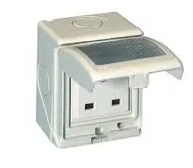
  • indeed - hence my comment that it would be safer to de-fang the PSSR a bit more and permit almost any other connectors that are actually designed to be left outdoors in the UK weather (even some  that don't have shutters boo-hiss, but are finger proof by dint of the hole size )

    A lot of 'outdoor' 13A sockets are only really weather-proof with nothing plugged in to make sure the flap closes.

    like this popular Gewiss model

    Fine for a lawnmower you unplug when not in use, then its IP 55 with the flap shut apparently,  but I'd argue not really if its left with the `flap up in the rain 

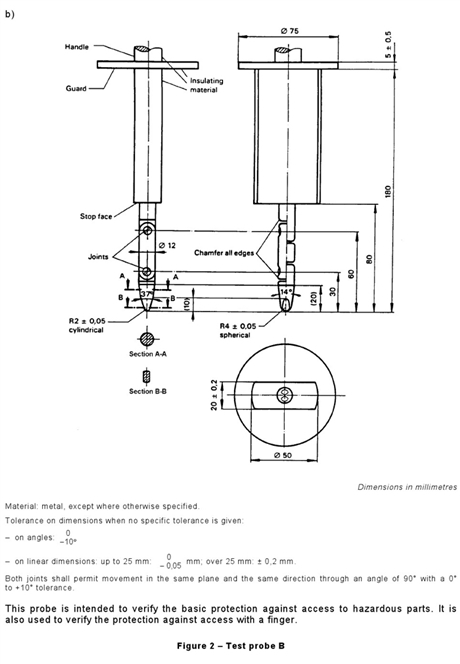
    There is also a related and  slightly odd question of why there  in effect a very poor  equipment IP rating set by " BS EN 60529, with Test Probe B" as this is in effect IPXXB - so much much weaker than say IP44. 
    regards

    Mike

    PS
    That B probe 'finger' allows 11mm holes with live part  a few mm behind or larger holes up to 19x49mm with only basic insulation behind and allows exposed  things wed normally worry about like choc block the large finger tip cannot touch.

    1. Finger Diameter: 12 mm

    2. Finger Length: 80 mm

    3.Stop surface Plate 50* 20mm long axis at right angles to knuckles

    4. Baffle Plate Length: 100 mm

    5. Baffle thickness: 20 mm


  • Hmm, but the odds of a householder putting a 13A one in if they can't find a 5 or a 7 for that matter, must be pretty high. There are plenty of low wattage  table lamps with 13A fuses for that reason ;-) 
    M. 

  • 5A fuse is not a recommended value

    There are precedents for non-preferred fuse sizes ... IIRC the standard for wiring systems for office furniture demands a 7A fuse for each outlet.

    5 A BS 1362 fuses seem to be readily available.

    BS 1362:1973+A3:2021

    6.3.2 Rated current of the fuse link
    The rated current may be any value not exceeding 13 A. For use in plugs, the preferred rated currents are 3 A and 13 A.

    Hmm, but the odds of a householder putting a 13A one in if they can't find a 5 or a 7 for that matter, must be pretty high. There are plenty of low wattage  table lamps with 13A fuses for that reason ;-) 

    Clearly, a fuse must be fitted to a BS 1363 plug, and the value must be > 3.5 A, but does it matter if a 13 A fuse is fitted? Surely, an overload is impossible, and it will not protect a damaged cable. If the fixed wiring develops a fault, the MCB will trip and the solar PV will shut down.

  • Thanks for pointing that out.  there are links out to German documents comparing sales and registrations that suggest that In the HTW survey from 2022, that  49% of users had not yet registered their system. I suspect that the UK may be similar or worse in that respect.

    Mike.

  • like this popular Gewiss model

    The MK one is IP 66 when in use, provided of course that the door is properly shut.