Soil thermal resistivity and ambient temperature

For buried cables, the soil thermal resistivity and ground ambient temperature are required to be able to calculate the CCC of the buried cable.

The Regs states 2.5 K.m/W and 20 °C respectively but with the caveat that other values may be used either where measured or the ERA figures can be used.

Table 4A2 shows example drawings of buried cable which appear to show the cable buried direct in the soil with no indication of sand/pea gravel bedding, cover etc. (How many installations just dig a trench, drop the cable in then just backfill with the soil that's been dug out with no bedding/cover?)

Chapter 16 of the Commentary on the Regs states that the 2.5 K.m/W value is "conservative" and that "...BS 7769-3-1 (IEC 60287-3-2) provides standard conditions for the UK as follows:" and lists 1.2 K.m/W and 15 °C.

1. Why doesn't the Regs use the "standard conditions for the UK"?

2. Where does sand/pea gravel bedding/cover come into this, or is the "conservative" 2.5 K.m/W meant to cover such but it just isn't mentioned anywhere?

Parents
  • As a general rule with cable ratings the regs always err on the conservative side for the book values. As a noddy example, cables clipped direct ought to have 2 ratings, one for vertical and one for horizontal, as convection makes these noticeably different, but in the book only the more pessimistic case is given. (This latitude is then mopped up by installers failing to get the grouping factors correct. !!)

    Soil in the UK is very variable in thermal (and electrical) conductivity, at the extremes over a range of more than ten to one, and more commonly sand alone varies over about three to one with moisture content, but only a single figure is given, and unless the installer is going to look at testing the local soil type you have to assume a fairly  poor conductor, as that is where the cable heating is greatest.
    Thermal conductivity is set by several things, firstly  water in any gaps- it has a much higher thermal conductivity than air. Dry soil has low conductivity ( resistance as bad as 3K.m/W is possible.Sandy soils with a high quartz conduct heat better than similarly fine-grained organic soils;more densely packed soils are better conductors , allowing for better particle-to-particle heat transfer and higher thermal conductivity - any air pockets are good insulators. So a backfill of fine play sand below the water table is best ;-) 

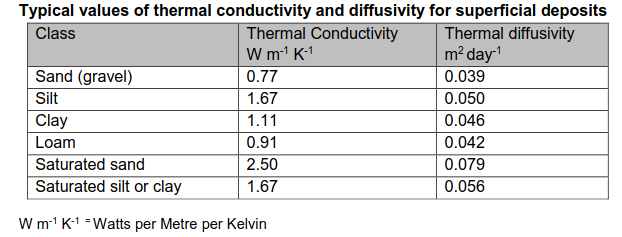
    The figures in the regs are probably inspired by (I'd hope) publications like this British Geological survey Geo report note the wide difference between dry sand at the top and wet sand near the bottom of the list.

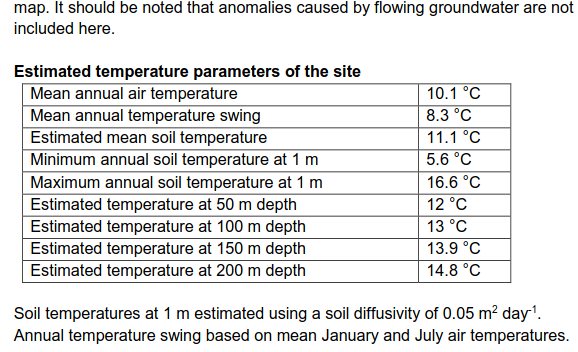
    Soil temperature vs depth is also important - from the same report some typical figures note the max/min at 1m depth are very much smoothed compared to the day time variations.

    In short to condense a proper site survey to a single figure to estimate a cable size is a huge simplification and has to be set to round up the cable size in most places to avoid cooking it in a few that run hotter.
    Mike.

Reply
  • As a general rule with cable ratings the regs always err on the conservative side for the book values. As a noddy example, cables clipped direct ought to have 2 ratings, one for vertical and one for horizontal, as convection makes these noticeably different, but in the book only the more pessimistic case is given. (This latitude is then mopped up by installers failing to get the grouping factors correct. !!)

    Soil in the UK is very variable in thermal (and electrical) conductivity, at the extremes over a range of more than ten to one, and more commonly sand alone varies over about three to one with moisture content, but only a single figure is given, and unless the installer is going to look at testing the local soil type you have to assume a fairly  poor conductor, as that is where the cable heating is greatest.
    Thermal conductivity is set by several things, firstly  water in any gaps- it has a much higher thermal conductivity than air. Dry soil has low conductivity ( resistance as bad as 3K.m/W is possible.Sandy soils with a high quartz conduct heat better than similarly fine-grained organic soils;more densely packed soils are better conductors , allowing for better particle-to-particle heat transfer and higher thermal conductivity - any air pockets are good insulators. So a backfill of fine play sand below the water table is best ;-) 

    The figures in the regs are probably inspired by (I'd hope) publications like this British Geological survey Geo report note the wide difference between dry sand at the top and wet sand near the bottom of the list.

    Soil temperature vs depth is also important - from the same report some typical figures note the max/min at 1m depth are very much smoothed compared to the day time variations.

    In short to condense a proper site survey to a single figure to estimate a cable size is a huge simplification and has to be set to round up the cable size in most places to avoid cooking it in a few that run hotter.
    Mike.

Children