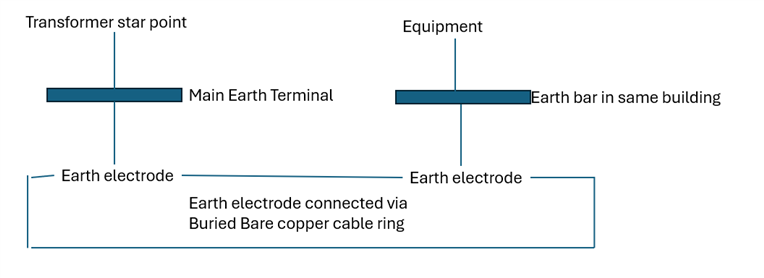
Classification of an earthing arrangement where an interconnected earth electrode system provides the earth fault return path — TN-S or TT?

Hi all. I am trying to determine if this system is considered as a TT or TNS based on the image above.

From BS7671

TN System is

A  system  having  one  or  more  points  of  the  source  of  energy  directly  earthed,  the  exposed conductive-parts of the installation being connected to that point by protective conductors.

TT System is

A  system  having  one  point  of  the  source  of  energy  directly  earthed,  the  exposed-conductive-parts of the installation being connected to earth electrodes electrically independent of the earth electrodes of the source.

The design earth fault current return path is from the equipment earth bar to the equipment earth electrode to the buried bare copper ring back to the transformer earth electrode and back to the transformer earth bar then back to the transformer neutral.

I am trying to determine whether a fault current path that uses an earth electrode system can still be considered a protective conductor, and whether this arrangement would be classified as a TN-S system rather than a TT system, given that the installation earth electrodes are not electrically independent from the source earth electrodes.

  • Thanks for the reply. The means of earthing is distributed from the transformer by a conductor via the buried earth ring connected to the earth electrode. This means the earthing for the installation also utilizes an earth electrode which makes it a hybrid? Sorry, i am still having issue wrapping my head around this.

    If the installation uses ADS (Automatic Disconnection of Supply), and overcurrent protective devices are used to achieve this, whether or not the installation is TN, TT or IT, the cpc must be run in the same wiring system as the live conductors, or in its immediate vicinity (Regulation 534.6.1).

    So, if there is no cpc, meeting this requirement, and OCPDs are used to provide ADS, the installation does not conform to BS 7671.

    It's very common to see bonding ring conductors and multiple earth electrodes on infrastructure buildings and installations; however, a cpc meeting the relevant requirements of BS 7671 (including) must still be used. It's not a hybrid approach ... there's nothing to stop protective conductors in general being multiply-earthed.

    One cpc may serve more than one circuit (for example, where conduit is used as a cpc, and contains more than one circuit).

  • What I think may be causing confusion, is that distribution wiring (generally but not always to BS7671) does not have to  include  a distinct CPC unless its TN-S.

    A network operator may provide a single phase feed may be 2 wire, or a 3 phase feed 4 wire,  if either the neutral is a PEN for TNC-s, or if the distribution is TT. 

    In this case the transformer is on customer premises ,so it there is a possibility that this is  a private LV distribution, which nowadays would be installed to BS7671 in any case, but there are plenty of legacy set-ups where it was not - this might be one of them.

    Depending where metering is and where the load-side wiring begins,  (the 'break'  between distribution and consumption of the electricity -usually metering...) the site owners may be acting as a network operator of sorts and not realising the significance.

    There is a domestic version of the same problem that can occur within blocks of flats originally wired by the now defunct electricity boards, where the wiring (that never met any version of the IEE wiring regs, let alone the current version of '7671) has become the property of the building network operator - the free holder in effect has that responsibility  - and these are a source of some very hard to correct non-compliances.

    Mike

  • Regulation 534.6.1

    Slight typo? 543.6.1

  • One point that may help the discussion is the concept of electrical independence.

    Although the fault current leaves the installation through an earth electrode, it does not return through the general mass of earth alone. The installation earth electrode is intentionally bonded to the transformer earth electrode by a buried bare copper ring, creating a permanent low-impedance metallic return path.

    From that perspective, the buried copper ring effectively forms part of the protective conductor network. The earth electrodes mainly provide the connection to the soil, but the designed fault return path is via the interconnected earthing system rather than through independent electrodes.

    This seems to differ from a conventional TT system, where the installation earth electrode is electrically independent of the source earth electrode and the fault current returns predominantly through the earth.

    Would it therefore be more accurate to classify this arrangement as a TN-S system with an interconnected earth electrode network, assuming the metallic interconnection is permanent, adequately sized, and intended to carry earth fault current? Or is there a specific requirement in BS 7671 or IEC 60364 that would still classify it as TT despite the intentional metallic interconnection?

    I’d be interested to hear how others interpret this, particularly with reference to BS 7671 definitions and IEC guidance.

  • the concept of electrical independence.

    Then there is the practical and legal aspects... which don't care about the basic science. 

    Legal frameworks can be 'dumb' (say nothing) about the whys & wherefores of their scientifically 'stupid' (apparently irrelevant) requirements. Often the reasons are buried in historic failings and blinkered legal responses [in the horse racing sense] (*)

    More earthing is usually better, not enough is almost always worse. They trade off one set of 'abbreviations' for another, TN; TT; ADS; etc. The 'fault current' safety conductor ends up needing to be maintainable/inspect-able/close-by so that it's maintainable/inspect-able/close-by.. 

    (*) reminds me of a legal tale from the US where (in Chicago) headlights were required when it was raining. This became a legal decision that operating windscreen wipers meant the driver knew it was raining, and ultimately that automatic windscreen wipers needed to automatically turn on the headlights... or some variant of a similar tale.