Greener on the other side

I have seen an increase in enquiries from very well qualified people who want to achieve the NVQ L3 as a route into the practical side of the electrical installation sector. Many have degrees in electrical and electronic engineering and similar electrically biased third level qualifications. For example, one chap has a HND and held down a senior role in a consultancy practice. I didn’t ask but I should imagine that the salary is north of 50K.

At the moment we only offer a route via the experienced worker assessment, which, as an entry requirement, requires five years post training experience operating as an installation electrician. As with the chap in the example, most seem to want to move into a specific discipline within the sector, solar PV and battery being a popular focus. Whether one is intending to work in the microgeneration side or on the larger scale projects, having the right brace of qualifications is becoming increasingly essential. Unfortunately, some of the qualifications restrict entry to candidates with a NVQ L3, which, for those with the top class academic qualifications, means achieving accreditation for those practical skills that the NVQ demands.  Gaining such experience can be elusive, if not impossible. I am not at all convinced that some of  the practical skills, such as bending steel conduit, should prevent someone achieving a NVQ and thus prevent access to the renewable qualifications. However, I am not pretending that the answer to allowing gates to open to facilitate folk to move into the installation sector, with all its extensive disciplines, is an easy one.

As for the chap in the example, I met him by chance on a large solar project in an industrial site. He had ditched the suit for a pair of overalls and was helping to pull in long runs of fairly lumpy SWAs. He looked over the fence, decided the grass was greener and took up a job with a contractor who, erstwhile, he gave directions to! He tells me that in time, he will be seeking to enrol on whatever route will see him achieve the NVQ L3 and AM2 and ultimately, the electricians gold card.

Good luck to him, he will be an asset to our industry. I wish I could make it easier for other similar high quality individuals to climb over the fence. Perhaps the grass will not be as green as they thought, but at least we would have them on the right side!.

Parents
  • Lyle, I was under the impression that to do the Experienced Worker Route (2357?) you now need a Level 2 qualification in electrical installation. Is that true, or does past experience count?

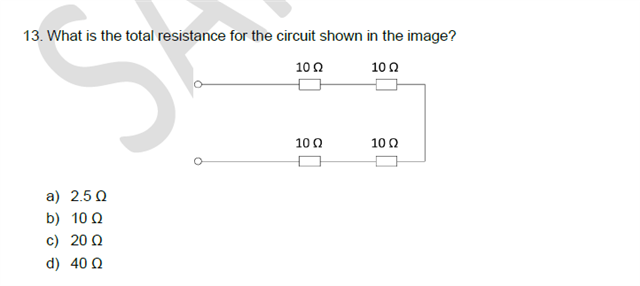
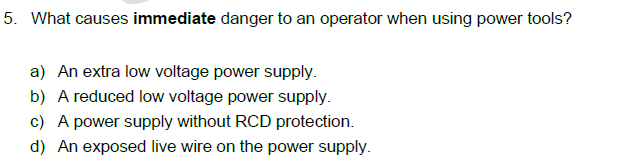
    The minimum underpinning knowledge qualification required for entry to the EWA is a recognised Level 2 qualification. That needs to be supported by a written determination by the assessor that the candidate has appropriate Level 3 underpinning knowledge, albeit not formally recognised. If the candidate has been in the industry for at least 10 years then they can sit a single online entry test where really difficult questions are asked such as the two from the sample below! 

    This is also an example of me being deliberately snooty as MapJ pointed out in his excellent post above, often exists between the theoretical and practical. It is quite amazing the number of really good practical sparks who have difficulty with anything related to theory, no matter how simple, that involves maths. 

    To be clear, I am not clever enough to be snooty and even if I was, I definitely wouldn't be! I prefer to build bridges instead.

  • Well  I don't know about anyone else, but I can answer both of those without resorting to hard sums. I hope that does not make me appear to be showing off or elitist ;-)

    I sometimes feel that there is a problem, with the teaching of maths, (and magnetism oddly) in that it is taught without context, as a stand-alone subject. 

    This makes it easy for the schools - this is a maths lesson, this is a PE lesson, or whatever, and allows the school to measure and assess and right reports by subject  (' e.g. [[mapj1]] expends great effort in his PE lessons, but sadly the achievements remain disappointing . This sort of thing may in part be why I went down the physics and maths path instead, and discovered cross-country running ...)

    The problem is that the 'by subject' and then the 'I cant do ' thing becomes ingrained and very hard to undo when people are older and really need to.

    Maths is not a distinct thing that can be put in a box - it is (and in my mind is only useful as ) a quick way of describing the world about us in a way that allows us to predict in advance what will happen next if we change something. E.g. How much hotter the resistor will get if we change the current or whatever.  In that sense what used to be called 'applied maths' should be taught first, then the pure abstract kind to those who want to pursue it, In real life this is how we use the maths, for engineering problems, but when we teach it, we do this the other way about then look surprised when it seems to match reality in a few places..

    How I think magnetism should be taught is probably better left for another post... 

    Mike. 

  • That Q5 had me thinking for a long while about all the possible devious parts to such questions (the curse of knowledge problem).

    Could they all be potentially dangerous? Is it multiple choice? Does an ELV supply actually have a 'live'? etc.

    Over-thinking, Under-thinking, and Wrong-direction thinking..

  • Of all the things in that test, rank them in order of how much you would like to touch it, even glancingly.

    If there is a live wire flapping about, my advice is not to touch it. Left alone maybe its not dangerous, as demonstrated by many rat-chewed examples exposed in lofts and cellars for years 

    Far better, when wrapped in 'site applied insulation' it can be made 'fairly' safe . For those who use paper roll and PVC tape for small cuts, the Elastoplast section of the 1st aid kit holds something that may be used as a good temporary insulation.

    For the rest of us there is a proper way to do it that involves replacing, refitting or isolating. 
    M

    PS sometimes I am 'tongue in cheek' , some of this post is. 

  • I sometimes feel that there is a problem, with the teaching of maths, (and magnetism oddly) in that it is taught without context, as a stand-alone subject.

    Maths was my strongest subject at school, so I have never really understood the difficulties of those who struggle. However, I think that I had good teachers in infant school. Times tables were drummed in, but I think that knowing things like multiples of 5 always end in 5 or 0 and the sum of the digits of any multiple of 3 is also a multiple of 3 go back to my early days.

    What is guaranteed to lead to failure is an attitude like, "I am no good at maths".

Reply
  • I sometimes feel that there is a problem, with the teaching of maths, (and magnetism oddly) in that it is taught without context, as a stand-alone subject.

    Maths was my strongest subject at school, so I have never really understood the difficulties of those who struggle. However, I think that I had good teachers in infant school. Times tables were drummed in, but I think that knowing things like multiples of 5 always end in 5 or 0 and the sum of the digits of any multiple of 3 is also a multiple of 3 go back to my early days.

    What is guaranteed to lead to failure is an attitude like, "I am no good at maths".

Children
  • I agree with your final sentiment - once someone has decided any one subject is beyond them and they will never understand it, the battle is kind of lost for ever, and the same applies for reading or understanding maps or preparing a meal - it needs to be something you don't mind doing for fun that with practice  becomes  almost effortless.

    In my case, the use case for arithmetic was half learnt with playing 'shop' at school where the doubtful benefit of a mix of pre and post decimal plastic play money,  in later life made the magic denominations  in the Harry Potter stories seem quite reasonable...  

    Tables, much like the alphabet were just learnt like song lyrics - I can sing you old Macdonald had a farm or the Alphabet forwards or backwards with the same alacrity more then half a century after first doing so.

    Likewise the metric conversion chants

    ' A litre of water 's a pint and three quarters,  a meter measures thee-foot three, longer than a yard you see ; two and a quarter pounds of jam, weigh about a kilogram.

    Loads of electrical rules of thumb followed and many have equally odd mnemonics. 

    None of it should be feared.

    M