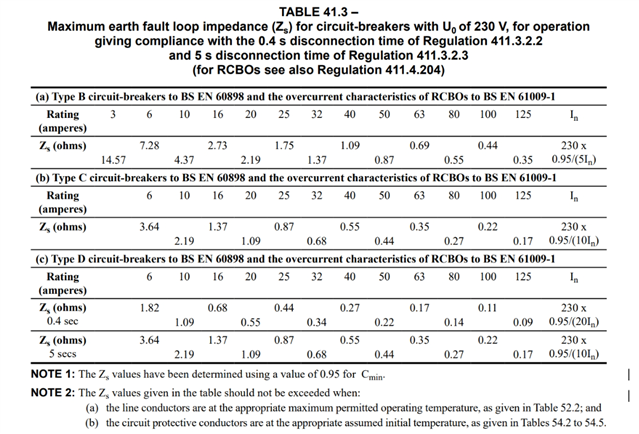
Table 41.3 Max Zs for MCB and disconnection times

I have been running some design calcs with Trimble ProDesign, selecting a 63A Type C iC60H Schneider MCB as the protective device.

The circuit has a Zs of 0.51, a disconnection time of 3.2s and fault current of 0.43kA, according to trimble, and trimble has passed this as acceptable.

By chance i was looking at table 41.3 and noticed the max Zs it states is 0.35, see screenshot
 

Now i am sat here thinking that doesn't make sense but i doubt neither Trimble or BS7671 is incorrect, so can someone educate me please.

Thank you in advance.

Parents
  • ProDesign is using manufacturer's data, rather than Table 41.3 of BS 7671.

    Table 41.3 of BS 7671 applies to the worst-case possible for circuit-breakers to BS EN 60898 or BS EN 61009.

    The Schneider iCH60 is to BS EN 60947-2 as well as BS EN 60898, and the performance actually exceeds the requirements of BS EN 60898 ... 

    The values in Table 41.3 are simply calculated from the formula in Regulation 411.4.4 using the current causing the relevant disconnection time listed in Appendix 3 to BS 7671.

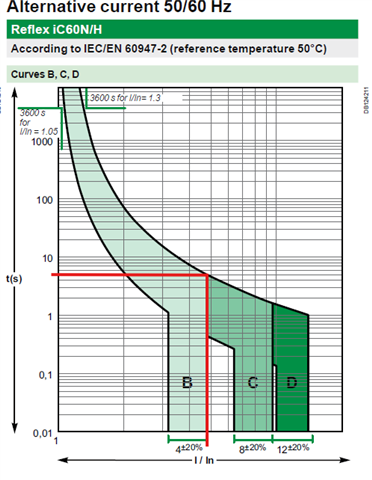
    If you look at the manufacturer's tripping curve data: https://se.my.site.com/ckmContent/sfc/servlet.shepherd/document/download/069Kj00000UQ7H9IAL

    Looking at the curves for the iC60H, we can see that the 5 s disconnection time requires a minimum current of approx 4.8 × In (my red lines to illustrate)

    NOTE: This on the assumption that it's a TN system, and a 63 A circuit with no socket-outlets according to Reg 411.3.2.3. A 63 A circuit supplying socket-outlets in a TN system has a disconnection time of 0.4 s according to Regulation 411.3.2.2.

    We can use this information in the formula of Regulation 411.4.4, and In=63 A, to get:

    Zs ≤ 230 × 0.95 / (4.8 × 63) or Max Zs = 0.72 Ω.

    Which means that a calculated Zs of 0.51 Ω conforms.

  • Thanks Graham, this is very helpful.

Reply Children
No Data