Earth Loop Test

Our ground floor extension has 7x 12v Halogen with the necessary 240v to 12v transformers on a circuit from the wall switch. I would like to upgrade to integrated LED lamps. I understand that if I am competent, I can exchange the fittings and still be within the Building Regs rules. The new LED lamps (Collingwood H2 Lite CSP) need an earth connection.

The existing round 5A junction boxes have an in and out for the circuit (1mm twin and earth) and a feed to the transformer for each light (the transformer doesn't require an earth connection).

To verify the earth connection, I have removed the junction box and transformer for the lamp at the end of the circuit, and temporarily connected a 13A 3 pin socket and I have plugged in a KewTech Loopcheck 07. The KewTech reports all the connections are present, (so earth is connected for the circuit), but it is saying "Check loop test" because it has detected a safety earth path between 1.80 ohms and 92 ohms. 

If I plug the Kewtech into a proper 13A power circuit, it reports everything is OK.

My questions

a) Could the 240v / 12v transformers that are before the Kewtech cause an impedance issue?

b) Could one of the junction boxes have a non perfect connection and therefore cause an impedance issue?

c) Is the use of the Kewtech on a lighting circuit a valid test?

I could move the temporary 13A socket to the start of the circuit, not connect the outgoing circuit and use the Kewtech at that point. If it said everything was OK, I could work around each lamp until the Kewtech complains. 

Alternatively, I could look at a solution that doesn't need an earth connection but since the Kewtech has found an issue, it would sit in the back of my mind. 

Thank you


Parents
  • Quote “The KewTech reports all the connections are present, (so earth is connected for the circuit), but it is saying "Check loop test" because it has detected a safety earth path between 1.80 ohms and 92 ohms”

    What is the issue?

  • What is the issue?

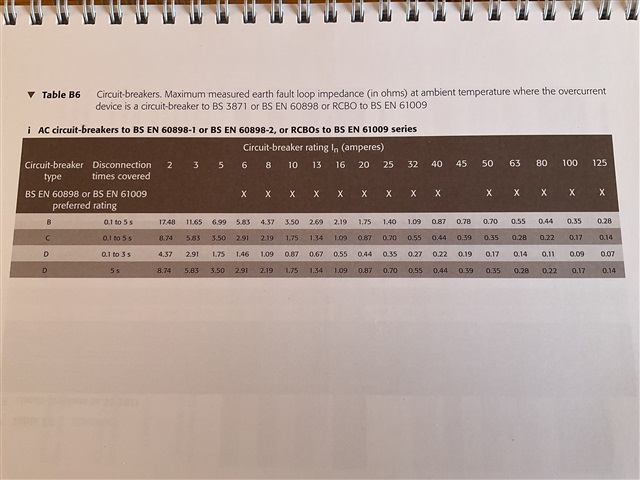
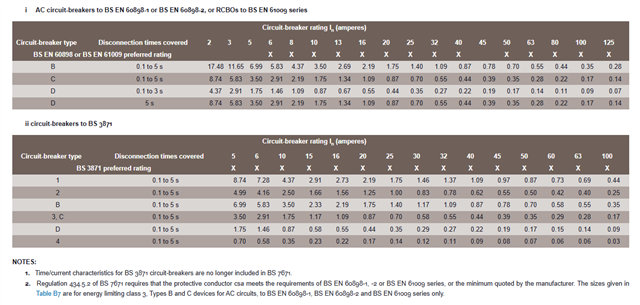
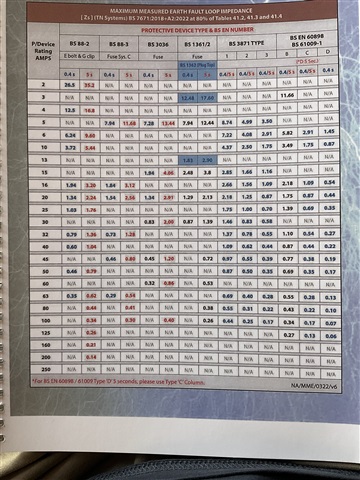
    90 ohms is greater than 5.83  Ohms ... there is no RCD as far as we know ...so we don't know whether it's got sufficiently low earth continuity/lopop impedance.

    Also, are we sure we're on the right part of the table, we don't know whether the circuit-breaker is  BS EN 60898 or BS 3871 Type B, or BS 3871 Type 1 (as   earlier identified ,7.28 ohms limit), but similar conclusion "don't know whether it's OK".

  • So the issue is it’s a completely inconclusive test result, maybe it is okay, maybe it’s not okay.

    British Gas giving their gas engineers testers like these created lots of work for electricians, because having got a test result they had absolutely no idea if it was acceptable or not, so they stuck a warning notice on the equipment and told the customer they needed to get an electrician to check it.

    The real answer is probably, don’t use a plug in 13-amp socket tester like this to test anything other than 13-amp sockets and definitely not a lighting circuit.

  • The real answer is probably, don’t use a plug in 13-amp socket tester like this to test anything other than 13-amp sockets and definitely not a lighting circuit.

    Agreed. As I pointed out earlier, 'quick test' socket checkers are great for peripatetic workers who work with electrical equipment plugged into standard socket-outlets, provided they are trained to use and understand their indications.

    Don't forget, even with socket-outlets, they might indicate a potential issue with socket-outlets in a perfectly fine TT system if the EFLI exceeds 90 ohms or so. 

    I don't think it's a valid method for testing earth continuity and EFLI to an extension circuit, or a replacement socket-outlet, but a quick check for correct polarity absolutely (but even then, it won't indicate a swapped L and CNE at a PME service intake equipment, that could have happened between the last EICR and the socket-outlet being replaced).

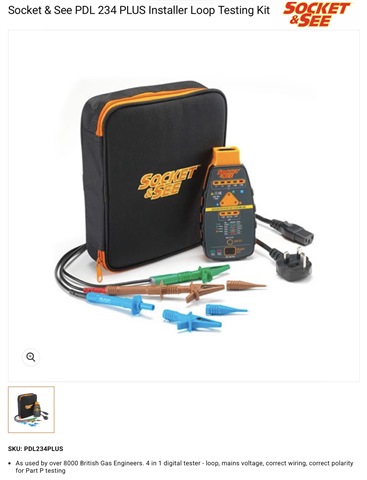
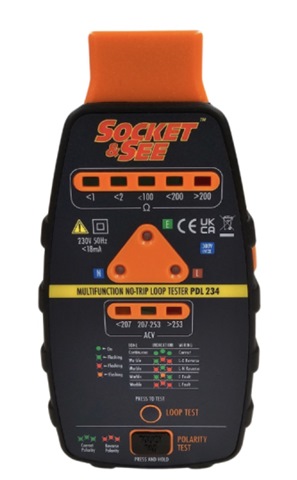
  • The Socket and See tester, as used by over 8000 British Gas engineers, has a 13-amp plug lead as well as a three wire test lead set, it also has more range indicators but there is a big difference between less than 2 ohms and less than 100 ohms, so it isn’t really more accurate.

Reply Children
No Data