Earth Loop Test

Our ground floor extension has 7x 12v Halogen with the necessary 240v to 12v transformers on a circuit from the wall switch. I would like to upgrade to integrated LED lamps. I understand that if I am competent, I can exchange the fittings and still be within the Building Regs rules. The new LED lamps (Collingwood H2 Lite CSP) need an earth connection.

The existing round 5A junction boxes have an in and out for the circuit (1mm twin and earth) and a feed to the transformer for each light (the transformer doesn't require an earth connection).

To verify the earth connection, I have removed the junction box and transformer for the lamp at the end of the circuit, and temporarily connected a 13A 3 pin socket and I have plugged in a KewTech Loopcheck 07. The KewTech reports all the connections are present, (so earth is connected for the circuit), but it is saying "Check loop test" because it has detected a safety earth path between 1.80 ohms and 92 ohms. 

If I plug the Kewtech into a proper 13A power circuit, it reports everything is OK.

My questions

a) Could the 240v / 12v transformers that are before the Kewtech cause an impedance issue?

b) Could one of the junction boxes have a non perfect connection and therefore cause an impedance issue?

c) Is the use of the Kewtech on a lighting circuit a valid test?

I could move the temporary 13A socket to the start of the circuit, not connect the outgoing circuit and use the Kewtech at that point. If it said everything was OK, I could work around each lamp until the Kewtech complains. 

Alternatively, I could look at a solution that doesn't need an earth connection but since the Kewtech has found an issue, it would sit in the back of my mind. 

Thank you


  • or it is not suitable for use on 1mm2 T&E or something else

    The impedances on lighting circuits can be higher, and so you might expect this (as   said in an earlier post).

    It's not really the correct tool for the job.

    I'll contact Kewtech to see if they have any guidance.

    Kewtech make the correct tools for the job, so I guess they would point you to those, for example:

    https://www.kewtechcorp.com/products/kt300dl/

    https://www.kewtechcorp.com/product-category/multifunction-testers/

    I'm sure they would recommend 'dead tests' for this purpose for safety.

  • You could, and in the circumstances of some odd readings, maybe should, be able to verify the continuity of the earth wire at each light back to the board, either indeally with a real low resistance ohm meter, or even just a lamp and a battery or  a bell and a battery, and a long wander lead of some kind. Anything other than a good connection when passing a reasonable test current, should be investigated. (the same test but between fittings can be used to identify a broken section of the chain)

    Just because you have access to a Kewtech loop tester does not make it the ideal weapon of choice in this case. (Think of the 'when you only have a hammer all screws become nails' sort of thing. Don't forget to focus on what you are supposed to be looking for, not just the fancy machine that goes ping..)

    Also a continuity wander lead check ('R2') like that can be done with the power off,  and once you have opened everything up to see what's happened and have exposed terminals, or bare ends poking out that is a much preferable method.

    Mike.

  • Thanks for the info, as I always learn new things from here!

  • Thanks everyone,

    I had already received a quote from an electrician for swapping the lights (integrated and separate lamp options). Since my testing method has revealed something not quite right, I will take up the quote. It could be my incorrect use of the Kewtech 107 on a lighting circuit is creating a false result.

    I think the electrician will also want to upgrade my Wylex Push Button MCB which doesn't provide RCD to one that provides RCBO. That's something that I hadn't considered. 

    Are there any estimates for the cost to upgrade an MCB with 2x5A, 1x15A and 3x30A to a current version? Is it straight forward? 

    I also have a future requirement for power to a shed (once the shed has been replaced) so I'll cover that at the same time.

    Thank you.

  • Your talking about changing the Consumer Unit as you cant get rcbo for that type of board i think. This would be a good idea as the electrician should test all the circuits and you will get rcd additional protection for the sockets which you may not have now

  • If you get the consumer unit exchanged, the first step for a responsible installer is to inspect and test because to a degree they are adopting the existing wiring as safe, and taking some responsibility for it. This is the more expensive unknown part, or can be, depending on the age and condition of what is found. (*)
    Unless horribly strapped for cash, there are 2 additional things worth doing - one is an isolator between meter and consumer unit if there  is not one already, so that it can be made dead for any future work (thinking about that shed and anything else you add later ) The other is to make it an all-RCBO board with a few spare ways, either blanked or with a stub circuit to a JB you can extend from yourself later. This is slightly more expensive  than a box with one RCD covering a group of  MCBs, but any earth related fault in that group and the whole  lot goes off. Separate RCBOs will make isolation and any future fault finding so much easier.

    your best bet is to ask for a couple of quotes.

    M.

    * which may be nothing needs doing at all, up to a complete re-wire if it is all in a really poor state, or grief with circuits with previously undetected damage or faults that trip the new RCD/RCBO (where there was not one before) so it refuses to stay powered on that have to be investigated before the new board can be used.

  • it could be that the Kewtech 107 isn't suitable for 1mm cables.

    It's not a simple suitable/not suitable - more that 1mm² cables have a higher resistance per meter than thicker cables, so moderate lengths are more likely to push things over some arbitrary limit. E.g. 1mm² have a resistance of about 36.2 milli-Ohms/metre whereas modern 2.5mm² T&E is 19.51 mΩ/m - so you need about 50m of 2.5mm² cable to add 1Ω to the earth loop impedance (or likely significantly longer lengths if it's part of a ring circuit, so there are two cables in parallel to some extent) whereas less than 28m of 1mm² will have the same effect.

      - Andy.

  • 2x5A, 1x15A and 3x30A

    That is showing its age. 

    From the sound of it, at least a new CU is in order.

    RCDs are a bit like seatbelts. You may never need one, but if a fault does arise, it may save your life.

  • Quote “The KewTech reports all the connections are present, (so earth is connected for the circuit), but it is saying "Check loop test" because it has detected a safety earth path between 1.80 ohms and 92 ohms”

    What is the issue?

  • What is the issue?

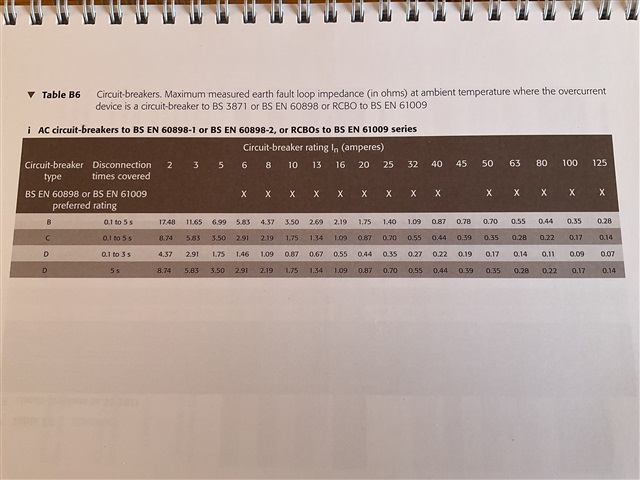
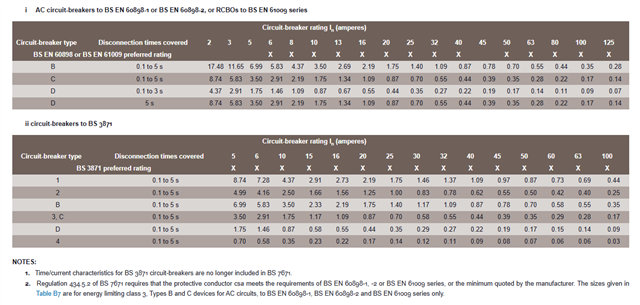
    90 ohms is greater than 5.83  Ohms ... there is no RCD as far as we know ...so we don't know whether it's got sufficiently low earth continuity/lopop impedance.

    Also, are we sure we're on the right part of the table, we don't know whether the circuit-breaker is  BS EN 60898 or BS 3871 Type B, or BS 3871 Type 1 (as   earlier identified ,7.28 ohms limit), but similar conclusion "don't know whether it's OK".