Who is responsible for non compliantbev install

EICR on 3 year old house thats a rental property. C2 because ev charger is sharing an rcd with other circuits in a split load board.Complied with how many organisations interpreted the regulations at the time of design.

No.high integrity ways available, only practical solution is replace the board or additional board for the ev charge point. Could consider rebuilding the internals of the existing cu, but still time consuming and fairly expensive.

Just generally interested in how the as long as it complied at the time approach works.

Who is responsible for the costs?

Parents
  • The safety of the EVSE is not compromised, the risks arise on all the other circuits that share the upfront 30 mA RCD.

    Just to compound the issues, in a couple weeks time after the 27th August 2026 the tenants may buy some plug in PV with a disconnection time on loss of supply of two seconds, which takes the maximum disconnection time of the RCD protected circuits out to 2300 milliseconds, 2000 mS for the PV plus 300 mS, plug in two PV units protected by the upfront RCD and it may never trip.

    And therein lies the problem, if the EVSE is sharing an upfront 30 mA RCD with socket circuits, no one can really anticipate how the tenant will use them and what they will plug in that will affect the performance of the circuit protection, particulary the upfront 30 mA RCD. If you are preparing the EICR whilst the house is empty prior to letting, how can you determine if thre installation will be safe when the tenants move in and start using it?

    So, if the EVSE is pushing the upfront RCD to the limits of its performance, it cannot cope with having other circuits to protect as well.

  • Just to compound the issues, in a couple weeks time after the 27th August 2026 the tenants may buy some plug in PV with a disconnection time on loss of supply of two seconds, which takes the maximum disconnection time of the RCD protected circuits out to 2300 milliseconds, 2000 mS for the PV plus 300 mS

    Not if you have a DP RCD - the plug-in PV may hold up the L-N voltage downstream of the RCD but as long as the RCD has physically tripped and so opened the N connection, what's downstream should be pretty much floating w.r.t. Earth - so shock currents very limited (i.e. just what can sneak through filters on Class I equipment and the like - as as that should be below 9mA if it's on a 30mA RCD, the shock risk seems pretty low in practice).

    (I thought the proposed UK version of the standard had a much shorter disconnection time on power fail too - I'll have to check that).

    So, if the EVSE is pushing the upfront RCD to the limits of its performance, it cannot cope with having other circuits to protect as well.

    Which limit? If it's cumulative leakage (sorry, protective conductor) current, then at worst it's going to nuisance trip - so no additional shock risk there. If it's blinding then an A type in the CU together with a RCD-DD in the EVSE seems to tick all the boxes (provided there's only one EVSE). Selectivity etc. certainly point to it being a pretty shoddy approach - certainly not what I'd want at home, but that not usually enough to make it a BS 7671 C2. If the CU RCD was an AC type, or an A type and the EVSE didn't include an RDC-DD,  then you could conclude that the RCD could be compromised - so loss of additional protection - so C3 for indoor circuits, perhaps a C2 for any circuits feeding mobile equipment outdoors or bathroom circuits if there wasn't supplementary bonding. I'm not saying it can't be a C2, I'm just suggesting it's quite so simple as 'sharing an rcd with other circuits in a split load board' is always potentially dangerous.

       - Andy.

  • (I thought the proposed UK version of the standard had a much shorter disconnection time on power fail too - I'll have to check that).

    To save time.. 

    The interim UK standard says two things. The first about ceasing to generate AC.

     In deviation of ES1 (for laypersons) of Table 5 of BS EN IEC 62368-1:2024+A11:2024,
    the inverter shall automatically disconnect from the mains supply within 100
    ms.
    The voltage at accessible plug pins shall decrease to below 34 V within 100 ms following

    disconnection from mains supply. NOTE: This requirement is taken from DIN VDE V 0126‑95.

    but if the plug is pulled out then a longer applies time in respect of stored charge that may leave a DC voltage between isolated but accessible parts if there is no load. 

    For plug pins without contact protection, there is a risk that the internal capacitor may maintain
    hazardous voltage on the plug pins for a short period following AC disconnection. For normal
    operation, the voltages at accessible plug pins shall comply with the ES1 limits (for laypersons)
    in Table 5 of BS EN IEC 62368-1:2024. Following disconnection from mains supply,
    capacitors larger than 100nF shall discharge to a voltage not exceeding 34 V within 1 s.

     In the case of the supply side RCD opening, then its probably the upper 100msec  time that applies, as there will still be LN loads connected to that will draw current and run down the caps a lot faster than the 'unplugged bare pins' case.

    More generally I agree - sharing an RCD with sockets that may have almost anything plugged in, even the humble induction motor, will extend the time fro, when the  RCD contact opens to the voltages dropping to a safe level, however this is not a new thing, and is why generally we test RCDs with things unplugged or suffer occasional silly readings.

    However it is important to be clear, that additional over-run is not special to plug-in solar, which if anything is more tightly regulated than many situtions.

    Mike.

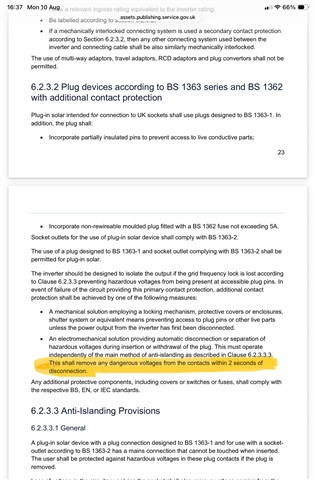
  • I quoted the 2 seconds from memory, that requirement is actually here.

  • yes, that's the 'electromechanical solution ' by which I assume they mean they want a contactor or a mechanical switch - but the inverter has stopped outputting any AC voltage long  (well,  1.9 seconds ) before that has to operate. M.

  • It seems there is a blending of requirements from three sources in the UK specification, a bit of mix and matching going on.

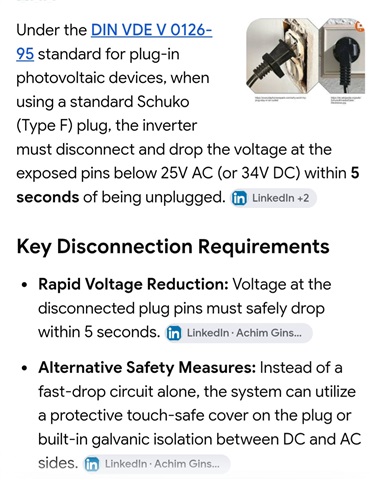
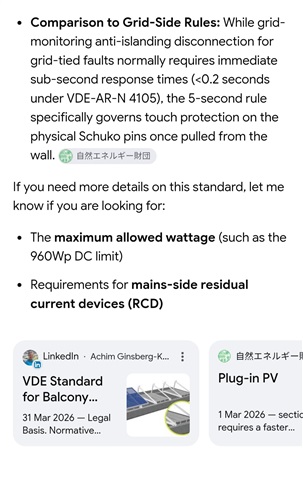
    An internet search result throws up this response.

Reply Children
No Data