Who is responsible for non compliantbev install

EICR on 3 year old house thats a rental property. C2 because ev charger is sharing an rcd with other circuits in a split load board.Complied with how many organisations interpreted the regulations at the time of design.

No.high integrity ways available, only practical solution is replace the board or additional board for the ev charge point. Could consider rebuilding the internals of the existing cu, but still time consuming and fairly expensive.

Just generally interested in how the as long as it complied at the time approach works.

Who is responsible for the costs?

Parents
  • Hi 

    Just to confirm that as Soarky Chip says my main concern about the shared rcd is 5mA from the EV plus 5mA of dc leakage from other circuits equals 10mA on the shared rcd, if its a type A it may not trip.

    Given that many houses now have ev chargers  induction Hobs  air con units etc this and higher can easily occur. I am fairly sure NAPIT would recommend C2 for this.

  • Also it's becoming quite common practice to game the cheap energy tariff by having one car on a proper ev charger and  a second in a granny charger.

  • There's a more simple concern ... BS 7671 has the requirement, because an EV might have a "leakage current" around 10 mA. This doesn't leave a lot more for other equipment before a 30 mA RCD might operate in unwanted situations.

  • Having read the DPC of the guide to EVCPs this morning, my attention was drawn to Figure A53.2, which is new to BOB.

    So the issue is not about safety at the EV because that is covered by the (assumed) RCD in the EVCP; nor is it unwanted tripping because of lack of selectivity. Instead, the risk is blinding of the (Type AC?) RCD in the CU.

    I can see that one might argue that if the RCD in the CU is likely to be blinded when the EV is on charge, it may as well not be there; and if it were not present, C2 would be appropriate.

    I realise that Annex A53 is informative only.

Reply
  • Having read the DPC of the guide to EVCPs this morning, my attention was drawn to Figure A53.2, which is new to BOB.

    So the issue is not about safety at the EV because that is covered by the (assumed) RCD in the EVCP; nor is it unwanted tripping because of lack of selectivity. Instead, the risk is blinding of the (Type AC?) RCD in the CU.

    I can see that one might argue that if the RCD in the CU is likely to be blinded when the EV is on charge, it may as well not be there; and if it were not present, C2 would be appropriate.

    I realise that Annex A53 is informative only.

Children
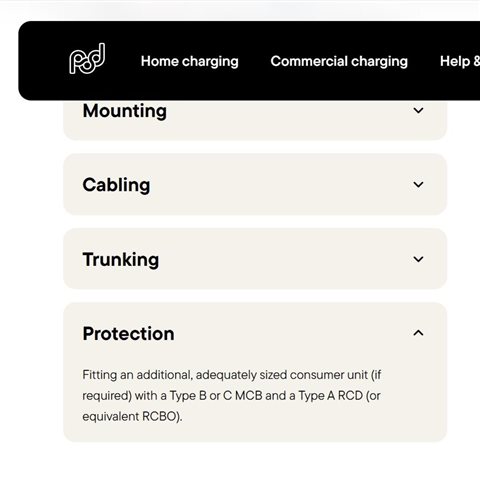
  • I thought that I would have a quick shufti at some manufacturers' instructions, or at least their web sites.

    Mercedes have some sort of link with Pod Point.

    As the screen shot shows, they seem to be perfectly happy to protect the EVCP circuit with a type A RCD in the CU.

    ETA: all right, the EV will not blind other circuits, but if its individual RCBO is blinded, what happens when the householder sticks a nail through the cable which is buried less than 50 mm below the surface of the wall?