Have your say on the Electrician’s Guide to Domestic Electric Vehicle Charging Equipment Installation

The Draft for Public Consultation (DPC) is available for the IET’s Electrician’s Guide to Domestic Electric Vehicle Charging Equipment Installation. This is your opportunity to review the draft and provide feedback to help ensure the publication meets the needs of electricians, designers, installers and other professionals working with electric vehicle (EV) charging equipment. 

As EVs become increasingly common across the UK, the demand for safe, and compliant charging installations continues to grow. This guide has been developed to provide practical guidance on the selection, design, installation and certification of domestic EV charging equipment, helping practitioners navigate the technical and regulatory requirements associated with this rapidly evolving sector. 

What the guide covers 

The draft publication provides a comprehensive overview of domestic EV charging installations, including: 

  • The various EV charging modes and types of charging equipment 
  • Relevant regulations, standards and key sources of information 
  • Assessment considerations before system design and installation 
  • Methods of electrical protection and earthing 
  • Domestic and small commercial installation design, including control devices, circuit design and cabling 
  • Certification and documentation requirements 

Bringing together essential technical guidance and industry best practice, the guide is intended to support both experienced electricians and those new to EV charging installations. 

Why your input matters 

The DPC provides an opportunity for industry professionals to help shape a practical and authoritative resource for the electrical sector. Whether you are involved in EV charger installation, inspection and testing, electrical design, training or compliance, your feedback can help ensure the guidance remains relevant, accurate and aligned with current industry practice. 

Your comments will help strengthen the final publication, supporting safer installations and promoting consistency across the growing EV charging market. 

Visit the website to find out more and submit your comments by 21 August 2026: https://spkl.io/600073To0

Parents
  • I did the City and Guilds Domestic and Commercial EVSE course and gained the qualification five years ago, the syllabus has since been changed.

    When I took the exam the cable calculation was extremely basic.

    The tutor walked around the room with a pack of cards in each hand, one for a domestic installation and another for commercial installation, everyone got to pick a card from the pack, apart from me, I was given the last two remaining cards after everyone else had chosen theirs.

    Both of mine simply said that the EVSE required a 16-amp circuit and the cable was to be T&E clipped direct, the only difference was the length of the circuit.

    So all I had to do was select a cable size from the regs book and confirm the voltage drop was okay, so for both I wrote down that I could use 1.5 mm T&E and what the voltage drop would be, confirming it was okay, referencing BS7671 Table 4D5, but I will use 6.0 mm.

    That was it, I didn’t have to determine what the design current was, I was told it was 16-amps.

    I have been told that now a full cable calculation is required and electricians have been failing the exam as result of this to the extent that on one occasion only one out of twenty electricians passed the exam. I asked several electricians if they had been advised to revise the cable calculation before going on the course and they said no, if they had known what was expected they would have revised and prepared themselves in advance.

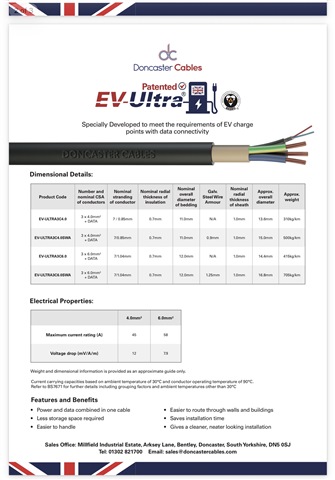
    Doncaster Cables make their specialised EVSE cables in both 4.0 and 6.0 mm, and state “These cables are designed to be installed in air, clipped to surface, on cable tray/ladder work and embedded in concrete. The cables can be laid direct in the ground providing that suitable mechanical protection is in place.” Then go on to say the 4.0 mm is rated at a maximum of 45-amps, which could easily lead to complacency as there appears to be more than enough capacity, but if only a short amount of the cable runs through an insulated building the could be some considerable derating to be factored in to the design.

    www.doncastercables.com/.../EV_Ultra_Datasheet...pdf

Reply
  • I did the City and Guilds Domestic and Commercial EVSE course and gained the qualification five years ago, the syllabus has since been changed.

    When I took the exam the cable calculation was extremely basic.

    The tutor walked around the room with a pack of cards in each hand, one for a domestic installation and another for commercial installation, everyone got to pick a card from the pack, apart from me, I was given the last two remaining cards after everyone else had chosen theirs.

    Both of mine simply said that the EVSE required a 16-amp circuit and the cable was to be T&E clipped direct, the only difference was the length of the circuit.

    So all I had to do was select a cable size from the regs book and confirm the voltage drop was okay, so for both I wrote down that I could use 1.5 mm T&E and what the voltage drop would be, confirming it was okay, referencing BS7671 Table 4D5, but I will use 6.0 mm.

    That was it, I didn’t have to determine what the design current was, I was told it was 16-amps.

    I have been told that now a full cable calculation is required and electricians have been failing the exam as result of this to the extent that on one occasion only one out of twenty electricians passed the exam. I asked several electricians if they had been advised to revise the cable calculation before going on the course and they said no, if they had known what was expected they would have revised and prepared themselves in advance.

    Doncaster Cables make their specialised EVSE cables in both 4.0 and 6.0 mm, and state “These cables are designed to be installed in air, clipped to surface, on cable tray/ladder work and embedded in concrete. The cables can be laid direct in the ground providing that suitable mechanical protection is in place.” Then go on to say the 4.0 mm is rated at a maximum of 45-amps, which could easily lead to complacency as there appears to be more than enough capacity, but if only a short amount of the cable runs through an insulated building the could be some considerable derating to be factored in to the design.

    www.doncastercables.com/.../EV_Ultra_Datasheet...pdf

Children
No Data