Why are we still using ring final circuits?

Hi all, I wanted to discuss the use of ring final circuits in electrical installations in the UK. 

I am an electrical contractor based in Surrey, England and, though I have predominantly spent my 20 year electrical career in the industrial sector, I have recently found myself in the domestic installation world - which has really opened my eyes to, what I believe to be, certain dangers of this installation practice here in the UK. I'd like to share two recent scenarios I have encountered domestically.

Scenario 1

I was called to a customers house to investigate a fault which was preventing the customer from switching on her 32A MCB without it immediately tripping. Upon beginning my investigation, I immediately discovered that the ring circuit in question had no continuity on both the Line and Neutral conductors. I also noticed that various sockets on the ring circuit had a black, sticky residue seeping from all 3 terminals of each outlet. After locating the fault causing operation of the MCB, I returned to the case of the broken ring continuity. I discovered that the Line and Neutral conductors had broken behind a countertop socket in the customers kitchen. It then became apparent that all sockets with the residue were sockets on the leg of the ring leading up to the broken point. Along this route were sockets feeding every appliance and piece of equipment in the kitchen, so my assumption is that the load, and subsequent heat, on this leg of the ring must have caused the insulation to deteriorate so and seep out from the terminals. 

Scenario 2

I was asked to install a few extra sockets onto an existing ring final circuit in a customers house to provide a newly built entertainment unit with several socket outlets. Immediately, I isolated the power and tested for ring continuity of the existing circuit only to discover, again, that the Line and Neutral conductors were not continuous. After a short investigation I discovered, much to my own and my customers horror, electrical cables protruding from a box with insulation stripped and copper conductors free to the touch. Whoever had removed an electrical accessory must have completely forgotten to return and re-connect it before turning the power back on. The scary thing about this one is that it was tucked away in a cupboard that my customers 8- and 10-year old sons kept their bike helmets - which the used every day to get to and from school. 

Both of these scenarios frighten me a little in the sense that these faults lay completely hidden and undetectable from untrained eyes. Because of the configuration of the wiring, nobody could tell that anything was wrong with the circuits, or that possible danger lay in wait. Does this not pose a huge, yet unnecessary, risk? To me there's absolutely no reason that we still need to be installing these circuits in 2026.

I personally feel that the industry as a whole might have gotten a little lazy. Showing up and installing numerous rings seems, to me, to be lazy design. Though I don't feel we're being taught any different. My apprentice informs me that they're still learning about them in college at the moment. Isn't it time we started designing our installations more efficiently: dedicated circuits for fridge/freezers, washing machines & tumble driers, induction hobs etc, 20A radials for ordinary sockets? Or, am I wrong? 

At the very least, if this kind of fault occurs on a radial circuit then some points - at the very least one - will cease to work and give the user of the system an indication that something is wrong. 

Does anyone agree?

  • I think it is completely relevant. There were numerous sockets on either side of the disconnected point both making their path back to the consumer unit. If it was a radial circuit then whichever side of the circuit was downstream would have ceased to provide any power and this would have been quickly apparent to the customer, prompting them to get some assistance. However, because it was installed as a RFC, nothing appeared to be wrong and the bare conductors remained like that for at least a year since they moved in. And, I've heard it many times that "if they are installed properly and well maintained then they're perfectly fine". But I think we all know that domestically, this isn't always the case. Handymen and DIY'ers are allowed for too much freedom to meddle in our trade. We live in quite a dangerous age at the moment where electricians are posting videos online (for likes and popularity, I can only assume), encouraging those who are not qualified to venture into our world of electrical installation and maintenance.

  • but I feel that more should be done to encourage radial circuit use with dedicated circuits for different electrical items. The fridge/freezer is the best example I can think of - who wants their fridge/freezer to be knocked off due to a fault somewhere else on the circuit

    Been there, done that. In fact it was a matter of the pre-payment meter going off whilst I was (unavoidably and unexpectedly) absent. What a stench!

    However, there are swings and roundabouts.

    Do you put your smoke detectors/alarms on their own circuit, or for example, downstairs lights? In the former case, nothing extraneous will disturb them, but what if the circuit fails? Will you notice?

    By contrast, if the circuit includes the downstairs lights, you are bound to notice.

  • Thanks for directing me to these texts. Whilst I duly note all the points regarding the use of the ring, I reiterate my point made above in my reply to aligarjon, I don't believe that we currently have controls over who can freely alter and work on electrical installations in domestic premises here in the UK. It's literally a free-for-all. I'm fairly new to the domestic scene but I know not of any measures in place to prevent unskilled individuals from meddling with installations. I strongly believe that electrical installation materials should only be available to verifiably certified electricians, but I highly doubt anyone will challenge/enforce this on wholesalers or giants like B&Q etc. Anybody is free to purchase and try their hand at DIY electrics - again, especially with all the self-help videos available now. Possibly making all electrical work notifiable might help too, that way we can be sure the correct people are carrying out the work and testing it thoroughly. Homeowners should also have more pressure on them to elect the correct individuals. 

  • I personally feel that the industry as a whole might have gotten a little lazy. Showing up and installing numerous rings seems, to me, to be lazy design.

    I think you might argue there has been some laziness regarding the protective devices for ring final circuits - back when they were first introduced the only affordable, practicable protective device was a rewireable fuse, with a cartridge fuse an incremental improvement, fast forward and now we have MCBs, and the manufacturing efficiencies have reached a point where the cost has fallen so that a single pole MCB now costs less than a cup of coffee or a sandwich. These devices are now remarkably cheap.

    So I wonder, given the falling costs of protective devices, whether there's a case to introduce a more advanced MCB design for ring circuits, with independent thermal overload monitoring for each leg, to protect against the inherent weaknesses of the ring final, the risk of overloading due to uneven loading of the ring, or due to breaks in the ring.?

  • independent thermal overload monitoring for each leg,


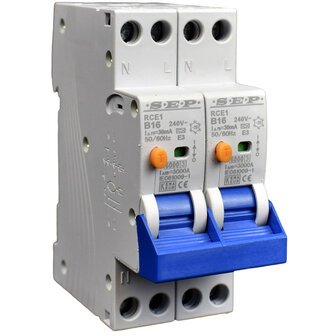
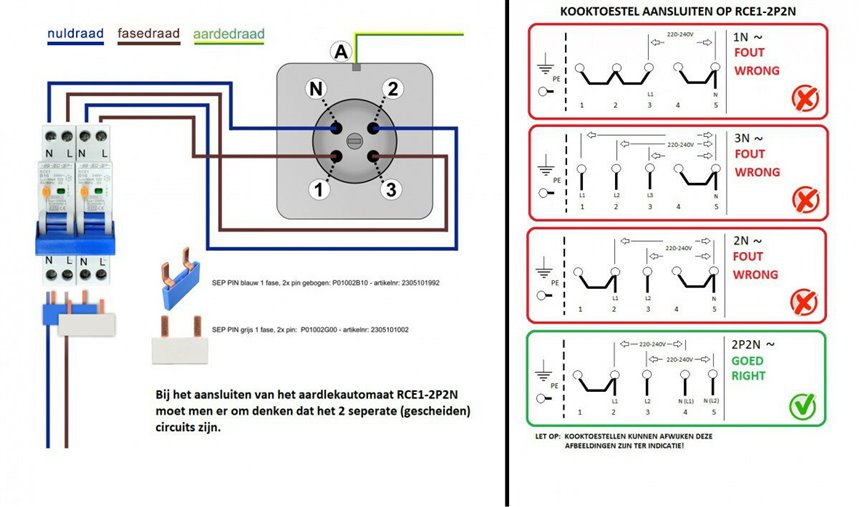
    That is comparable in complexity to the Dutch approach  for single phase cookers - a pair of 16a Breakers on a common handle, giving the cooker two ganged radial supplies that share a route and a length of flexi conduit  Either test button fires the both sides of the trip...


    For a UK ring wired in 2,5mm2, to take proper advantage of the cable rating   the breakers for the two sides could be 20A or maybe 25A depending on on installation method, and correct  operation of the RCD would require one sense coil and 4 wire sensing to avoid false trips.

    It seems a lot of effort for something that in practice causes very few issues.


    Mike

    PS a tip for those broken rings that are beyond redemption is to lower the breaker to 25A, and treat it as a complex radial.... 

    As far as the kookgroep  wiring goes my Dutch is not good enough to understand how grouping factors get applied in their regs, but as most things are wired as unsheathed ("single insulated" ) singles in conduit, the actual heating won't be the same as a cable like twin and earth anyway,