Guidance for plug in solar for Electricians

We are now a few days from plug in solar being legal. The likes of Martin Lewis is recommending people should ask an electrician to check their installation before plugging a solar system in.

I have seen various comments referring back to changes in the law and changes to the specification for a 13A plug.

But I haven't seen any guidance from IET, NAPIT or NICEIC for electricians stating under what conditions it's acceptable to plug one of these systems in.

Personally as it stands today based on what I have seen I would not be willing to say iny installation is acceptable unless it was a single socket on it's own circuit protected by a bidirectional type A RCBO. Which I am sure isn't what the government wants.

Have I missed something, is something in the pipline?

I know lots of people will just do it, but in those situations I am not responsible.

Parents Reply Children
  • I fear that is partly a German to English translation issue.


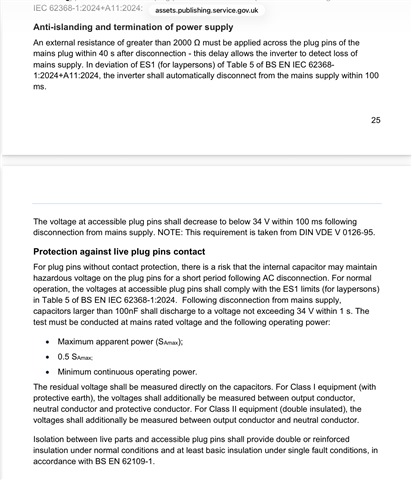
    In VDE 0126 -95: 2025 as part of the testing, after removal from the supply, a  resistor of any value at least 2000 ohms is connected  back across the exposed pins of the plug, and this is listed as one of a set of actions to test that the inverter does not try to restart when there is no grid, but there may or may not be connected low current resistive loads or  worse a person in parallel.

    It does seems a bit odd to cherry pick parts of a test in this way without the rest of the explanation and other tests.

    The VDE standard stipulates that, following a grid disconnection 
    (e.g., due to a power outage or voltage faults), a photovoltaic inverter
    must continuously monitor the public grid for a period of at least
    20 to 60 seconds (with the standard setting being 40 seconds).
    The inverter is permitted to automatically reconnect
    only once the grid has remained
    (imagine this says within tolerance and - MAPJ1)
    absolutely stable throughout this period.

    Mike

  • That is all very nice but what I would like to know what time it takes for the inverter output voltage to fall to zero on not seeing the grid?

    Then I can add that time to the operating time of the RCD in the  event of a circuit fault to earth to verify that is an acceptable time for protection against shock?

    JP

  • what I would like to know what time it takes for the inverter output voltage to fall to zero on not seeing the grid?

    Then I think we can all agree, you don't want the 40 seconds figure - that's all about not being fooled into automatically restarting too soon..


    And of course you don't really just want 'fall to zero', you need  'fall below, and stay below, a safe level'  Much as you would for oltages  generated by a washing machine motor spinning down or an SMPS with capacitors on the input. And here depending on what product standard you want to compare  to , there is a choice. 
     
    Probably the most useful in your case is 

    "The voltage at accessible plug pins shall decrease to below 34 V within 100 ms following
    disconnection from mains supply"
     
    Really though to align with BS7671, you need 50V as the touch voltage limit, but as 34 is less than 50, we can say 'faster than 100msec, but by an indeterminate amount '

    the other alternative, more use if opening covers,  is

    "Following disconnection from mains supply, capacitors larger than 100nF shall discharge to a voltage not exceeding 34 V within 1 s"


    Both of these are directly lifted from existing product standards for equipment that plugs in .

    So in the very worst case you may observe the voltage on an RCD that only just opens at  the maximum permitted 0,4 seconds after 30mA fault, with a worst case inverter plugged in, fall away to less than 50V in something under 0,5 seconds instead.
    (and indeed disconnecting a worst case washing machine mid spin cycle would be similar)

    Generally though most RCDs are a lot faster than that to open their contacts, so the real ADS situation is not as bad as that suggests.

    Mike.