


Kindly share your comments and experience on the application of AFDD on electrical distribution system.
Is it proven on enhancing electrical safety and is it worthwhile on the additional cost involved ?
Kindly share your comments and experience on the application of AFDD on electrical distribution system.
Is it proven on enhancing electrical safety and is it worthwhile on the additional cost involved ?
we are preparing to use AFDD on a wider scale but we find it difficult to justify the very high cost involved.
It's interesting to compare the situation with RCDs - which were similarly expensive when first introduced. The obvious difference is that the early RCDs (or ELCBs) were usually used to cover a complete installation - whereas AFDDs seem (for reasons that still seem less than totally clear to me) seem to be aimed at individual final circuits at most (so you need many more of these expensive beasts for the same effect) - which reduces take-up and therefore evidence of their abilities in practice.
"poor crimp connection"
Which presumably could have resulted in simple resistive heating (as in many reported CU fires) rather than necessarily any arcing.
If it was a series arc, the current would presumably been limited by the load of the appliance itself (unless there were additional faults) - and as most AFDDs don't respond to currents below about 3.5A and most domestic fridge-freezers generally draw a lot less than that, it's certainly questionable whether an AFDD would have responded even if arcing was involved.
There are some interesting videos on youtube showing many AFDDs failing to respond to arcs between two metals - it seems that carbon (e.g. burnt PVC) needs to be involved .. which again may well not be the case in a series arc of a metal to metal crimp or more generally in a loose terminal connection.
- Andy.

Which presumably could have resulted in simple resistive heating (as in many reported CU fires) rather than necessarily any arcing.
Although the overheating sets forth a chain of events that could eventually result in a series or parallel arc?
If it was a series arc, the current would presumably been limited by the load of the appliance itself (unless there were additional faults) - and as most AFDDs don't respond to currents below about 3.5A and most domestic fridge-freezers generally draw a lot less than that, it's certainly questionable whether an AFDD would have responded even if arcing was involved.
was it a series arc in this case? Did the overheating lead to damage of insulation that eventually led to a parallel arc?
Worth reading the expert report.
carbon (e.g. burnt PVC) needs to be involved .. which again may well not be the case in a series arc of a metal to metal crimp or more generally in a loose terminal connection
For a single arcing event, perhaps ... but for repeated arcing over time, carbon can build up.

I tend to disagree with the "MUST" aspect.
We shouldn't need to kill people first, so as to gather evidence to allow our selves to be safer. We do have to match that tendency to being scared of our own shadow, to decide about ALARP (as low as reasonably possible), or other 'value of a life' etc. financial measures of safety.
To make something safer, requires that there must be some level of unsafety, some risk, some hazard or danger to begin with, and further it requires that whatever action we propose to take will somehow reduce that risk or danger.
Evidence does not require us to wait until people are killed or injured, the Accident Triangle principle of identifying near-hits, low level events that point to the risk of more severe events occurring in future, is still good evidence toward justifying action.
If we're then going to make some intervention, then to know it actually improves safety requires some evidence that it is effective, that it does indeed reduce the danger or risk, otherwise we could pursue ineffective and ultimately pointless activities, when our efforts and expenditure would have been better spent on other more effective measures. Again, that does not require us to wait for severe events, deaths injuries, the evidence could come from testing, trials, sampling or other methods.
But to go back to your key point "to allow our selves to be safer" well if we have no evidence of there being a hazard, a risk and we have no evidence that what we propose to do will effectively reduce that hazard or risk, then have we really made anything safer? Arguably we may have been better searching out and focusing on other safety hazards.
It is a 'gamble'. We are happy to pump prime commercial industries for gain (the early funding for wind power, solar power, etc), where that investment creates rapid learning with scale benefits, so we should be able to do the same with safety systems.
Today, we already have a number of highly effective safety measures which are not universally used, for example smoke alarms, probably one of the most powerful and effective measures to prevent deaths by fires. A quick check, shows Government statistics indicate 20% of all electrical fires occur in houses without a working smoke alarm, greatly increasing the risk of injury and death.
So if our goal is to improve public safety, wouldn't you start by amending the Wiring Regulations to stipulate that in every domestic property at least one hard-wired smoke alarm shall be installed, connected into the fixed wiring, either a lighting circuit, or a dedicated smoke alarm circuit where available to provide protection against electrical fires, and all fires in general.
That is likely to be a far more effective safety measure, and provide a far better cost-benefit outcome than AFDDs.

Dr GLover's complete report is here
Mike, Graham, thank you for the links.
I am struggling a bit with the addendum to Dr Glover's report.
Figure 7 shown a L-N fault.
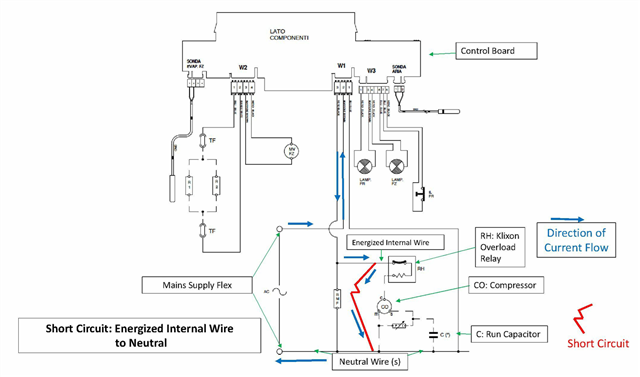
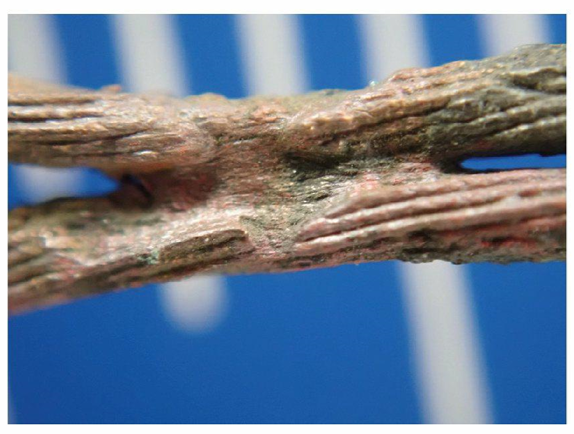
Figure 5 shows what appear to be two multi-strand conductors which have fused together due to an arc. They could have been at line and neutral potential respectively.
I agree that such an event could have tripped the MCB of circuit 7. However, I am troubled by the explanation for the RCD tripping.
Smoke and smoke particles (soot) are electrically conductive. When smoke and smoke particles attack an electrical socket, the socket receivers can be affected by deposition of soot. After the 32-A MCB for Circuit No.7 tripped and prior to Mr. Kebede turning off the Main Switch at the Consumer Unit, Circuit No.8-Flat Sockets (not including those in the kitchen) as well as the RCCB remained energized. It is probable that smoke and smoke particles, having exited the kitchen before Ms. Kinfu vacated Flat 16 and before Mr. Kebede turned off the Main Switch, attacked an energized socket resulting in a current flow to the grounding socket receiver in excess of thirty milliamperes (30mA), which tripped the RCCB.
How did so much soot enter a socket? How did it get behind the shutters?
Then we have:
Mr. Kebede states, however, that when he left his flat, the smoke had not spread beyond his kitchen [Paragraph 76, IWS00000490].
But he had opened the main switch. So there is an important inconsistency here.
Then we have in (paper) page 516 of the report which Mike linked, In my view it is better to accept that it is not possible within the scope of this Inquiry to identify with confidence the precise nature of the defect in the large fridge-freezer which caused the fire.
The real issue was to do with the cladding.
I have to say, with the assistance of Occam's razor, that there had to be a L-E fault in the fridge-freezer, and it tripped both the MCB and the RCD.
It follows that an AFDD would have added nothing.
I am struggling a bit with the addendum to Dr Glover's report.
I can see that. Unfortunately, without being able to fully examine the evidence, I'm unable to help further ... because it would simply be a set of hypotheses.

We shouldn't need to kill people first, so as to gather evidence to allow our selves to be safer. We do have to match that tendency to being scared of our own shadow, to decide about ALARP (as low as reasonably possible), or other 'value of a life' etc. financial measures of safety.
It is a 'gamble'. We are happy to pump prime commercial industries for gain (the early funding for wind power, solar power, etc), where that investment creates rapid learning with scale benefits, so we should be able to do the same with safety systems.
The thing about wind and solar is that they may have been expensive initially, but it was clear that they worked.
But in this case, we are requiring people to fit "safety" systems that
Is this improving anybody's safety? If it discourages people from updating an old consumer unit, because the new one is too expensive, then it's actually reducing safety. If it takes away money that could have been spent on other safety devices, then it also reduces safety.

wind and solar is that they may have been expensive initially, but it was clear that they worked
You may be remembering different, but I well remember the levels of doubt about the ability to scale wind turbines beyond the tens of kilowatts, and the pathetic solar efficiencies.
My comments about it being a 'gamble' came from a worked mathematical example from a Danish wind researcher about their pump priming of the industry [Jesper Gundermann, Technological Learning - Why Subsidizing new Technologies has Zero costs to Society, 13. April 2000, http://www.dea-ccat.dk].
Because we don't value human life we find difficulty in speculative investment in safety.
Agreed.
Suppose that the kitchen circuit had been on an AFDD. Assuming that it would have tripped before an arc had set fire to the fridge-freezer, the occupant might have tried resetting it. It would have tripped again. The appliance would have been replaced. Nobody would have been any the wiser. The success of the AFDD would have been unrecorded.
So, I think that it may be impossible to prove that AFDDs are beneficial.
Of course, if a second disaster happens with AFDDs fitted, we really are in trouble.
So, I think that it may be impossible to prove that AFDDs are beneficial.
To be honest, I think the same goes for RCDs ... and in fact most other protective measures in BS 7671.
Of course, if a second disaster happens with AFDDs fitted, we really are in trouble.
Why? I'm sure AFDDs don't come with a 100 % guarantee.
With respect to both points, it has been said elsewhere that the only way we could show benefit, would be a suitable set of statistics of fires possibly caused by arc faults (or for RCDs fatalities and life changing injuries in cases that might be classified as being covered by what we now call 'additional protection') from before the devices were in use, compared with a similar set of statistics from today ... and hopefully we see a reduction.
Pinning that reduction on the presence of the device, however, is purely circumstantial, as changes occur in other standards (such as product standards), to which the reduction could also be attributed.
So, overall, I think I'm siding with the 'it may be impossible to prove' even if we actually had some statistics to hang an argument on.
A few years ago when AFDs were being introduced I tried to find stats from America about the reduction in fires that they had produced. I could not find any meaningful data as the American data I could find assumes all electrical fires are caused by arc faults. The patent information gave very large figures for the lives that would be saved and a considerable reduction in electrical fires with corresponding $ savings and also stated that electrical fires were caused by arc faults.
I am certainly not qualified to comment on whether electrical fires can only be caused by arc faults but suspect that poor connections causing overheating without an arc may also occur.
We're about to take you to the IET registration website. Don't worry though, you'll be sent straight back to the community after completing the registration.
Continue to the IET registration site
