What would a clean-sheet set of wiring regulations look like today?

The wiring regulations and associated legislation (on sockets etc) have developed in stages over the last hundred or so years.

As a result, the way they have developed is a product of the technological development over that time and of choices that were potentially made decades ago in very different environments.

When BS1363 socket or ring mains were developed, I doubt the people about them were considering a world with inexpensive multi-poles RCBOs, 8000 series Al alloys or the electronics of today.

So, if you could start from scratch with a new wiring regulations system to best achieve affordable, effective and safe electrical systems for installation in domestic or light commercial environments, how do you think it would differ from the status quo?

Parents
  • It is an interesting thought experiment to consider how things might have been done differently if it wasn't for historical accident..

    Years ago we weren't that fussed about ADS, just made sure that everything was solidly earthed. If we'd continued down that line we might now have c.p.c.s that a 4x the c.s.a. of the line conductors (so even during earth faults exposed parts remain below 50V) and probably concentric earth cables (perhaps think SWA but with copper armour strands) so far less reliance on RCDs etc.

    Part of the idea behind ring circuits was instead of having multiple final circuits, you run the distribution circuit to the socket and have a final circuit for each appliance (far better discrimination, and better use of resources as copper is shared between different uses, making the best use of diversity). Ideal when you want lots of sockets for relatively low power appliances. Had we carried on in that vein, especially with the vast increase in the number of appliances, we might have ended up with domestics based on something more like flush dado bus-bar trunking with sockets just clipped in where ever they're wanted, no lighting circuits, just a FCU in each room for the lights, and possibly high demand appliances like cookers and showers tapping into the same system. So no CU as such, just one or two big fuses (maybe one per floor).

      - Andy.

  • I've thought quite a bit about this over the last few days.

    It'd be a very interesting way to do things, although a CPC with a quarter the linear resistance of the phase conductors could get very expensive.


    If all copper we'd end up with 6mm2 cooker circuits with a total copper area of ~36mm2, which is getting towards some feeder cables!
    I suppose they'd be a big drive in favour of three phase circuits in that regard, because replacing a 45A single phase with 16A three-phase circuit would reduce the copper area to 4x1.5+6 = 12mm2. Time for three phase radial socket circuits with different sockets on different phases?

    It would be even worse for truly chunky whole-floor rings I would think. 16mm2 of phase conductor area would have a total copper area of 96mm2!.

    I suppose you could try something like the American "MC-AP" cable from Southwire. That uses copper phase/neutral conductors with an aluminium earthing conductor which is in intimate contact with an interlocking aluminium armour sheath.

    Hard to get concrete figures, but a 10AWG (~5.3mm2) copper single phase cable has an 8AWG (8.4mm2) continuous aluminium conductor in contact with aluminium armour that is something like 26mm2 of cross section. So total of 34mm2 of CPC.

    Even adjusting for aluminium vs copper and the armour being interlocking rather than a welded tube,  that probably gets close to what you suggest! Just a thought.

    Probably easier to work with than pyro, which would achieve the 4x CSA requirement more or less by default.

  • Well the old lead sheathed paper was a  bit like that - a massive outer covering compared to the cores. 
    Like Wensleydale, I do like a bit of pyro but not unlike SWA, the mechanical skills to install it well are in short supply. 

    Given we can do ADS, and the RCD has been invented, luckily we don't need it any more, I do like the idea of a distributed CU, with fuses at the light switches or lighter loads.

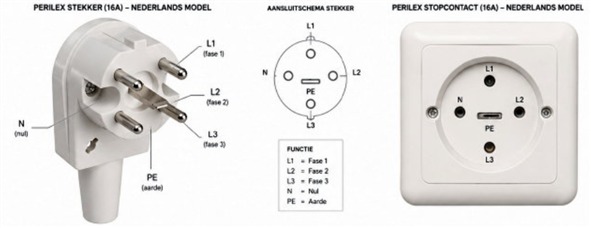
    Personally I'd also be up for 3 phase sockets, no need to keep phases in separate rooms. There seem to be no great excess of phase to phase accidents and these 16A 3 phase things are moderately common in domestic Dutch kitchens for cookers and larger instant water heaters

    I think we tend to put 3 phase on a pedestal of being in some way harder and more dangerous to do than single, yet in terms of difficulty,  in many ways 4 thin cores fused at a lower level, are easier than 2 fatter ones backed by a higher PSSC.
    regards Mike.
    PS some other Dutch kitchens wire the same style of connector as 2 ganged single phases so a meter is useful.

Reply
  • Well the old lead sheathed paper was a  bit like that - a massive outer covering compared to the cores. 
    Like Wensleydale, I do like a bit of pyro but not unlike SWA, the mechanical skills to install it well are in short supply. 

    Given we can do ADS, and the RCD has been invented, luckily we don't need it any more, I do like the idea of a distributed CU, with fuses at the light switches or lighter loads.

    Personally I'd also be up for 3 phase sockets, no need to keep phases in separate rooms. There seem to be no great excess of phase to phase accidents and these 16A 3 phase things are moderately common in domestic Dutch kitchens for cookers and larger instant water heaters

    I think we tend to put 3 phase on a pedestal of being in some way harder and more dangerous to do than single, yet in terms of difficulty,  in many ways 4 thin cores fused at a lower level, are easier than 2 fatter ones backed by a higher PSSC.
    regards Mike.
    PS some other Dutch kitchens wire the same style of connector as 2 ganged single phases so a meter is useful.

Children
No Data