What would a clean-sheet set of wiring regulations look like today?

The wiring regulations and associated legislation (on sockets etc) have developed in stages over the last hundred or so years.

As a result, the way they have developed is a product of the technological development over that time and of choices that were potentially made decades ago in very different environments.

When BS1363 socket or ring mains were developed, I doubt the people about them were considering a world with inexpensive multi-poles RCBOs, 8000 series Al alloys or the electronics of today.

So, if you could start from scratch with a new wiring regulations system to best achieve affordable, effective and safe electrical systems for installation in domestic or light commercial environments, how do you think it would differ from the status quo?

Parents
  • Standardisation of wiring colours would be a useful step. Green/Yellow for ground/earth is almost there but the rest of the colours are scattered in function between the different countries. If I remove a light fitting in my Swiss apartment I may find a black wire and a yellow wire. The black is phase, the yellow is neutral. 

    Redefining any of the current colours would merely increase the already huge legacy problem Confused

  • We have coped on a 60 A fuse for years and, frankly, if you are above that level for a significant amount of time, your leccy bill is going to be eye-watering.

    I'm sure that 60A was plenty when my house was built in 1968. But now it's starting to look a bit weedy.

    If I plug the car in to charge (7.2kW*) and take a shower (7.5kW), then that's the entire supply capacity for the house.

    I'd like to install an A2A heat pump one day, in place of the gas central heating. But that's another large load that could be running for hours on end. Plus I would have to use the 3kW immersion heater overnight for the hot water.

    Realistically, any new house should be wired 3 phase, and maybe an upgrade programme for older houses that need it.

    *Actually my EVSE is currently set to 5kW, for reasons.

  • I'd like to install an A2A heat pump one day, in place of the gas central heating.

    In which case you'd have the option of using the HP for (pressurised) hot water too - so no need for the instantaneous electric shower - so that's 32A freed up (before diversity).

    In France, I gather, instantaneous electric showers as we know them are practically unheard of (because of their 32A or 40A single phase supply limitation) - their way of doing an electric shower is an immersion heater in a pressurised cylinder run off-peak - generally more expensive to install, but better flow, cheaper to run and fits naturally between larger daytime loads like cooking.

       - Andy.

  • If I plug the car in to charge (7.2kW*) and take a shower (7.5kW), then that's the entire supply capacity for the house.

    Surely, you can arrange your routine so that you charge the car and shower at different times. ;-)

  • I agree that load control has an important part to play, but I think one of the most important advantages of electricity is that the householder can use lots at once if they need to. I'd be very worried about diluting that advantage. After all, decarbonisation will require people to use a great deal more electricity than they have before, even if the heat pump rollout delivers everything that is promised.

    We could quite easily end up in a situation where we have a 32A car charger and a ~20+A heat pump running continuously for hours. Especially if the 7kW charger load swaps between two vehicles in sequence. That wouldn't leave much for things like a cooker on a 60A or even a 100A system.

    I would think that any future supplies should be based on 2 or 3x100amp supplies.


    We do have an example of a highly electrified society, in Quebec. Now obviously their heating loads are way more extreme than in the UK, especially in a heat pump future, but they also don't have huge penetration of electric cars there. 

    Typical electrical installs there are 240/120V split phase systems with 200A on each side. That's something equivalent to a 200A supply in the UK.

    I don't think the terminations or the cost of the cable is really a major driver on supply cables, so I see little reason not to provide people with a three phase supply. I think we should be aiming for major growth in electricity use as it displaces all other fuel sources, after all, using more is a good way to make electricity cheaper by amortising fixed costs - doubling the rating of a distribution system doesn't double its capital  or operating cost after all.

    Do French Linky type meters simply open the contactor instantaneously if the current flow goes over a set limit, or are they sophisticated enough to run a current history model?

  • Do French Linky type meters simply open the contactor instantaneously if the current flow goes over a set limit, or are they sophisticated enough to run a current history model?

    The traditional French approach to was for the supplier (EdF) to supply a kind of adjustable 500mA RCBO (like this: www.manomano.co.uk/.../itron-400020-differential-circuit-breaker-edf-2p-60a-500ma-selective-sdb-ii-500-60a-s-6422703 ) at the demarkation point - the 500mA RCD provides a starting point for ADS (as their supplies are all TT) and the little window shows the current setting - usually 30, 45 or 60A I think. I believe the current setting is sealed and if tripped it's a call to the supplier to get it reset (and repeat offenders are 'offered' a higher (more expensive) option. I presume the underlying mechanism is similar to the thermal element of an MCB, but that is a guess.

    I don't know if they're sticking with the same approach with smart meters.

       - Andy.

  • We do have an example of a highly electrified society, in Quebec. Now obviously their heating loads are way more extreme than in the UK, especially in a heat pump future, but they also don't have huge penetration of electric cars there. 

    Typical electrical installs there are 240/120V split phase systems with 200A on each side. That's something equivalent to a 200A supply in the UK.

    The economics are very different though, Quebec has what are to British eyes, almost unbelievably cheap domestic electricity rates of around 7 CAD cents per kWh, that's about 3.5p/kWh. After the first 40kWh per day, that rate rises to the giddy heights of 11 cents, so 5.5p/kWh !

    At those kind of prices, simple resistive heaters and storage heaters are a competitive form of heating.

    With British domestic electricity unit rates around 5X that, the cost aspect will act to constrain demand in Britain.

  • Well yes, Quebec electricity rates are so low as to almost justify the old claim of electricity "too cheap to meter".

    There is actually a cheaper tariff than the one you suggest if you have an auxiliary heat source to use in deep winter (defined as when the thermostat in your meter cabinet reads less than -12C!). That gives you 5.3 canadian cents per unit the rest of the time,  albeit with the cost of 30 canadian cents below -12C.
    There is a reason  that Quebec has as many private pools per capita as California.

    Whilst rates are in Ontario are much greater, they too have a time of use tariff with an overnight rate of only 3.9 canadian cents, or 2.1 pence per unit. That is a heavily nuclear dominated system, with their regular rates about 12 cents canadian per unit.

    Off peak electricity will be extremely cheap in a renewable dominated system,although the times when it is used may be unpredictable.

    If significant nuclear capacity is built it will be almost free. I believe before electricity market liberalisation, the "Option TEMPO" six-rate time of use tariff provided by EDF varied from 50 eurocents per unit to only 3.

    We won't reach canadian levels, but the average electric car charging load will be something like 10GW, based on existing car mileage. If car mileage goes up due to low marginal costs, it will be more. We should expect radically more use than before, and this will probably drive down unit costs by amortising fixed costs.


    EDIT: The cost delta per unit between my energy providers 'Economy 5' EV tariff and gas is getting much smaller than it has been in the past....

  • After all, decarbonisation will require people to use a great deal more electricity than they have before, even if the heat pump rollout delivers everything that is promised.

    Indeed. Average gas consumption in UK seems to be about 4 times as much as electricity. In our household, it is about 10 times as much, but we use gas for heating (including water) and cooking.

    I would think that any future supplies should be based on 2 or 3x100amp supplies.

    Future houses should have a very much reduced heating burden as well as solar, so that may not be necessary. I'd certainly specify 3-phase for a self-build.

  • After all, decarbonisation will require people to use a great deal more electricity than they have before, even if the heat pump rollout delivers everything that is promised. 

    That might  be far harder then you imagine. If you envisage the ADMD rising to anything above about about 8 amps per house, then every substation, every HV main and all the kit that supplies it will have to be re-done or at least re-configured. Just because all houses in the street have a 60/80/100A fuse next to the CU does not mean the street can supply that to each of them without catastrophic failure.  60-80 houses per phase on a half megwatt unit, fused at 400A /phase is a typical set-up on a modern-ish housing estate, older ones are less generous. An "all-electric" estates may increase that  half up to a one megawatt transformer, and then two branches of 400A each doing half the houses.
    Given the speed with which we are still removing pre-war fused neutrals and looped supplies from terraces wired up in the early 1900s, I'm not sure we'll have the capacity to get your desired 3 phase to the house in time for the gas running out completely, let alone just getting rather expensive, as it is now.
    The cheapski method is to up the voltage and transform at both ends, but that is not as easy as it sounds either. (though uplifting 11kV routes to 33 has some appeal, it is still a lot of substations to change).
    So in the short term while we do that, probably only the first couple of decades, we either need heat pumps to be pretty efficient,  or to go back to a pre- central heating mentality, and learn to knit our own jumpers.

    Mike

  • If you envisage the ADMD rising to anything above about about 8 amps per house

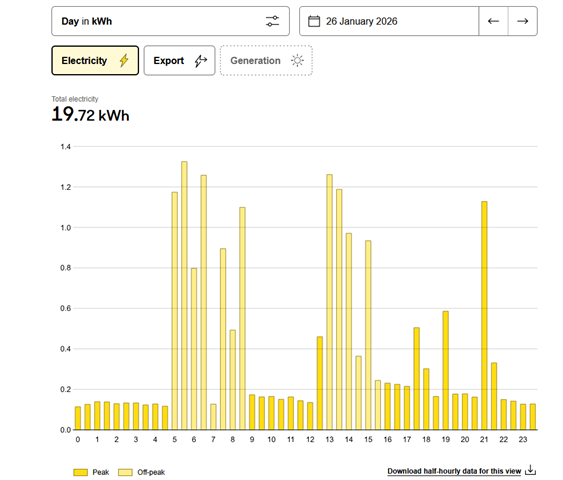
    I put in a heatpump to replace the ageing gas boiler about a year ago, so we're "all electric" now (other than not having an EV yet) - cooking is all electric and the gas has been disconnected. Even on the worst day I can find data for (Jan 26th) we used less than 20kWh with the highest half-hour reading of 1.3kWh - so less than 12A over that half hour- and that level only lasted a couple of hours - the average over the day is still below 4A.


    The place is pretty well insulated & airtight though - which probably makes a significant difference - but that's the sort of thing that can be replicated elsewhere if people have a mind to.

    Adding in say another 7kWh a day for an EV - if it could be spread sensibly between other loads - could still work. After all 27kWh over 24 hours is still below 5A average.

      - Andy.

Reply
  • If you envisage the ADMD rising to anything above about about 8 amps per house

    I put in a heatpump to replace the ageing gas boiler about a year ago, so we're "all electric" now (other than not having an EV yet) - cooking is all electric and the gas has been disconnected. Even on the worst day I can find data for (Jan 26th) we used less than 20kWh with the highest half-hour reading of 1.3kWh - so less than 12A over that half hour- and that level only lasted a couple of hours - the average over the day is still below 4A.


    The place is pretty well insulated & airtight though - which probably makes a significant difference - but that's the sort of thing that can be replicated elsewhere if people have a mind to.

    Adding in say another 7kWh a day for an EV - if it could be spread sensibly between other loads - could still work. After all 27kWh over 24 hours is still below 5A average.

      - Andy.

Children
No Data