


Is this derating of busbar is correct? As instead of 4000A, we now get only 2962A
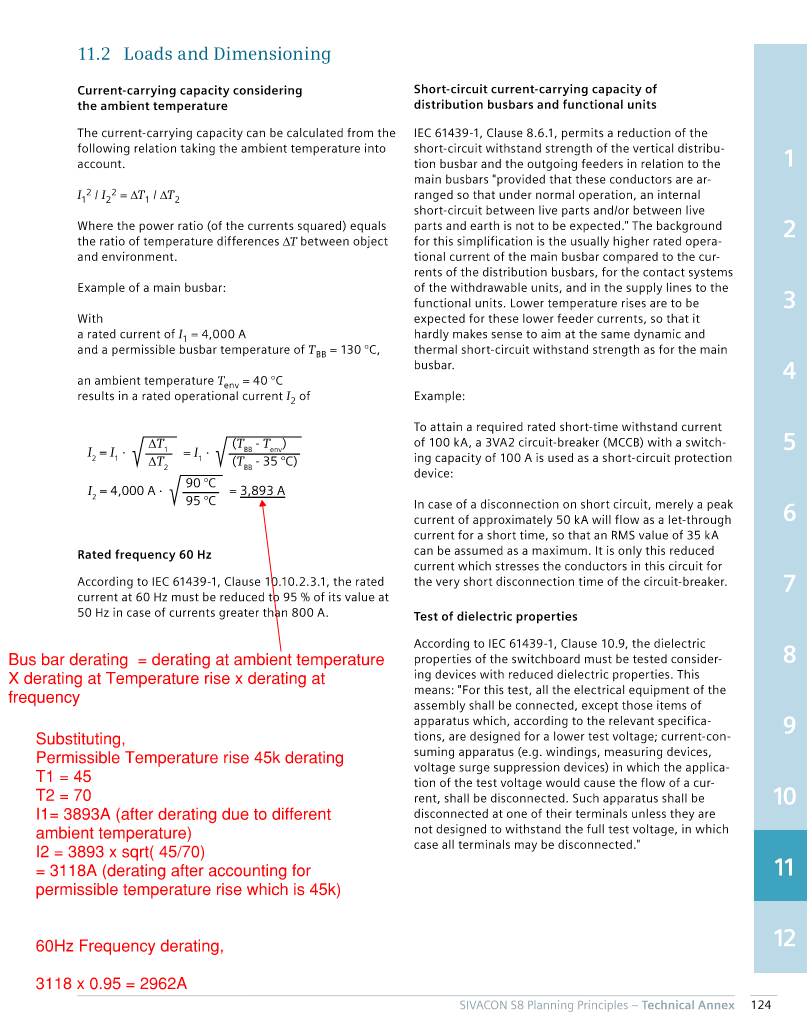
Is this derating of busbar is correct? As instead of 4000A, we now get only 2962A
Edit: our spec calls for temperature rise of 45k and the 70k in the equation is assumed to be the manufacturer tested temperature rise

Err possibly. ;-)
Lets understand where those formulae come from - they hide a few assumptions which may or may not be correct in your case.
I presume the busbar is plastic coated,or plastic parts are in contact with it, and that sets the 135C upper limit with the maximum current flowing for a long period. Its not the same as a fault rating, that can be quite a bit hotter if the ADS is prompt.
Here temperature rise is assumed linear with power, which is a bit dodgy, as convection increases the air circulation and then the rate of cooling with increasing temperature gradient.
Secondly that power dissipated is assumed to be proportional to the square of current, that is neglecting the fact that the resistance rises a bit when hot.
Maybe these two cancel to a degree.
Are you using 60Hz ? At higher frequencies the magnetic forces push the strands of current apart more noticeably, so the more current flows near the outer surface than in the core. At 50Hz in copper that 'skin depth' is a touch under 10mm and more like 8.5mm at 60Hz so in really thick conductors less of the core is used. Flat bus-bars (thin compared to the skin depth) don't have the same problem and the DC 50 and 60 Hz ratings are the same.
Then, only then one must ask what is the thermal condition for the 4000A rating, and how much is that different in your use case. I'm not too sure from your question what those conditions actually are..
Mike.
Err possibly. ;-)
Lets understand where those formulae come from - they hide a few assumptions which may or may not be correct in your case.
I presume the busbar is plastic coated,or plastic parts are in contact with it, and that sets the 135C upper limit with the maximum current flowing for a long period. Its not the same as a fault rating, that can be quite a bit hotter if the ADS is prompt.
Here temperature rise is assumed linear with power, which is a bit dodgy, as convection increases the air circulation and then the rate of cooling with increasing temperature gradient.
Secondly that power dissipated is assumed to be proportional to the square of current, that is neglecting the fact that the resistance rises a bit when hot.
Maybe these two cancel to a degree.
Are you using 60Hz ? At higher frequencies the magnetic forces push the strands of current apart more noticeably, so the more current flows near the outer surface than in the core. At 50Hz in copper that 'skin depth' is a touch under 10mm and more like 8.5mm at 60Hz so in really thick conductors less of the core is used. Flat bus-bars (thin compared to the skin depth) don't have the same problem and the DC 50 and 60 Hz ratings are the same.
Then, only then one must ask what is the thermal condition for the 4000A rating, and how much is that different in your use case. I'm not too sure from your question what those conditions actually are..
Mike.
We're about to take you to the IET registration website. Don't worry though, you'll be sent straight back to the community after completing the registration.
Continue to the IET registration site