Regulation on surface mounted cabling and wall penetrating cables for building entry call unit in a block of flats

Dear Engineering folk,

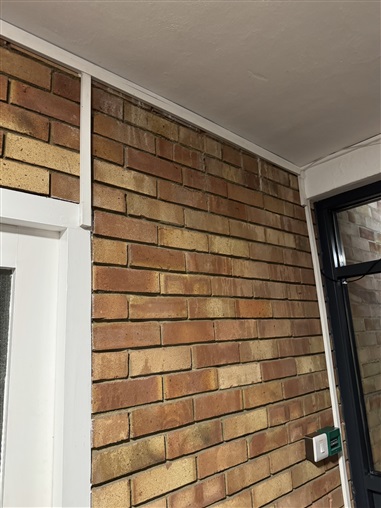
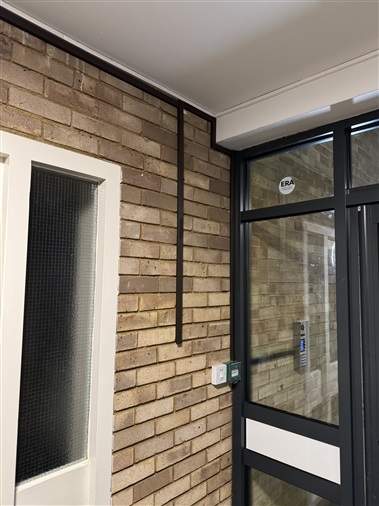
To enable new fire doors to be installed in 60 flats, across 5 buildings, some entry system cabling is currently penetrating existing door frames, so has to be moved.

The surface cabling is surface mounted in mini-trunking in the common hallways.

Two main questions:

  1. Can the existing cable be removed from the door frame and re-drill new cable penetrations into the brick wall, to connect the handsets, avoiding the new certified door frames?  Photograph 1 and 2.
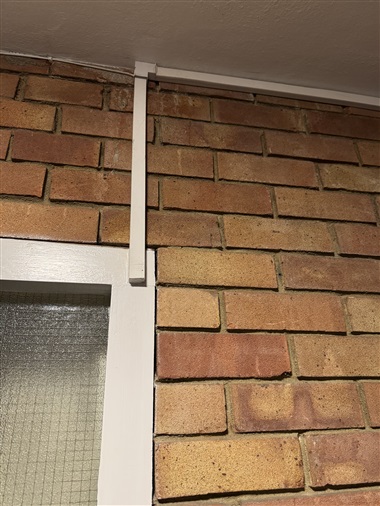
  2. There are other buildings with recently installed call units, using surface mounted mini-trunking (brown) and wall penetrations - is this allowed?  Photograph 3.

If the above is not permissible, what should be done instead and can you point me at the appropriate regulation?

One building has a gsm entry call unit, so no cables, which is probably ideal, although owners seem reluctant to change from fixed wired units with video and audio.

Apologies, I do not have copies of the regulations, as I am not an electrical expert.

Many thanks,

Mark
      

Parents
  • regs wise there is nothing magical about interlock wiring. It should either follow a visible route (trunking, conduit and even surface clipped in areas of low risk are all examples of that) or if concealed under a wall surface, follow a vertical or horizontal line between fittings, or be deep enough (50mm say) not to be casually damaged by decorating or later building work work (shelves and notice boards). Or in the ceiling wall corner is considered a 'safe zone.
    Drilling a hole through brick is fine, far better than damaging the frame, I'd expect the hole to be cleaned and mastic (normal or firestop depending on location ) to stop insects and draughts, a short length of plastic tube to protect it or guide it through a cavity wall may be appropriate, this is most important if the cable jacket is soft and may be scuffed. If the change of direction is too sharp then a box can be fitted on one or both sides of the hole.
    Cables that are overhead, must be secured so as not to fall in a fire - so if there is plastic trunking stuck on a ceiling , you may need some builders band or metal clips that would stop hot sticky cable garotting someone trying to escape, and folk worry about plastic wall plugs, and like to avoid them if possible.
    That's about it ;-) 
    Mike
    Edit https://uk-store.netceed.com/thick-wall-customer-lead-in-kit-061827-p10.html is an example of special thin conduit for protecting data cables, fibres and similar through walls

  • Hi Mike,

    Thank you very much indeed for your quick response - all makes complete sense.

    My basic public research mentioned only penetrating fire compartment walls (e.g. between Flats - Common Hallways) for necessary safety kit - fire alarms, emergency lighting etc.  If you do penetrate, use fire resistant cable and intumescent sealant.  So, should that ideally be steel trunking and boxes flanged over penetration points?

    I did wonder whether the following 'guidance notes' might help me to point people at formal regs for fire prevention/control - to protect people from smoke/fire ingress into their flats/keeping common escape root clear, as well as protect the cables of course:

    Guidance Note 4: Protection Against Fire is a vital guide to an important safety aspect of working with electricity.

    Electrician's Guide to the Building Regulations includes the latest guidance relating to competent person schemes, third-party certification and covers relevant parts of the Building Regulations, including Fire Safety, Ventilation and Conservation of Energy.

    I am not a practicing Electrician, so is it worth purchasing the above to dig into fire stopping guidance?

    Thanks again for any thoughts.

    Kind regards, Mark

  • Generally, unlike big drains or ventilation, the holes for alarm cables and so on are not significantly large  in terms of spread of fire ,and the use of intumescent mastic or stuffing is normally enough - the resistance to fire in hours is something to look at - trendy downlighters cut into ceilings are often problematic.

    More generally the principles here https://www.gov.uk/government/publications/fire-safety-approved-document-b  are worth a look if not already perused. 

    If you have a lot of cable in fire escape routes you, or rather your designers, may want to specify a low smoke and fume cable for those and other confined spaces, but to then put it in a PVC trunk makes little sense. Fire alarms are usually wired in FP series cables that carry on working long after normal ones have melted. Door buzzers and so on, generally not - unless there is a critical fire escape consideration but normally things can be opened from the inside even after the power has failed.
    Mike.

    PS edit to add links - expect to see something like this sealing holes

    https://www.tlc-direct.co.uk/Products/FXFRCW.html
    wires held up by these
    fire clips
    In a really big hole maybe 
    https://www.fireprotectionshop.co.uk/product-subcategories/intumescent-pillows 
    or if you want to see the options you usually don't need,
    https://envirograf.com/product-category/electrical-and-plumbing/socket-and-conduit-protection/ 

  • Mike - this is very helpful - very much appreciated.  Your experience and pragmatic approach lands the important points very well.

    I will read the Gov approved document.

    Many thanks, Mark

Reply Children
No Data