This April and May, the spotlight is on BroadcastAsia 2026, Asia-Pacific’s leading broadcast and media event, which will showcase topics of real importance to both regional and global stakeholders. The themes selected are timely, essential, and certain to resonate with those navigating the fast-changing broadcast and media landscape.
The BroadcastAsia 2026 Conference, alongside parallel events, will be held in Singapore from May 20 to 22 at the Singapore EXPO. Over three days, the programme will span both radio and television, examining their production and distribution, as well as the ongoing consolidation of services.
The IEEE-Broadcast Technology Society (IEEE-BTS) continues its role as a supporting organisation of BCA2026. Representing IEEE-BTS as a Distinguished Lecturer, I will be producing and moderating two sessions, one focusing on radio and the other on television, featuring world-renowned industry leaders as speakers.
Radio and television commenced their migration from analogue to digital distribution more than two decades ago. Previous discussions have highlighted the challenges that accompanied these transitions, even as digital platforms introduced a wide range of advantages. Progress varies across countries, with each national market reaching different milestones in its journey.
The rise of online delivery and the growing penetration of broadband have intensified competition within national broadcast and media sectors. At the same time, global events continue to add volatility to the environment, alongside new challenges posed by emerging technologies such as AI.
I will be moderating the session, Digital and Hybrid Radio for Future Audio Experience, which will discuss how digital radio and new creative formats are enabling universal, inclusive, and resilient service for audiences. The discussion will cover geo-location-based automatic safety alert systems, an increasingly vital tool as the world faces disasters such as floods, storms, and earthquakes with greater frequency and intensity.
As audiences are confronted with an ever-growing volume of content, finding what they want has become more difficult, while broadcasters face the challenge of retaining engagement in a fragmented market. This session will also examine how to move beyond audio, service discovery, and listener engagement, highlighting strategies to strengthen audience connection. By combining online delivery with over-the-air distribution, broadcast radio and IP can work together to deliver a richer, more dynamic listening experience. The panellists will share approaches to overcoming these challenges and to serve a wider, more diverse audience.
A session on television broadcasting services will examine how broadcasters within a country can consolidate their services. Recent surveys and research in several markets have underscored the continued importance of over-the-air broadcasting and the strong influence of advertising delivered through these channels.
The session, Content Creation & Distribution Trends Impacting Personalisation and Monetisation, will look ahead to the future of broadcast and media distribution, as well as evolving access models. As moderator, I will guide the panellists in discussing the importance of understanding cross-device viewer behaviour and the need for seamless delivery of personalised content and advertising across multiple platforms.
Just as radio audiences require effective service discovery, television viewers expect a consistent user experience across devices. Meeting this expectation demands an optimised content strategy informed by viewer data.
The session will also address personalisation, target advertising and monetisation, as well as critical issues as the industry faces funding challenges in sustaining its services.
5G broadcast has become a prominent topic of discussion, and this session will thus examine how 5G technologies can enhance broadcasting services while navigating spectrum constraints, device diversity, regulatory timelines, and other requirements.
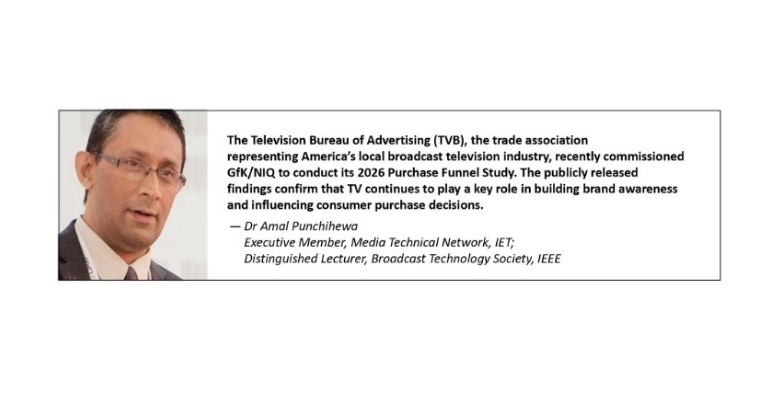
The Television Bureau of Advertising (TVB), the trade association representing America’s local broadcast television industry, recently commissioned GfK/NIQ to conduct its 2026 Purchase Funnel Study. The publicly released findings confirm that TV continues to play a key role in building brand awareness and influencing consumer purchase decisions.
The study examined more than 20 media platforms across both traditional and digital categories. Focusing on consumers in key local markets who had been exposed to advertising, the study measured the relative importance of each platform in the purchase decision process. The findings revealed that exposure alone did not guarantee influence, except in the case of television. TV emerged as the most important driver at every stage of the purchase funnel, ranking five times higher than social media and seven times higher than non-TV streaming video such as YouTube.
TV’s impact was consistent across all major demographics, including age groups, higher-income households, high-net-worth households, and ethnic groups. Greater exposure to TV advertising strengthens awareness, trust, and preference, while local TV station assets, particularly local broadcast TV news, were identified as the most trusted media platforms.
The findings also revealed that for consumers, the choice is not TV versus streaming – it is both. Even among heavy streamers, linear TV remained the most important influential driver of brand awareness. The findings of the 2026 Purchase Funnel Study highlight TV’s unmatched ability to build awareness and shape consumer decisions across all ages, income levels, and demographics.
A recent study by Sky Media has analysed the effectiveness of addressable TV advertising, revealing what it calls the “Addressable Advantage”. According to Sky Media, the analysis compared the ability of addressable campaigns to deliver more effective outcomes, greater certainty for advertisers, and measurable business growth for brands, beyond what linear TV alone can achieve. The study drew on household-level data from Sky’s five-million-home panel and examined results from 2,400 campaigns across 535 advertisers between 2020 and 2025.
Sky Media reports that addressable TV delivers stronger, more accountable results. In this context, uplift in TV advertising refers to the measurable increase in brand awareness, consideration, and purchase intent attributed to a specific campaign. It is a key indicator of effectiveness, quantified through metrics such as brand perception, aided recall, and intent to purchase. According to Sky Media, compared with linear TV alone, addressable campaigns generate a one-times uplift in awareness, a +121% increase in aided ad recall, and a three-times uplift in incremental web traffic.
The study is built on household-level outcomes rather than proxies such as award entries or market mix models. It focuses specifically on addressable TV campaigns and includes results from both top-performing and lower-performing campaigns, providing a representative view of real-world effectiveness.
Similar to the earlier study, TVB recently commissioned GfK/NIQ to conduct the 2026 Media Comparisons Study on multimedia use and effectiveness. The publicly released findings found that US broadcast TV continues to lead in both reach and time spent.
The study examined media use among US adults aged 18 and above across more than 20 traditional and digital media platforms, including free and paid ad-supported streaming services, advertising-free platforms, and user-generated or short-form content such as YouTube. It measured linear broadcast viewing across TV sets, mobile devices, websites/apps, and other digital devices to provide a comprehensive picture of broadcast assets.
Beyond reach and time spent, the study also explored which news sources audiences consider most trustworthy, and the extent of community involvement fostered by broadcast.
To share some of the key findings of the study that may provide greater confidence and leverage, the study confirmed that television, viewed on a TV screen, delivers the highest reach and time spent across all age groups and categories measured. Most viewers are reached through broadcast TV, with linear TV viewing primarily done on TV sets, though not exclusively. Local broadcast TV emerged as both the most turned-to and most trusted source for local news, while TV advertising was shown to motivate audiences to conduct further research online.
The analysis also found that more time is spent with broadcast TV across all devices than with cable or streaming programmes, and respondents spend significantly more time on broadcast TV than on user-generated and short-form content such as YouTube. Broadcast assets collectively reach nine out of ten adults aged 18 and above, with broadcast websites and digital viewing adding more reach than cable and ad-supported video-on-demand (AVoD). Nearly half (47%) of respondents cite local broadcast TV assets as the most involved in their communities.
When examining long-form ad-supported programming, linear TV accounted for 68% of viewing time compared with 32% for streaming. Broadcast also reached 94% of ad-supported streamers who watch on their TV sets, and even among ad-free streamers, broadcast assets reached 92%.
Together, these three studies provide a wealth of insights that will inform the BCA2026 Conference sessions, offering valuable perspectives to better understand the APAC landscape and guiding broadcasters as they navigate evolving challenges and opportunities.
On behalf of APB+ and IEEE-BTS, I look forward to welcoming you to Singapore from May 20 to 22 at Singapore EXPO for BroadcastAsia 2026 and its related events.
I wrote this article in late March/early April 2026 and published it in a monthly article of the APB+ publication.
This is an article published on 02 April by APB+DistributionNews & Events
Written by a Member of the Executive Committee of MTN, FIET and CEng of IET, Distinguished Lecturer and Senior Member of IEEE-BTS and FEngNZ.