Summary: The information density of professional-level training is often too high and, therefore, not conducive to learning. To create highly effective learning, we must define realistic expectations, start with the simplest possible framework, and progress slowly.
Imagine that you’re at a typical conference. It’s been a full schedule and you have already seen several talks. Now you are in yet another presentation of post-doctoral level complexity and the speaker tells you “as you can see in this slide…”.
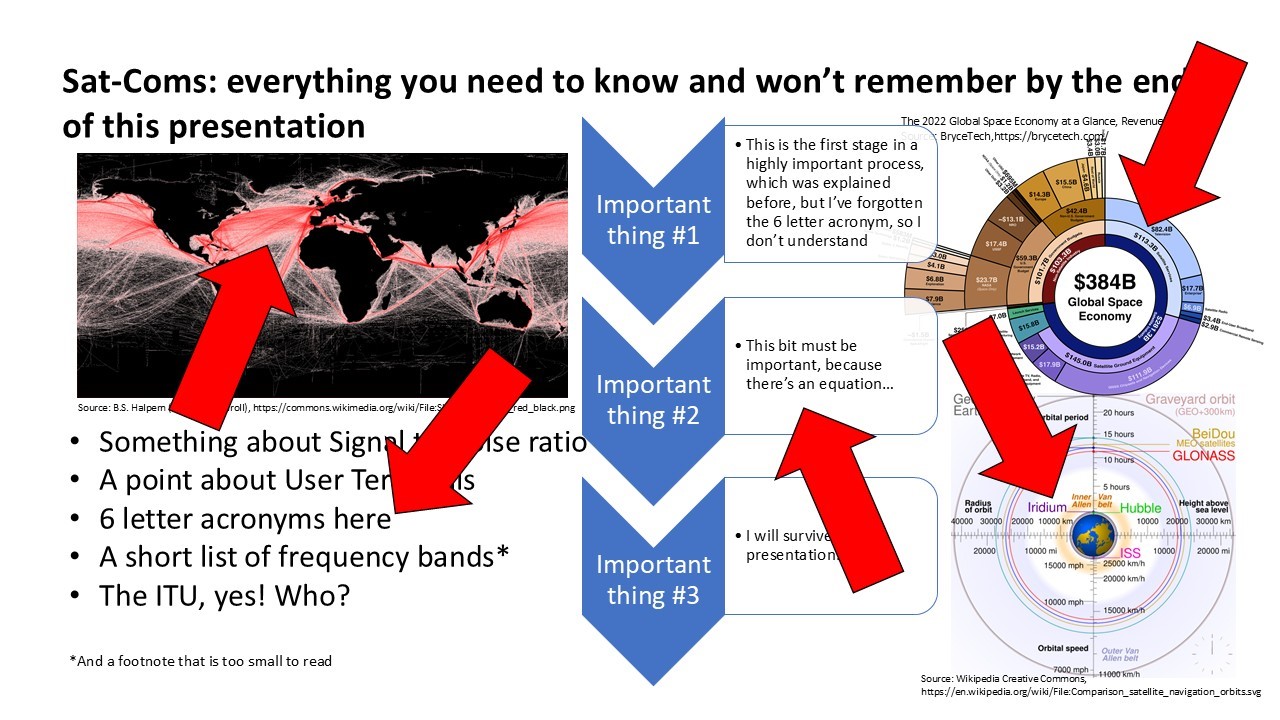
You and everyone else in the room leans forward slightly, squints, and scans the slide quickly, hoping that what “you can see” will become visible. It doesn’t. Despite everyone’s efforts, among the text, charts, diagrams, and font size 6 annotations, which fill the slide, no one can see it.
Like an insurance policy, there is just too much information to take in. Several days and hundreds of slides, charts, diagrams, and font size 6 annotations later, you return home. Most of that information has faded forever from your mind.
And that is the normal human response.
At a conference this may not be important. One can argue that the most valuable part of a conference is the opportunity meet and engage with peers, not the presentations.
However, when we consider a training programme, the effect of each session is highly important. Despite this importance, professional-level training programmes are much like conferences: attendees are bombarded with information, so much so that they leave without remembering much.
Imagine now that you were to attend a beginners’ lesson in a foreign language. It’s reasonable to expect that, after a 2-hour class, one would learn to say something rudimentary, like “Hello, I like apples.” Any good language teacher knows this and will structure the class to start simply. If the teacher presented everything about the language, he or she would demonstrate his or her knowledge and yet teach nothing.
Human languages are complex, so much so that to achieve fluency in a language can take years. Similarly, professional-level skills and knowledge are complex. To become proficient in such skills, may also take years.
In the sat-comms sector there is certainly an information density problem. Sat-comms training is presented like at a conference, with too much information presented too quickly. The human mind simply cannot absorb the information.
A more effective approach to sat-comms training is to mimic language training. We must start with the simplest possible framework and through a process of learning, trying, and reviewing, we can become more skilled.
If we want high-performance organisations, we need high-performance people. And for that we need to invest in better sat-comms training.