With the theme “Shaping Media Revolution & Production Beyond Boundaries”, BroadcastAsia 2026 reaffirmed its place as a significant fixture in the Asian broadcast and media calendar.
Held from May 20 to 22 at the Singapore EXPO — where the IEEE Broadcast Technology Society, a not-for-profit professional membership organisation of broadcast engineers, was once again a supporting organisation — the event marked 36 years since BroadcastAsia made its debut on 29 May 1990 at the World Trade Centre Singapore. Over four decades, it has been a privilege to monitor the evolution of the broadcasting industry, both regionally and globally.
With an estimated 20,000 attendees from over 110 countries, BroadcastAsia 2026 cemented Singapore’s role as one of the region’s key hubs for broadcast and media technology innovations.
As in previous years, BroadcastAsia 2026 served as the premier gathering for Asia Pacific’s broadcast, media, and entertainment professionals — a platform where the industry’s key players converged to explore cutting-edge technologies, connect with leaders and opinion-makers, discover new solutions, and gain the insights needed to navigate a rapidly changing media landscape.
BroadcastAsia 2026 was held as part of ATxEnterprise, organised by Informa Tech and the Infocomm Media Development Authority (IMDA) of Singapore, bringing together conferences and exhibition booths spanning broadcast media, information and communications technology, satellite operations, and innovative start-ups across the B2B technology landscape.
ATxEnterprise encompasses a broad portfolio of industry events — BroadcastAsia, CommunicAsia, SatelliteAsia, Tech Leaders Forum, AI for Enterprise, DevelopersXperience, and CISO Briefing — anchored this year by the AI Summit Singapore, reflecting Singapore’s ambitions to establish itself as a leading hub for AI innovation in the region.
The event also featured the annual Asia Pacific Broadcasting (APB+) Awards. Now in its fourth successive year; the award recognises innovation and excellence across the broadcast industry.
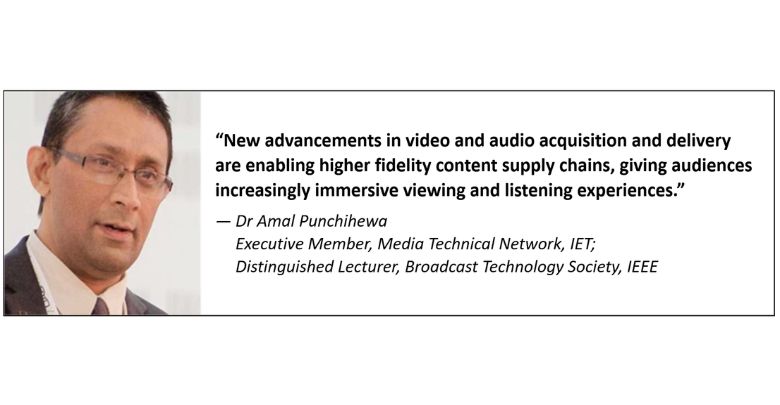
New advancements in video and audio acquisition and delivery are enabling higher fidelity content supply chains, giving audiences increasingly immersive viewing and listening experiences. At the BroadcastAsia conference, technology leaders shared the latest innovations driving this shift, from high dynamic range (HDR) and high-resolution video to spatial audio and other cutting-edge formats that are redefining live event coverage and pushing the boundaries of what audiences can experience at home.
The exhibition catered to a broad cross-section of the industry. Broadcasters gained insights into the technology and market trends shaping Asia’s media landscape, while reconnecting with regional peers to discuss strategies for navigating the future of broadcast.
Solution providers, meanwhile, had the opportunity to assess the impact of an evolving and consolidating media ecosystem on their businesses, engage with key decision-makers, and track investment trends across the broadcast and media sectors in APAC.
Based on general feedback, BroadcastAsia 2026 delivered meaningful engagement, quality leads, and a renewed sense of momentum for the region’s broadcast and media technology ecosystem.
The IEEE Broadcast Technology Society designed and moderated two conference sessions with global experts at BroadcastAsia 2026. The first, held on May 20, focused on television broadcasting; the second, on May 21, addressed radio broadcasting.
The television session, titled “Content Creation & Distribution Trends Impacting Personalisation and Monetisation,” brought together panellists to discuss a range of interconnected themes: the future of broadcast and media distribution and access; cross-device viewer behaviour; multi-platform delivery of personalised content and advertising; service discovery and consistent user experience across platforms; content strategy optimisation through viewer data; targeted advertising and monetisation; 5G broadcast technologies; and the alignment of spectrum, device, and regulatory timelines.
On the second day of the BroadcastAsia 2026 conference, the IEEE Broadcast Technology Society moderated a dedicated radio session.
The session examined how digital radio and new creative formats are now enabling universal, inclusive, and resilient services for audiences. Discussion centred on four key areas: geo-location-based automatic safety alert systems; thinking beyond audio and service discovery; enhancing listener engagement; and the convergence of broadcast radio and IP to deliver a richer listening experience, although the conversation ranged well beyond these themes.
The session featured two panellists from not-for-profit professional membership organisations dedicated to advancing radio through new technologies, services, and standards: Nick Piggott, Project Director of RadioDNS, and Bernie O’Neill, Project Director of WorldDAB.
The discussion explored where digital broadcast radio — including DAB+ — fits into the future audio ecosystem as audio becomes increasingly connected and platform-driven.
The panellists, with me as the moderator, reaffirmed why radio still matters — why it remains a trusted, universal, free, and resilient service. Despite it being so, the medium faces real challenges as audio consumption grows more fragmented and platform-controlled. And despite this, broadcast retains a unique strength in universal, one-to-many delivery that no other medium can replicate at scale.
A key theme was that the future lies in a complementary blend of broadcast and IP, instead of a choice between them. O’Neill highlighted DAB+ as a modern digital broadcast infrastructure built for mobility and automotive environments, noting that once broadcasters have resilient broadcast delivery as a foundation, hybrid technologies can build far richer listener experiences on top of it.
Piggott concurred that broadcast and IP are most powerful when used together, each playing to its strengths. He noted that RadioDNS sets the technical standards for enhancing broadcast radio with IP connectivity, working across all major broadcast standards, including DAB, HD Radio, and FM.
O’Neill offered a concrete example of digital radio moving from concept to deployment, walking the audience through Automatic Safety Alerts (ASA) over DAB+. ASA is geo-targeted, capable of automatic wake-up and switching, and designed for scalable one-to-many communications.
Germany is currently in the process of ASA implementation, while France is actively testing the system. O’Neill also noted growing international interest and collaboration across broadcasters, regulators, and the automotive sector — a sign that ASA is gaining serious traction beyond its early adopters.
Piggott explained how hybrid broadcast radio can coexist alongside pure IP streaming applications. He argued that radio should be the most prominent and accessible audio option in the car — positioned at the top of the in-vehicle navigation interface. By linking listeners directly from live broadcast radio into a station’s own on-demand app, hybrid integration removes the friction of navigating app stores, making it far easier for audiences to move between live and on-demand content from the same station without interruption.
O’Neill closed with a compelling argument for digital radio’s evolving role, “ASA shows that digital broadcast radio is no longer just about entertainment — it is becoming part of critical national infrastructure. In moments of crisis, people do not care about platforms; they care whether trusted information reaches them quickly, reliably and universally.”
Piggott was equally direct in his closing remarks: “We can’t ignore IP and apps, but we can embrace them and make them a complement to broadcast. Broadcast is still the fastest, easiest way to start an audio journey in the car, but we can guide that journey into the station’s own IP apps.”
The next instalment of this column will present and analyse the discussions from the IEEE Broadcast Technology Society’s television panel, which coincided with Freeview New Zealand’s official announcement of its next-generation distribution service based on DVB-I — the culmination of close to two years of preparation.
This is an article that I have written and published in June that analysed a session I, member of Executive committee of Media Technical Network of IET and Distinguished Lecturer of IEEE Broadcast Technology Society, produced and moderated on Radio Broadcasting at the BroadcastAsia2026 (which is like IBC in Europe)
You can access the original article on https://apb-news.com/asa-asap-digital-radio-not-about-entertainment-but-a-critical-part-of-a-nation-info-infrastructure/.
Published on 18 June 2026 11 AM NZ time
By Dr Amal Punchihewa