“Storytelling” has become the defining buzzword of the moment, and NAB 2026 captured this well with the theme of “Where Media, Entertainment & Storytelling Converge.” Broadcasters and the media industry have spent over a century telling stories and delivering entertainment, from over-the-air radio and television to today’s online services.
Previously, we examined the funding challenges facing broadcast and media operations and the complexities of navigating a disrupted ecosystem. Audiences and markets continue to respond, while regulators work to establish a level playing field for all stakeholders. Research, surveys, and critical studies are increasingly shaping the broader broadcasting, media and entertainment (M&E) landscape.
Across every industry, including media and broadcast, there is a strong belief in the power of data, yet translating that belief into measurable impact remains a challenge for most organisations. As noted in previous articles, the value of insights generated from data is only as strong as the data itself, making the collection process and the clarity of definitions critical from the outset.
Effective studies begin by defining the right questions, then identifying the data points needed to answer them. Without that purpose, dashboards multiply, but strategies stall. Processed data should drive decisions, not merely record historical performance. Metrics that only look backwards are not enough to shape the future.
Media companies sitting on abundant data are often drowning in it, with little of it adding real value to their operations. Data gathering should focus on measuring what matters most and prioritising metrics of greatest strategic importance rather than those that are simply easiest to measure.
This challenge is at the heart of the latest report from Digital Production Partnership (DPP), which finds that while data is abundant, its impact remains uneven.
The report suggests media companies are “drowning in data but lacking alignment” and calls for greater “data coherence” across four key areas of the media business: management and operations, audience engagement, business strategy, and the technology foundations that support them.
The report, Making Data Pay, drew on input from over 70 contributors representing 19 content organisations and 19 vendors. Despite significant investment in data capabilities, many organisations are still struggling to translate that investment into measurable impact.
The study examines where data is already delivering value, where complexity is emerging, and the practical lessons the industry has learned so far.
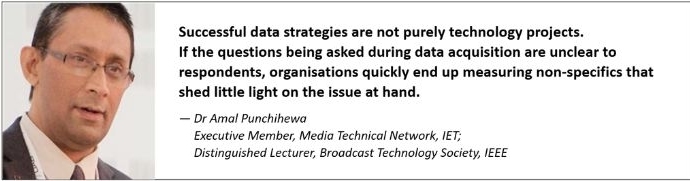
Successful data strategies are not purely technology projects. If the questions being asked during data acquisition are unclear to respondents, organisations quickly end up measuring non-specifics that shed little light on the issue at hand.
This tension between intent and outcome extends beyond data practices into market structure. The EU connected TV (CTV) operating system market has grown increasingly concentrated around large ecosystem platforms between 2019 and 2024. In response, 11 European broadcasting associations have jointly written to the European Commission’s Executive Vice-President for Competition, urging the Commission to act under the framework of the Digital Markets Act.
The letter stated: “With the future viability of many European TV broadcasters at stake, and with millions of EU businesses and consumers relying on CTVs to promote and access an expanding range of content via TV applications, it is crucial that the Commission designate major TV operating systems as gatekeepers and ensure adequate oversight to guarantee fairness and contestability.
“CTVs assume a central intermediary role between media providers and end-users and can therefore exercise significant influence over the discoverability, accessibility and use of media services.”
Shifting to video monetisation, a report by the FreeWheel Video Marketplace (VMR) charts the changing dynamics of how enterprise-class content owners and distributors are monetising premium digital video content. According to VMR, premium video ad views grew 11% year-on-year in the second half of 2025 across both the US and Europe, reflecting the continued and growing significance of streaming in the industry.
CTV remains the primary source of ad views in both markets, accounting for 86% of total views in the US and 50% in Europe. Targeting preferences, however, differ by region. In the US, there is a slight preference for demographic over behavioural targeting in programmatic delivery (54% vs. 46%) while Europe shows the inverse, with a 60-40% preference for behavioural targeting.
As the industry pushes for greater efficiency and transparency in the CTV Ad ecosystem, automation tools are reshaping every layer of the supply chain — from predictive AI helping publishers maximise monetisation opportunities across video-on-demand (VoD) and live inventory, to agentic AI enabling real-time, autonomous interoperability between buyers and sellers. These advancements are seen as essential to reducing fragmentation, strengthening trust, and building a more efficient and democratised streaming ecosystem.
A major challenge for free-to-air channels in horizontal markets remains poorly targeted broadcast ads, which represent a missed opportunity. What is needed is an affordable, standardised solution suited to horizontal markets that can also assess the feasibility of ad campaign measurement in offline environments.
Meanwhile, new primary research from Omdia reveals that media multi-tasking is no longer a habit confined to younger generations. More than half of adults aged 45–54 now watch video clips on their mobile phones while simultaneously watching television, highlighting a striking shift in viewing behaviour that underscores the growing fragmentation of attention across screens.
Omdia’s consumer research found that 52% of US viewers aged 45–54 reported doing so in November 2025, up from 39% in November 2022. The trend is accelerating among older viewers too, with 35% of those aged 55–64 now multi-tasking with mobile video, compared with 20% three years ago.
The first confirmed deployment of DVB-I comes from Freeview New Zealand, a move that signals a clear vision of DVB-I as the future of free-to-air TV – one that ensures broadcast content remains accessible on every screen.
By unifying satellite, terrestrial, and broadband services, DVB-I enables a truly multi-platform experience, keeping local broadcasting relevant for the streaming generation.
Emily Dubs, Head of Technology at the DVB Project, said, “What makes this launch even more impressive is its rapid pace. Only a few months ago, Freeview New Zealand joined DVB and its DVB-I Implementers Task Force, shortly after Freeview Australia and French stakeholders via the Forum Audiovisuel Numérique (FAVN), both preparing DVB-I trials.
Meanwhile, stakeholders in Ireland and Spain are progressing rapidly, following the path set by early movers in Germany and Italy.”
Global interest in DVB-I continues to grow, with adoption addressing real and specific challenges across diverse markets. Germany is finalising its launch preparations following the recent publication of the DVB-I Implementation Profile by Deutsche TV-Platform, while in Ireland, RTE has announced its own DVB-I trial.
Both DVB-I and targeted advertising in free-to-access television services will be among the topics discussed at a session produced by the IEEE-Broadcast Technology Society (BTS) at the BroadcastAsia 2026. I will be moderating this session, alongside a separate session on radio broadcasting with panellists from WorldDAB and RadioDNS.
European broadcasters have called on the EU to apply its strictest competition rules to smart TV operating systems and voice assistants, warning that platforms controlled by Google, Amazon, Apple, and Samsung are acting as gatekeepers.
In a joint letter, signatories including ITV, Canal+ and Sky argue that these platforms’ control over content recommendations and search risks distorting content discovery and undermining market fairness.
While AI standardisation work continues, AI is already transforming the newsroom. In terms of deployment, localisation services and camera automation are among the most mature applications, and real-time transcription and captioning have become standard practice.
These applications are approaching a plateau where incremental improvements remain possible, but the technology has largely reached maturity.
Attention is now turning to AI tools for production and fact-checking. The ICT industry has entered the age of edge computing, with AI running locally on devices. This is a development closely tied to the rapid advancement of large language models (LLMs) and their growing role in content production.
Canal+ has announced new partnerships with both Google Cloud and OpenAI to integrate AI into its streaming app. The French broadcaster intends to use Google Cloud’s technologies for video indexing across its content library, enabling more personalised content delivery to Canal+ App subscribers. It will also leverage Veo 3, Google’s generative AI video technology, equipping production partners and creative teams with tools such as scene pre-visualising before shooting and the recreation of historical moments from a single archival photograph.
Next month, we will examine Sora’s troubled video venture, with public reports suggesting the platform’s high daily operating costs rendered it financially unviable, illustrating the broader financial strain facing parts of the AI industry.
OpenAI is reported to be facing a US$16 billion loss in 2026, is targeting enterprise revenue to offset this, and notably saw Disney backing out of a $1 billion investment deal.
What is clear from the broader landscape is that broadcasters continue to place significant value on free-to-access broadcasting, with standards playing a key role in enabling targeted advertising as a means of sustaining funding.
Competition frameworks and regulatory oversight are increasingly being applied across broadcasting and related media services to ensure a level playing field, with smart TV operating systems and the transparency of recommendation algorithms firmly in regulators’ sights.
The growth in viewership can be attributed, in part, to broadcasters’ efforts to extend their reach via CTV and online services. Some are also exploring AI applications beyond subtitling and voice-to-text, although the impact and efficacy of these broader deployments have yet to be fully proven.
On behalf of APB+ and IEEE-BTS, I look forward to welcoming you to Singapore from May 20 to 22 at Singapore EXPO for BroadcastAsia 2026 and its related events.
It’s an opportunity to take a deep dive into the fast changing M&E world drowning in data and ready to ride the next wave of AI-driven changes to survive and thrive beyond 2030.
Once again, for this month’s article, the spotlight is on BroadcastAsia 2026, Asia-Pacific’s leading broadcast and media event, which will showcase topics of real importance to both regional and global stakeholders. The themes selected are timely, essential, and certain to resonate with those navigating the fast-changing broadcast and media landscape.
The BroadcastAsia 2026 Conference, alongside parallel events, will be held in Singapore from May 20 to 22 at the Singapore EXPO. Over three days, the programme will span both radio and television, examining their production and distribution, as well as the ongoing consolidation of services.
The IEEE-Broadcast Technology Society (IEEE-BTS) continues its role as a supporting organisation of BCA2026. Representing IEEE-BTS as a Distinguished Lecturer, I have produced and will be moderating two sessions, one focusing on radio and the other on television, featuring world-renowned industry leaders as speakers.
I wrote this article in late April/early May 2026 and published it in a monthly article of the APB+ publication.
This is an article published on 07 May by APB+DistributionNews & Events