


The future of manufacturing is being shaped by rapid technological change, from AI and automation to emerging concepts like soft robotics and even manufacturing in space. But alongside these advances sits another equally important challenge: ensuring that the people driving this innovation reflect the diversity of the society they serve.
That is why the collaboration between the IET Manufacturing Technical Network and the IEEE UK & Ireland Women in Engineering (WIE) event, Disruptive Technologies for Manufacturing and Automation, is so significant.
Taking place on 16 June, this hybrid event at IET London: Savoy Place, with online access available, brings together engineers, researchers and industry professionals to explore the technologies reshaping manufacturing. It also creates a platform to amplify voices that are still underrepresented across engineering and STEM.
Part of a much wider community
The IET’s Technical Networks are designed to bring people together through shared expertise. Spanning 18 different networks across fields such as manufacturing, energy, transport and digital systems, they enable global collaboration and knowledge sharing.
The Manufacturing Technical Network in particular has delivered a packed programme of activity this year. Topics have ranged from AI ethics and automation to clean environments and space manufacturing. With audiences in over 70 countries and more than 1,500 delegates reached in just six months, the network demonstrates the power of community-led engagement.
Crucially, these networks are volunteer-driven. They thrive on contributions from professionals across industry and academia, creating opportunities for individuals to build skills, share insights and shape the future of their field.
Collaboration
The Manufacturing Technical Network’s role here goes beyond co‑supporter and is a great example of collaboration in action, with the TN not just supporting the event, but actively contributing through its members. Magdalena Wywijas and Sadie Peacock joined as speakers and panellists with their participation highlighting what the network is really about, bringing real-world experience into the discussion and creating space for shared learning.
They were joined by a strong panel of speakers offering perspectives across technology, academia and industry, making this a genuinely collaborative event.
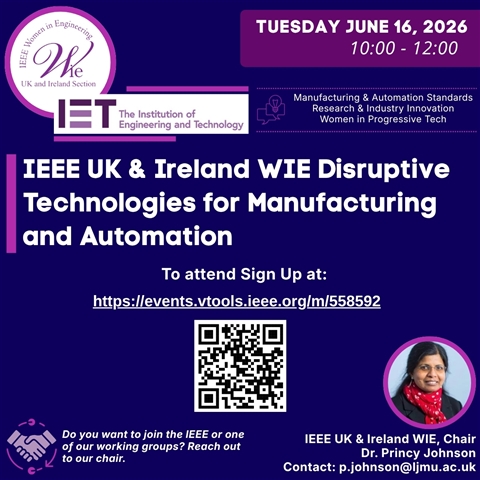
What was being discussed
When we talk about “disruptive technologies”, it’s easy to think in broad terms. But what does that actually look like in practice?
Across sessions like this, we’re increasingly seeing a mix of themes emerging:
- AI-Augmented Engineers: Leading Manufacturing in the Age of Autonomous Systems
- Advances in Human-AI Socialisation
- Automation for photocathode deposition
These technologies aren’t theoretical anymore. They’re already reshaping how products are designed, built and delivered.
Championing women in engineering
Despite progress, challenges remain. Research shows that up to 45% of women leave STEM careers at mid-career stage, resulting in a significant loss of talent and leadership potential. Visibility and representation are key to addressing this.
The speaker line-up reflects this ambition and there’s a clear and important focus on representation.
One of the key messages coming from WISE (Women in Science and Engineering) is simple but powerful: if people can see role models in STEM, they’re far more likely to see a place for themselves in it. In fact, girls are significantly more likely to consider STEM careers when they can see women already working in those roles. Yet the sector still faces challenges, particularly around retention, with many women leaving STEM careers at mid-career stage.
Creating opportunities for visibility, whether through panels, talks or informal networking, helps to address that. It gives people a chance to see themselves in the industry and to imagine what their future there could look like.
That idea sits behind initiatives like My Skills My Life, which focuses on making STEM careers visible and relatable by sharing real stories and showing the breadth of opportunities available. It’s about helping people connect their skills and interests to real career pathways, rather than feeling that STEM is something abstract or inaccessible.
Because often, the barrier isn’t ability. It’s visibility.
Creating pathways
Events like this are important, but they’re only one part of the bigger picture.
There’s also a clear focus on progression and retention, particularly for women already working in the sector. The reality is that many leave STEM roles mid-career, taking experience and future leadership potential with them.
That’s where initiatives like the WISE Leadership Development Programme and the My Skills My Life initiatives come in. Designed as a six-month programme for women in STEM who are new to or aspiring to leadership roles, it combines in-person learning, coaching and cross-industry collaboration.
It’s about building confidence, capability and networks, but also about creating lasting change within organisations.
Because inclusion isn’t just about getting people through the door. It’s about supporting them to grow and stay.
Join the conversation
Whether you are an established professional or just starting out, there are many ways to engage. Join the event, contribute to discussions, or explore opportunities to volunteer within the Technical Networks.
How can you help create a more inclusive future for manufacturing? It could start with something as simple as attending this event, sharing your perspective, or encouraging others to take part.