


Being admitted to the Freedom of the City of London prompted reflections on engineering, belonging and how professional journeys often span generations.
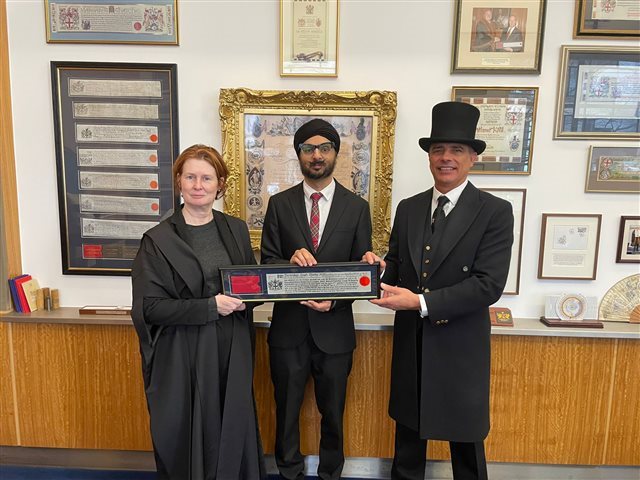
When I arrived at Guildhall to be admitted to the Freedom of the City of London, I was immediately struck by the weight of history in the room.
Guildhall sits at the centre of the City’s civic life. Standing there before the ceremony began, I found myself reflecting on the generations of people who had passed through those halls.
The Freedom of the City of London is one of the capital’s oldest civic traditions, with roots stretching back more than 800 years. Today it symbolises a connection with the City’s long history of commerce, public life and civic contribution.
The ceremony itself was brief but memorable. Afterwards, Laura Miller, Clerk to the Chamberlain’s Court, kindly took me through some of the history behind the tradition.
As we spoke, she showed me examples of people who had received the Freedom in the past. What struck me most was the extraordinary range of individuals. The list included presidents and global figures, but also ordinary people whose work had contributed quietly to the life of the City.
That was reassuring in its own way. It reminded me that the tradition has always been about recognising contribution in many different forms.
Laura also shared a story that stayed with me long after I left Guildhall. She described a Roman gravestone from nearly two thousand years ago that had been discovered in London. The inscription commemorated a man who had not been born in the city, yet on his gravestone he was described simply as a citizen of Londinium, the Roman name for London.
For me that detail brought the story of Londinium suddenly to life.
That moment also reminded me how engineers often look at the world. We are trained to notice systems, patterns and connections across time.
Even two millennia ago, London was already a place where people arrived from elsewhere, built lives and became part of the community. The idea that someone from another part of the Roman world could settle here and proudly identify with the city speaks to a much longer story about migration, opportunity and belonging.
Even though I was born in Britain, learning about that moment from Roman Londinium still felt meaningful. It was a reminder that London’s identity has always been shaped by people arriving, contributing and becoming part of the city’s story.
In many ways the modern City still reflects that same pattern, with people from across the world bringing their skills, ideas and ambitions to London and becoming part of its continuing story.
It reminded me that cities evolve much like complex systems in engineering. Over time new components arrive, interact and adapt, gradually shaping something stronger and more resilient than any single part alone.
Another thought occurred to me as well. The City of London has long been a place where technical skill, commerce and public life intersect. Long before modern engineering institutions existed, craft guilds and livery companies helped shape standards of skill and professional practice. In many ways those early communities were predecessors to today’s professional engineering bodies, where knowledge, mentorship and professional identity continue to be shared across generations.
In fact the thought lingered in my mind in the slightly unexpected way that something from engineering studies sometimes does. A little like remembering boundary conditions in fluid mechanics years after leaving university, it appeared out of nowhere and stayed with me for the rest of the day.
As I stood in Guildhall earlier that day, my thoughts had also turned to my own journey into engineering.
My career began studying mechanical engineering at the University of Sheffield. Over time it evolved into work across technology, data, artificial intelligence and organisational systems in a global corporate environment.
Although the subject matter has changed over the years, the mindset that engineering instilled has remained constant. Engineers are trained to understand systems, how parts interact and how problems can be solved in structured ways.
Part of that mindset comes from the scientific method itself. Engineers learn to form hypotheses, test them through observation and experimentation, and gradually understand how systems behave. I often find myself applying exactly that approach today when working with digital systems and organisational technology.
Many engineers eventually find themselves working at the intersection of technology, leadership and society. That has certainly been true in my own case.
Alongside my professional work, I founded City Sikhs as a professional network connecting Sikh professionals across business and public life. The aim was to create a space where professionals could support one another while also contributing to wider civic and charitable initiatives.
Over time those activities grew into mentoring programmes, leadership events and collaborations with organisations across different sectors.
Being recognised with an MBE for this work in diversity and inclusion was an important moment for me. It reinforced my belief that professional success carries a responsibility to help others navigate their own paths.
The ceremony at Guildhall also carried a more personal dimension.
Engineering has been part of my family story for three generations. My grandfather, Professor Sundar Singh Bhatia, began studying Mechanical Engineering at the University of Sheffield in 1926. My father later followed the same profession as a mechanical engineer. Nearly a century later I found myself studying engineering at Sheffield as well, continuing a connection with the discipline and the university that stretches across generations.
Standing in Guildhall, I realised that in many ways I was continuing a journey that began long before my own career started.
That sense of continuity between generations, professions and communities was one of the most meaningful aspects of the day.
It also reinforced something I often reflect on when speaking with younger engineers. Engineering is rarely a narrow technical path. The analytical mindset it develops can lead to roles across technology, business, public life and community leadership.
For me the Freedom ceremony was not simply a moment of recognition. It was a reminder of how the skills and perspectives developed through engineering can influence many parts of society.
And perhaps that Roman gravestone offers the most enduring perspective of all. Nearly two thousand years ago someone who arrived from elsewhere built a life here and was remembered as part of the city.
In many ways that same story continues today.
I would be interested to hear from other engineers in the EngX community. Where has your engineering mindset taken you beyond purely technical roles?
-

Lisa Miles
-
Cancel
-
Vote Up
0
Vote Down
-
-
Sign in to reply
-
More
-
Cancel
Comment-

Lisa Miles
-
Cancel
-
Vote Up
0
Vote Down
-
-
Sign in to reply
-
More
-
Cancel
Children