


From stargazing on Australian beaches to working on cutting-edge aerospace projects in Europe, Patrick’s journey is nothing short of inspiring. We caught up with Patrick to learn more about what sparked their passion for aerospace, how volunteering with the IET has shaped their career, and what advice they’d give to others looking to follow a similar path.
Let’s start at the beginning, what sparked your interest in joining the Aerospace sector? 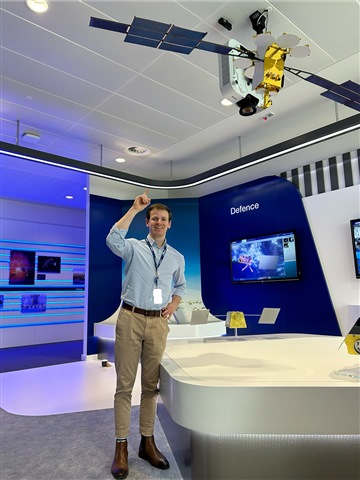
When I finished secondary school in Australia, I had no doubt in my mind that the university degree I wanted to follow had to involve aerospace engineering. This strong interest in the aerospace industry probably stemmed from a deep-seated fascination with space that I had since I was a young kid - and that I think a lot of young kids do.
I think I developed my fascination with space from long holidays to the beach with my family, where we were out of the city, away from the light pollution, and without as much technological distraction (especially compared to today).
There’s something about warm summer nights, hearing the waves crash on the sand, and watching the Milky Way, planets, stars, and galaxies come out that must just trigger the most primitive neurons in our brains. It certainly did for me and I spent hours every night on these holidays in awe that we’re just on this little rock screaming silently around a star, with a bunch of other planets, and all of that going around a galaxy with billions of other stars, and our galaxy doing the same with other galaxies. It’s pretty incredible when you zoom out.
I can also thank documentaries from scientists like Brian Cox and Neil deGrasse Tyson for this love for space as they provided the most surreal visualisations that I think draws a lot of people into the industry - and rightly so.
At the end of the day, space to me is this thing that all of us see every single night of our lives, yet it’s still so unknown to us despite the many probes and robots we have launched. I imagine this is how explorers of the Earth felt when they could see, or heard stories of, unknown lands on the horizon, but didn’t yet have good enough vessels to explore them yet.
I followed this passion through university by completing a Bachelor of Engineering (Mechanical & Aerospace) (Honours) and a Bachelor of Science (Mathematical and Computer) in 2022. The Bachelor of Science degree had some pretty cool computer vision courses and this broadened my interests to include artificial intelligence (AI), especially as the field was picking up pace pre-ChatGPT. During and after university I applied what I had learned at the Defence Science and Technology (DST) Group and Lockheed Martin Australia. Then, I had the opportunity to move to the United Kingdom for a Machine Learning Engineer role at Airbus - a perfect combination of my two main interests: artificial intelligence and aerospace engineering. 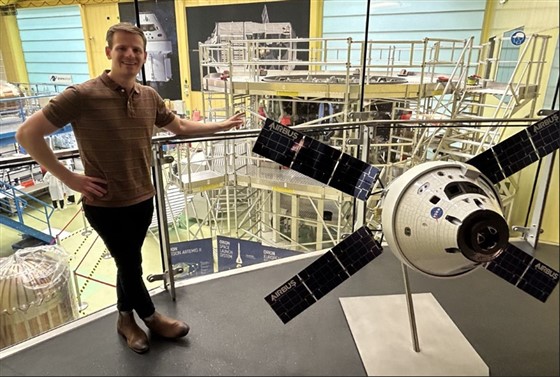
In this role I have had some incredible opportunities which were just not possible in Australia such as:
- Working in Bremen, Germany, on the European Service Module (ESM), which is Europe’s contribution to NASA’s Artemis mission to take humans back to the Moon.
- Working in Stevenage, UK, on the OneSat project.
- Publishing research papers intersecting the fields of reinforcement learning and logistics.
- Visits to London and Bremen for conferences and expos like the AI Summit and Europe Space Tech Expo.
- Visits to France and Germany to visit the most advanced and large-scale aircraft manufacturing plants in the world.
That’s an amazing journey so far! What kind of experiences have you had since joining the IET and the Aerospace Technical Network (TN)?
I first began volunteering with the IET in 2020 with an On Campus network that I set up with some friends at the University of Adelaide. After this I continued volunteering through the South Australia and Northern Territory Local Network and Young Professionals. However, it wasn’t until I was selected to attend the 2022 Young Professionals Summit in London that I first met the members of the Aerospace TN. We all got on really well and upon my return to Australia I had gained a position in the TN with the goal of expanding their reach to Australia as well. Through the Aerospace TN, my eyes were opened to the many career paths and amazing aerospace projects happening outside of Australia, and particularly in the UK. This was a strong driver for my decision to move to Airbus in the UK - to get some experience in world-class aerospace projects that are just impossible to get from Australia. My volunteering with the IET has also opened up many doors in my professional career, particularly from a networking perspective as I recently hosted a panel discussion to over 220 participants with AI and Aerospace experts from Airbus, Rolls Royce, Thales, and Airside Labs. Experiences like these wouldn’t be possible without my involvement with the Aerospace TN.
It’s great to hear how volunteering has helped shape your career. What advice would you give to someone hoping to build a career in aerospace?
The main piece of advice I would give to aspiring engineers is to just build things you find interesting. We have so much agency and potential to create things nowadays, especially with generative AI to help us get started and get up and off the ground - which is often the hardest part. Especially when it comes to making yourself unique in the job market, your main differentiator are your interests and your personality - so this is what you should use as your North Star for building things. Doing this will help you maintain interest in your projects, make it easier to speak to when networking or applying for jobs, and just to make you stand out amongst others. The hardest thing for others to copy are your interests and personality. Unfortunately, when it comes to building things, it’s also easier than ever to be distracted by social media and endless content. In moderation, this content can be good and helpful to stimulate creative thinking, but it’s also just as good to be bored in our own mind and to create towards our interests.
Whether you're just starting out or looking to take your aerospace career to new heights, their advice is clear: stay curious, build what excites you, and don’t be afraid to explore the unknown. 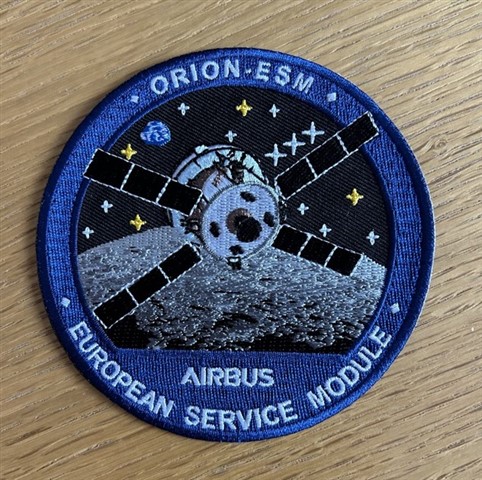
If you would like to find out more about what Patrick and the Aerospace Technical Network get up to? Read more in their latest blog. AI in Aerospace
For more information on how to join the technical network please email victoriarooke@theiet.org.
-

Tori Rooke
-
Cancel
-
Vote Up
0
Vote Down
-
-
Sign in to reply
-
More
-
Cancel
Comment-

Tori Rooke
-
Cancel
-
Vote Up
0
Vote Down
-
-
Sign in to reply
-
More
-
Cancel
Children