


The Quiet Uplink Crisis
For years, mobile networks were built around a simple asymmetry: users download far more than they upload. A smartphone streaming video pulls megabytes from the network while sending only a trickle of acknowledgment packets back. Downlink was the engineering priority; uplink was an afterthought.
AI is rewriting that assumption with urgency. As on-device intelligence moves from novelty to necessity — real-time scene recognition, generative image editing, cloud-assisted video synthesis — it is the uplink that buckles first. Industry lab measurements make the scale of the problem concrete.
Advanced 5G: The Bridge We Are Already Building
The good news is that operators do not need to wait for 6G to address the uplink gap. Advanced 5G — encompassing 3GPP Releases 17 and 18 and the emerging Standalone (SA) architecture — already delivers transformative uplink gains through a layered set of enhancements.
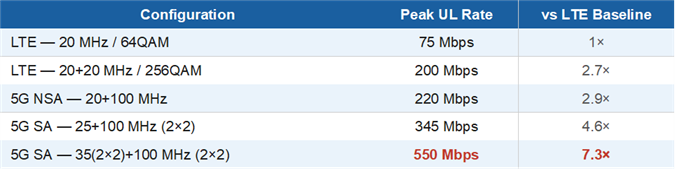
Industry uplink peak data rate measurements trace the arc clearly:
Uplink Peak Data Rate Evolution
|
Source: Industry field measurements, 2024–2025 |
The engineering levers behind these gains fall into three categories. First, antenna and receiver solutions — including 4RX on FDD bands, Dual Boost mMIMO, AI-assisted channel estimation, and FDD mMIMO with 8RX — together deliver more than a 4× uplink improvement. Second, reframing and device features — LTE-to-5G spectrum reframing, Standalone deployment with uplink carrier aggregation, Uplink TX switching, and High Power UE — contribute a further 2×. Third, looking ahead, new 6G spectrum combined with 6G-specific uplink innovations add another 2× multiplier. Stacked, these capabilities represent the projected 10× uplink boost for the Advanced 5G and early 6G era.
Where Operators Should Place Their Architecture Bets
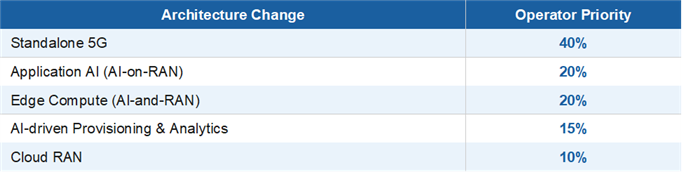
Not all 5G architecture changes are equal from a monetization standpoint. Industry surveys of operators consistently identify a clear hierarchy of value-generating changes:
Architecture Changes Most Likely to Maximize 5G Monetization
Source: Operator survey on 5G architecture monetization
Standalone 5G leads decisively at 37%, confirming that completing the transition away from 4G core dependency is the single highest-value move available. The paired AI results — Application AI (AI-on-RAN) at 18% and Edge Compute (AI-and-RAN) at 17% — together account for 35%, suggesting that AI integration into the radio access layer is viewed as nearly as transformative as the SA migration itself. The strategic message is clear: operators should pursue SA deployment and AI-RAN integration in parallel rather than sequentially.
What Advanced 5G Actually Delivers
Beyond headline throughput numbers, Advanced 5G defines a comprehensive value proposition across five pillars:
- Network efficiency: up to 10× capacity, up to 10 dB coverage improvement, up to 10× energy reduction
- Device energy efficiency: up to 10× reduction in device power consumption
- New use cases: sensing, satellite integration, device scalability
- AI and XR readiness: uplink improvements, native AI traffic support, XR-awareness
- Simple upgrade path: reuse of existing 5G core, spectrum, and sites
The energy efficiency gains are not merely operational cost improvements — they are a prerequisite for network sustainability at the traffic volumes that AI-driven applications will generate. A 10× reduction in energy per terabyte changes the economic calculus of deploying denser, more capable networks in ways that earlier generations could not contemplate.
Designing 6G: Six Technologies That Don't Exist at Scale Yet
6G is not simply more of the same. The technology requirements for the next generation represent genuinely new engineering territory across six dimensions, each addressing a limitation that Advanced 5G cannot fully resolve:
- Extreme mMIMO at 7 GHz — up to 400 MHz bandwidth and 1024 antenna elements, enabling spatial capacity gains well beyond current 5G arrays
- Super energy efficiency — DRX/DTX solutions and wake-up receiver architectures that allow radios to idle at near-zero power without missing traffic
- Uplink coverage boost — UE power boost, spectrum shaping, and AI-based receivers that dramatically improve uplink link budget in challenging conditions
- AI integration into radio — AI-native signal processing replacing traditional DSP chains, enabling continuous adaptation to channel conditions at a granularity impossible with fixed algorithms
- Sensing integration — a single radio simultaneously performing communication and environmental sensing, enabling new applications in positioning, gesture recognition, and environmental monitoring
- Scalable device design — architecture flexibility that allows IoT, wearables, and voice devices to operate on 6G from the first day of commercial launch
The AI receiver concept — where machine-learned signal processing replaces traditional DSP chains — is particularly significant for uplink coverage. In fringe conditions, learned channel models can extract signal from noise levels that rule-based systems cannot handle, effectively extending coverage without additional infrastructure.
5G vs 6G: The Full Comparison
The contrast between 5G and 6G targets reveals both the ambition of the next generation and the lessons learned from the current one:
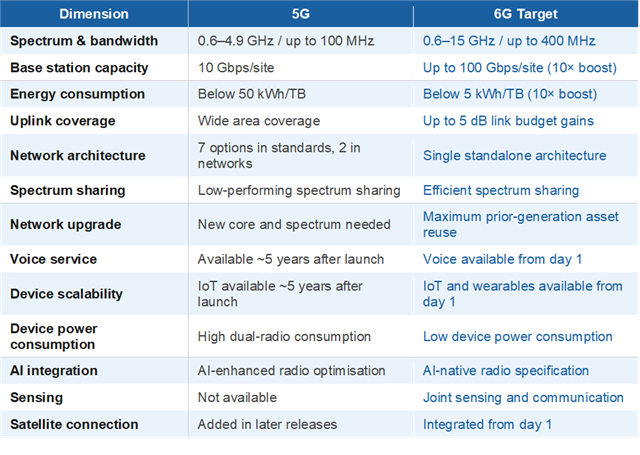
Two comparisons stand out above the rest. First, the architectural simplification: 5G launched with seven deployment options in the standards body (NSA options 3/3a/3x, SA option 2, and several more), creating a fragmented ecosystem that slowed feature rollout and device certification. 6G targets a single standalone architecture from the outset — a direct lesson from 5G's complexity tax.
Second, the 10× energy efficiency target is not aspirational. At 5G energy consumption levels, the projected volume of 6G traffic would be operationally and environmentally unsustainable. The efficiency target is an economic necessity, not a performance boast.
The 3GPP Clock Is Already Running
6G standardization is not a future event — it is actively underway. The first 6G workshop convened in March 2025, the study item commenced in June 2025, and technical RAN1 work started in August 2025. The current moment (early 2026) sits in the middle of active 6G requirements and technology studies under Release 20.
6G Standardization Timeline (3GPP)
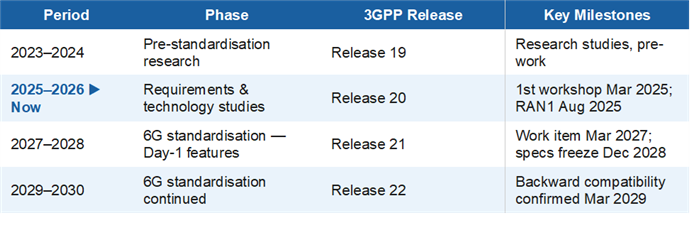
The backward compatibility milestone — confirmed for March 2029 — is strategically significant for operators making infrastructure decisions today. Investments in Advanced 5G are not building for obsolescence; they are building the substrate that 6G will upgrade rather than replace. Spectrum, sites, and core network assets made for Advanced 5G will carry forward.
The 6G specification freeze in December 2028 gives device manufacturers and chipset vendors approximately 18 months to prepare commercial hardware for a 2030 launch window — a compressed timeline that places early standards engagement at a premium.
What This Means in Practice
The through-line across these developments is a coherent strategic sequence. Device AI is creating uplink pressure today; Advanced 5G — specifically Standalone deployment combined with antenna and receiver upgrades — addresses that pressure within the current investment cycle.
The architecture survey tells operators that SA migration and AI-on-RAN integration are the two levers most likely to unlock new revenue. 6G then arrives not as a replacement but as a layer that adds new spectrum, sensing capability, AI-native radio design, and a simplified architecture — all while reusing the 5G assets that operators are building now.
For technology leaders, the practical implication is sequencing: prioritize SA migration and uplink enhancement now; treat edge compute and AI-RAN as concurrent rather than sequential investments; and engage with 3GPP Release 20 studies to ensure enterprise use cases are reflected in the 6G specifications that will govern networks through the 2030s.
The networks of the AI era will not look like the networks of the streaming era. But the path there runs directly through the Advanced 5G decisions being made today.
Data sources: Industry lab research; 3GPP Release roadmaps; operator survey on 5G architecture monetization. All figures as reported in industry presentations and standardization documentation, 2024–2025. This article has been produced as an independent analysis and does not represent the views of any specific vendor or operator.