


Nigeria is a country of staggering contradictions. It sits atop some of the world's largest crude oil reserves, generates enough natural gas to power a continent, and basks in some of the most abundant sunshine on earth. Yet over 85 million of its citizens wake up every morning to uncertain, unreliable, or entirely absent electricity. Businesses across Lagos, Abuja, and Port Harcourt spend a combined $14 billion every year running diesel
generators and its not because they want to, but because the grid forces them to.
We have chased solar. We have debated gas. We have mourned our transmission infrastructure. But there is an energy resource sitting above every rooftop, along every highway, and offshore every coastal state in Nigeria, one that barely anyone in this country is talking about seriously.
Wind.
And more specifically: the “Vertical Axis Wind Turbine”, this is a technology I first explored in my undergraduate final year project at Coventry University, UK, titled 'The Use of Vertical Axis Wind Turbines for Small Scale Energy Requirements.' That was an
academic exercise then. Today, I believe it is a commercial, infrastructural, and national energy imperative.
“There is an energy resource sitting above every rooftop along every highway, and offshore every coastline in Nigeria and its one that barely anyone is talking about seriously.”
What Is a VAWT — and Why Is It Different?
Most people picture a wind turbine as a towering white structure with three long blades spinning horizontally, the kind you see on wind farms in Denmark or Texas. Those are Horizontal Axis Wind Turbines “HAWTs” and they are remarkable engineering achievements. But they come with significant constraints: they must face the wind, they need relatively high, consistent wind speeds, they make noise, and they are structurally
unsuited to urban and built environments.
A Vertical Axis Wind Turbine operates on a fundamentally different principle. Its rotor spins around a vertical shaft, meaning it captures wind from every direction simultaneously plus there is no need to track or orient toward the wind source. The two
primary designs are the Darrieus turbine, which uses aerodynamic lift on curved blades and is highly efficient at sustained wind speeds, and the Savonius turbine, which uses
drag and is remarkable for self-starting at very low wind speeds. Hybrid Darrieus-Savonius designs combine both principles, making them particularly well suited to variable, turbulent environments.
For Nigeria, these differences are not just technical footnotes. They are the reason VAWTs
make sense here when conventional wind turbines do not.
Why Nigeria Is Ready for VAWTs
The Wind Resource
The conventional narrative about Nigerian renewable energy focuses almost exclusively on solar. And for good reason because Nigeria receives 3,500 to 7,000 hours of sunshine annually, and solar photovoltaic technology has improved dramatically in cost and accessibility. But solar has a structural weakness that is rarely discussed honestly: it generates nothing at night, and very little during harmattan season, heavy cloud cover, or the rainy season. For the 8 to 16 hours a day when solar panels are underperforming or idle, Nigerian homes and businesses fall back on generators.
Wind fills that gap precisely. Studies of Nigeria's wind resource, including data from the Nigerian Meteorological Agency (NIMET) and NASA's MERRA-2 global wind atlas, show that wind speeds along Nigeria's coastal belt consistently range from 5 to 9 metres per second at practical installation heights. In the far north places such as Sokoto, Katsina, Kano have wind speeds reach 8.4 to 14.7 m/s, among the highest in sub-Saharan Africa. Even in Lagos, Abuja, and Port Harcourt, urban wind speeds at rooftop height are sufficient for the small VAWT range of 600W to 5kW.
Crucially, wind in coastal Nigeria is often strongest at night and during cloud cover which is the precise moments when solar generation fails. A solar-wind hybrid system, combining panels with a small VAWT and a lithium iron phosphate battery bank, can
achieve 85 to 90 percent system uptime in Nigerian conditions, compared to 50 to 60 percent for solar-only installations.
“A solar-wind hybrid system can achieve 85–90% uptime
in Nigerian conditions. Solar alone achieves 50–60%.
That gap is where VAWTs win.”
— The Urban Advantage —
VAWTs have a specific set of properties that make them uniquely suited to Nigerian cities and infrastructure:
- They operate in turbulent, multidirectional wind which is exactly the kind generated by buildings, traffic, and coastal geography
- They have a low cut-in wind speed of 2 to 2.5 m/s meaning they start generating at wind speeds most people would not even notice
- They are silent in operation, typically below 45 decibels at 5 metres which is suitable for residential compounds and office buildings
- They are compact, with a small footprint suitable for rooftop, yard, or median strip installation
- They require minimal maintenance compared to horizontal axis turbines, with no gearbox in most designs
For a country where energy generation infrastructure needs to be distributed, resilient, and community-scaled rather than centralised, these are transformative advantages.
Three Applications Nigeria Should Prioritise
1. Telecom Base Stations
Nigeria has approximately 30,000 off-grid base transceiver station (BTS) sites operated by MTN, Airtel, IHS Towers, and American Tower Corporation. The majority of these sites run on diesel generators, at an estimated combined annual fuel cost that runs into hundreds of billions of naira. The Nigerian Communications Commission has explicitly called for telecom operators to reduce their carbon footprints and diesel dependence.
A 3 to 5kW VAWT paired with existing solar panels and a lithium iron phosphate battery bank is a near-perfect solution for an off-grid BTS site. The wind turbine provides generation during nighttime and low-solar-irradiance periods, the solar panels cover
daytime, and the battery buffers the variability of both. Telecom operators already understand the value proposition i.e they are paying for diesel today, and the payback period on a hybrid VAWT-solar system is typically 3 to 5 years.
2. Residential & Commercial Buildings
For the average Lagos household with a generator fuel bill of ₦80,000 to ₦300,000 per month, a 1 to 3kW VAWT hybrid system represents a credible path to energy independence. Unlike large wind farms that require dedicated land and high-tension grid
connections, small VAWTs can be mounted on the rooftop of an existing building, connected to a household battery bank and inverter, and integrated with existing solar panels in a single system.
The potential market is vast. With 40 million households lacking reliable electricity and 4.2 million registered businesses facing crippling energy costs, the addressable market for distributed wind energy systems in Nigeria is measured in the hundreds of billions of naira. The early adopters i.e upper-middle-class homeowners, estates, schools, clinics, and SMEs, are precisely the customers who already understand off-grid energy technology from their experience with solar, and who have both the resources and the motivation to adopt the next step.
3. The Lagos-Calabar Coastal Highway
Perhaps the most ambitious application is also the most visible. The Federal Government's 700-kilometre Lagos-Calabar Coastal Highway, currently under construction by Hitech Construction under an EPC+F framework, will traverse nine coastal states along the Atlantic corridor. The highway will require substantial electrical infrastructure for lighting, tolling, surveillance cameras, and emergency call points that are all currently dependent on grid extension or diesel.
The entire 700-kilometre corridor is exposed to consistent Atlantic trade winds. Installing small to medium VAWTs along the highway's central reservation and shoulder zones could power the highway's own electrical loads, generate carbon credits, and serve as Africa's first large-scale demonstration of highway-integrated wind energy. At a highway management level, the economics are compelling: replace recurrent diesel and grid
energy costs with an infrastructure asset that generates clean power for 20 to 25 years.
“Nigeria is building a 700km coastal highway along some
of West Africa's most consistent wind corridors. The
opportunity to make it Africa's first green highway
should not pass us by.”
The Technology Is Available. The Distribution Is Not.
One of the most striking facts about Nigeria's VAWT opportunity is that the technology is not nascent or experimental. Chinese manufacturers in Guangdong and Shandong provinces i.e Aeolos Wind Energy, Qingdao Greef New Energy, and several others
produce IEC 61400-2-certified VAWT systems in the 600W to 10kW range at commercially viable prices. Complete systems including the turbine, hybrid solar-wind MPPT charge controller, lithium iron phosphate battery bank, and pure sine wave inverter are available and can be imported, cleared, and installed in Nigeria.
What does not exist “yet” is a Nigerian specialist that sources, distributes, installs, and maintains these systems with the engineering rigour and after-sales infrastructure that customers need. The solar market in Nigeria matured precisely because distribution companies and installation networks emerged. The same trajectory is available for distributed wind energy. Someone needs to build that distribution infrastructure, and the window to establish first-mover advantage is open right now.
A Personal Note: From Final Year Project to National Conversation
I want to be transparent about where this perspective comes from. My final year undergraduate project at Coventry University, UK, was titled 'The Use of Vertical Axis Wind Turbines for Small Scale Energy Requirements.' At the time, I was exploring the theoretical and technical case for small-scale VAWT deployment. It was an academic exercise, grounded in NACA aerofoil design, wind resource data, turbine aerodynamics, and energy system sizing.
Years later, working as a Graduate Civil Engineer on Julius Berger Nigeria's Lagos Emergency Bridge Repair Works project with the Third Mainland Bridge, Carter Bridge, and Iddo Bridge as my daily working environment, I see Nigeria's infrastructure challenges from the inside. I see how much energy our cities consume, how much of it is wasted on diesel, and how much coastline and wind corridor we leave entirely unharvested.
Through my work with the Nigerian Society of Engineers as a Young Engineers Speaker, I have come to understand that Nigeria's engineering community is ready for this conversation. We have the talent. We have the infrastructure need. We now need the commercial and policy frameworks to make it happen.
Sultan-Othman Ventures is my attempt to begin building that framework, starting with the distribution of 600W to 5kW VAWT systems for residential, commercial, and telecom applications in Nigeria, sourced directly from Chinese manufacturers and supported by Nigerian engineering expertise.
What Needs to Happen Next
This is not a conversation that can stay in academic journals and engineering conference proceedings. It needs to move into policy, investment, and commercial infrastructure.
Specifically:
• The Federal Ministry of Power and the Rural Electrification Agency should commission a formal national wind resource mapping exercise, updating existing NIMET data with higher-resolution coastal and urban wind assessment
• The Nigerian Communications Commission should include wind-solar hybrid systems as an approved technology pathway in its green power certification programme
• The Nigerian Society of Engineers and COREN should develop a certification framework for VAWT installation professionals, adapting existing solar artisan training to include wind energy systems
• Engineers and entrepreneurs should engage with the European Enterprise Network, where European VAWT manufacturers are actively seeking African market development partners
• Investors and development finance institutions, including the NSIA/Africa50's $500M DRE Nigeria Fund should include distributed wind as an eligible technology category alongside solar
Most importantly: Nigerian engineers, particularly those working in renewable energy, power systems, civil infrastructure, and electro-mechanical engineering, should bring VAWTs into their professional discourse. The technology is proven. The wind resource is real. The market need is urgent. What remains is the professional community's willingness to champion a new conversation.
“The technology is proven. The wind resource is real. The
market need is urgent. What remains is the professional
community's willingness to champion a new
conversation.”
Conclusion
Nigeria cannot solve its energy access crisis with a single technology. Solar is essential but insufficient. Gas is abundant but centralised and politically complex. Wind where it is distributed, quiet, omnidirectional and complementary to solar is the missing piece that no one is yet building the infrastructure to deliver.
The Vertical Axis Wind Turbine is not a futuristic concept. It is a commercially available, technically proven, economically viable technology that can be imported, installed, and maintained in Nigeria today. It can power homes, offices, telecom towers, and highways. It can complement Nigeria's growing solar ecosystem and fill the nighttime and low-irradiance gap that solar cannot bridge alone.
I am writing this article in June 2026 as both an engineer and an entrepreneur who has been thinking about this problem since my undergraduate days at the University of Lagos. I am writing it publicly because ideas that stay private do not change policy, attract investment, or build industries. Nigeria's wind is blowing. It is time we started catching it.
About the Author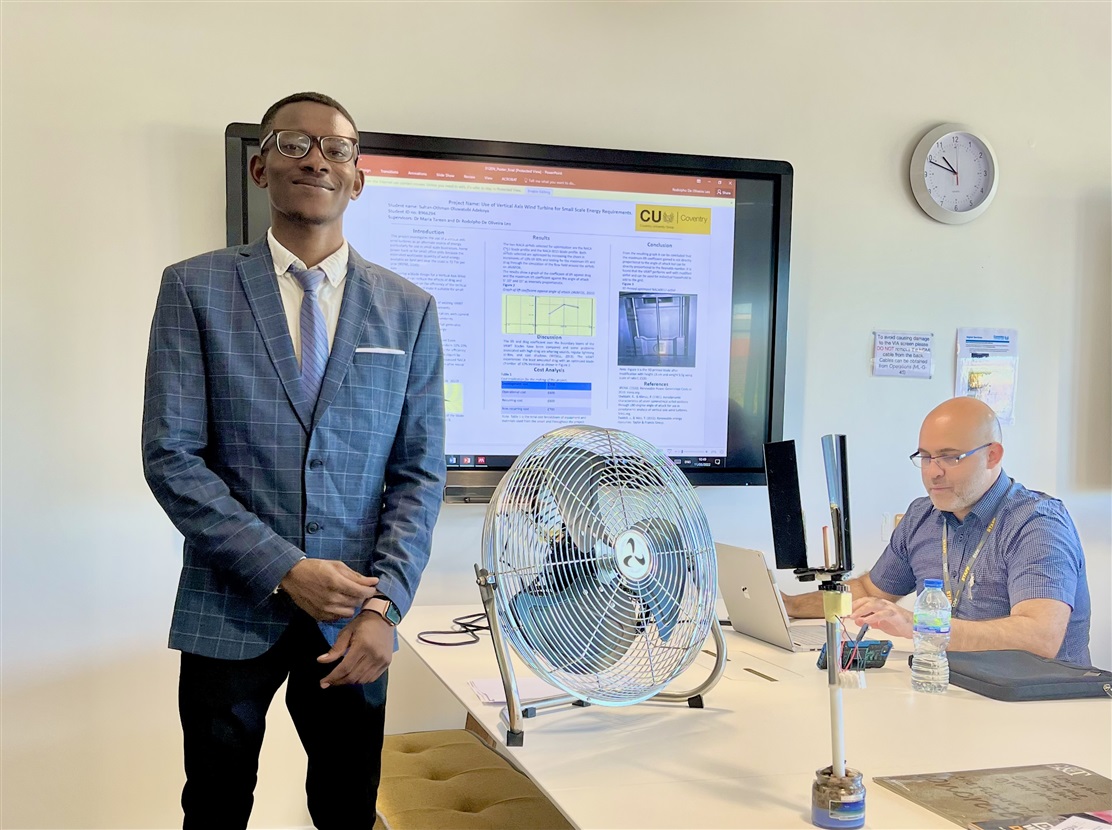
Sultan-Othman Adekoya is a multidisciplinary engineer holding a First Class B.Eng. in Electro-Mechanical Engineering (Coventry University, UK) and a B.Sc. in Civil & Environmental Engineering (University of Lagos). He is a Member of the Institution of Engineering and Technology (MIET), a Graduate Member of
the Nigerian Society of Engineers (GMNSE), and served as the Young Engineers Speaker at the 15th Mechanical Engineering Distinguished Lecture (MEDL) for the NSE. He currently works as a Graduate Civil Engineer with Julius Berger Nigeria Plc on the Lagos Emergency Bridge Repair Works Project. He is the
founder and CEO of Sonoman Innovation Services and Sultan-Othman Ventures, Nigeria's first specialist VAWT distribution venture.
Connect & Engage
If you are an investor, engineer, manufacturer, or policymaker interested in Nigeria's distributed wind
energy opportunity, I welcome your engagement. Connect on LinkedIn, reach out through the Nigerian
Society of Engineers, or follow my work on IET EngX.