


At the end of March, the IEEE International Workshop on Antenna Technology (iWAT 2026) came to Liverpool, bringing together researchers, industry specialists and students working at the forefront of antenna and electromagnetic design. Over three days at the University of Liverpool, the workshop offered a reminder of the value of smaller, more focused events, not just for sharing research, but for building meaningful professional connections.
iWAT has a distinctive format. All oral presentations are invited talks, which keeps the programme tight and ensures a consistently high technical standard. Alongside this, poster sessions play a central role, creating space for deeper conversations and more informal exchanges. It’s a structure that encourages dialogue rather than one‑way communication, and that really showed throughout the week.
What people were talking about
From the opening keynote onwards, several themes kept resurfacing. Metasurfaces and metamaterials were a major focus, particularly their role in advanced beam manipulation and compact antenna design. These engineered materials are opening up possibilities that simply weren’t achievable with conventional approaches, and it was clear how quickly this area is moving from theory towards application.
Another strong thread was the growing influence of AI and computational techniques in antenna design. Sessions explored AI‑aided optimisation, generative design methods and the use of digital twins to model increasingly complex systems. What stood out wasn’t just the ambition of this work, but the honesty around its limitations. There was plenty of discussion about validation, reliability and how these tools can be integrated responsibly into real engineering workflows.
At the same time, many sessions grounded the technology firmly in real‑world contexts. Talks on antennas for challenging environments, including implanted medical devices, underwater communication and high‑frequency systems for dense urban spaces, highlighted how performance, usability and measurement are becoming inseparable. As systems edge closer to 6G and beyond, testing and metrology are clearly as critical as novel designs.
A strong focus on early‑career researchers
One of the most encouraging aspects of iWAT 2026 was the attention given to students and early‑career professionals. Interactive poster sessions, Best Paper and Best Student Paper Awards, and a dedicated session on young professional innovations all reinforced the message that new voices are essential to the future of the field.
For many students, this was a rare opportunity to discuss their work directly with people whose research they’ve been reading for years. The workshop format made those conversations feel approachable and constructive, rather than intimidating, and that kind of experience can be genuinely formative.
For the IET community, iWAT 2026 is a useful reminder that progress doesn’t happen in isolation. Many of the topics discussed sit at the intersection of research, industry practice and standardisation. Focused workshops like this play an important role in bridging those spaces, helping ideas move from laboratories into reliable, deployable technologies.
As antenna technology continues to evolve, the conversations happening around it matter just as much as the technical advances themselves.
IET Student Prizes
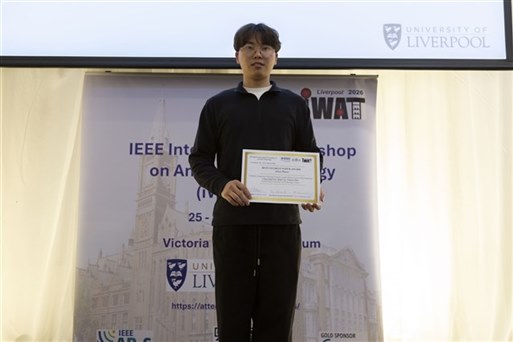
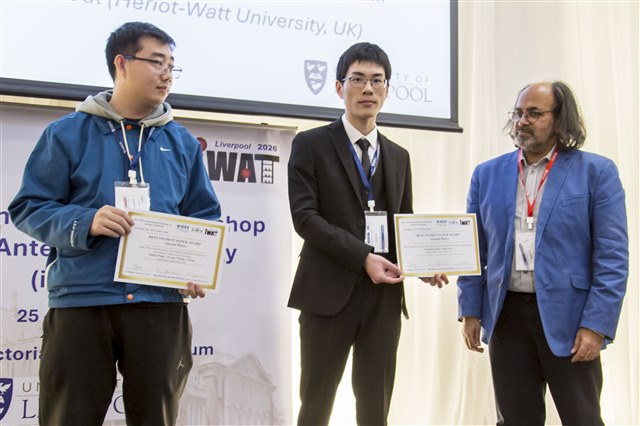
The IET Electromagnetics Technical Network sponsored there best student paper prizes and after much deliberation, the following were awarded IET prizes:
BEST STUDENT PAPER AWARD (First Place)
A Highly-Integrated Filtering Antenna Loaded with a Circle of Shorting Pins
Liang Xing Zou, Qing Luo, Chunxu Mao
South China University of Technology, China
BEST STUDENT PAPER AWARD (Second Place)
Leaky-Wave Antenna Array with Adaptive Radiation Pattern for 5G-Railway Tunnel Communication
Xingyu Pang, Y Geng, J Wang, L Wang
Lancaster University, UK
BEST STUDENT PAPER AWAR (Second Place)
Active Reflection Coeff. Distribution Study of Satellite Multi-Beam Antenna Array
Weiguang Song, J Hou, et al.
Heriot-Watt University, UK
Your thoughts?
Where do you see the biggest gaps between research and real‑world deployment? Share your thoughts in the comments.