


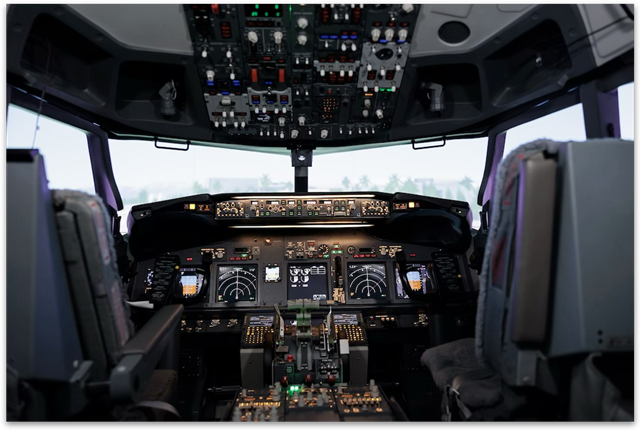
 Flight simulation has long been one of the aviation industry’s most powerful tools. Behind every smooth commercial flight is a pilot who has spent hundreds of hours mastering the controls, procedures, and decision‑making skills required to fly safely. And most of that mastery doesn’t happen in the air; it happens in a simulator.
At the next IET Sussex Network talk on Tuesday 14th April at 6:30pm, Jeremy Hopkins, an expert with deep experience in the simulation industry, will offer compelling insights into how commercial airlines rely on flight simulators, how these systems work, how they differ from their military counterparts and why simulation remains indispensable to modern pilot training. He will use the Boeing 787 Simulator Architecture as an example.
Why Flight Simulation Matters
Commercial aviation rests on consistency, precision and safety. Pilots must be prepared not only for everyday operations but also for rare, complex and potentially dangerous scenarios. Flight simulation fills this need perfectly.
With a simulator, airlines can expose pilots to:
- System failures that would be unsafe to reproduce in a real aircraft
- Severe weather conditions and unusual attitudes
- High‑stress emergencies requiring split‑second judgment
- Repetition of difficult manoeuvres without burning fuel or occupying runway space
Simulation allows all this training to take place in a controlled, repeatable environment. It dramatically reduces risk while preserving realism and ultimately produces safer pilots.
What Makes Up a Modern Flight Simulator?
A full‑flight simulator used by airlines is a marvel of integrated engineering. Jeremy will highlight several core components that work together to create the immersive, lifelike experience pilots rely on.
1. The Visual System
This is the vast panoramic display, typically spherical or dome‑shaped, that reproduces landscapes, airports, skies and weather. Modern visuals render cities, runways, and cloud layers with incredible fidelity and can simulate everything from dawn haze to violent thunderstorms.
High frame rates and low latency are essential; any lag breaks the illusion and can even induce motion sickness.
2. The Motion Platform
Under the cockpit is a multi‑axis motion base, often driven by electric or hydraulic actuators. These create the sensation of acceleration, turbulence, takeoff rotation, landing impact and more.
While simulators can’t fully recreate sustained g‑forces, they cleverly ‘cue’ the body by tilting or shifting the capsule, tricking the inner ear into perceiving movement.
3. The Cockpit Replica
A commercial simulator includes an exact physical reproduction of the aircraft’s cockpit, every switch, screen, knob and instrument is placed precisely, down to the millimetre.
Pilots sit in the same seats and interact with the same controls they will use in the real aircraft. In fact, for many airlines, a pilot’s final exam takes place in a simulator before they ever touch the real plane.
4. The Avionics and Flight Model
At the heart of the simulator is the flight model, software that calculates how the aircraft behaves in response to control inputs, weather and system conditions. Alongside it is a comprehensive replication of the plane’s avionics, from autopilot functions to navigation systems.
This is where the real magic happens: the simulator ‘flies’ like the real aircraft because it is constantly computing aerodynamics, thrust, control surface deflections, system responses and environmental effects in real time.
5. The Host Computing System
Behind the scenes, a powerful computing engine manages the physics, visuals, motion cues and avionics logic. Over the years, this host system has evolved dramatically, from early analog machines to digital mainframes and now to distributed, networked processors capable of simulating vast workloads with minimal latency.
How Commercial Simulators Differ from Military Ones
Although they share underlying technologies, commercial and military simulators serve different purposes and therefore diverge in several ways.
Training Objectives
- Commercial simulators focus heavily on procedures, safety and crew coordination. Pilots must master checklists, automation and predictable operations.
- Military simulators incorporate tactical manoeuvring, aggressive flight envelopes, air combat, weapons systems and mission‑specific training.
Flight Envelope and Dynamics
Commercial aircraft are not designed for extreme manoeuvres, so their simulators faithfully replicate stable, predictable handling.
Military aircraft simulators must accurately model high‑g turns, rapid climbs, evasive manoeuvres and weapons deployment.
Cockpit Layout and Interactivity
Military cockpits often include Heads Up Displays, multi‑function displays, targeting systems and controls that require different simulation strategies and more complex interfaces.
Mission Modelling
Military training requires simulated enemy aircraft, terrain threats, radar signatures and dynamic mission scenarios; elements unnecessary in a commercial environment.
In short, commercial simulators excel in procedural and systems training, while military simulators shine in mission realism and tactical fidelity.
Simulation vs Avionics Emulation
Jeremy will emphasise an important distinction: full‑flight simulation is not the same as avionics emulation.
Avionics Simulation recreates the behaviour of the aircraft’s electronic systems; autopilot, navigation, flight management and so on. It’s essential, but limited.
Avionics Emulation replicates the exact hardware and software of the aircraft’s avionics, often using the same processors or code as the actual aircraft. It’s extremely accurate but costly and complex.
Airline simulators often strike a balance: they simulate avionics at a high level but also integrate real components where necessary. The goal is fidelity without prohibitive cost.
Understanding this difference clarifies why simulators must be carefully engineered: it’s not enough to display information on a screen, it must behave correctly, respond instantly and integrate with the wider flight model.
A Look at the Boeing 787 Simulator Architecture
The Boeing 787 Dreamliner represents a new era of aviation and its simulator reflects that modernity.
Key Features Include:
- Fully digital cockpit replication with large‑format displays and advanced flight control systems
- Integrated fly‑by‑wire modelling, accounting for the aircraft’s computer‑mediated control laws
- Advanced motion cueing to reflect the 787’s lighter composite structure and unique handling
- Sophisticated failure modelling, enabling pilots to train for rare system anomalies
- High‑resolution global terrain and airport databases, supporting realistic long‑haul scenarios
The architecture relies on networked computing nodes dedicated to different subsystems: flight dynamics, avionics logic, motion control, visual generation and instructor station management. This modular design allows for updates, maintenance and extremely high reliability, crucial in an industry where downtime is costly.
How Simulators Fit into Pilot Training
For commercial pilots, simulation isn’t optional, it’s the backbone of their career development.
- Initial Type Rating. Before flying a new aircraft type, pilots spend extensive time in a full‑flight simulator learning procedures, handling characteristics and emergency responses.
- Recurrent Training. Every six months, pilots return to the simulator to demonstrate their skills and maintain certification. This ensures they remain proficient in normal procedures as well as critical failures.
- Scenario‑Based Training. Simulators allow instructors to create controlled, repeatable scenarios such as engine failures, rejected takeoffs, low‑visibility approaches, or complex weather patterns.
- Crew Resource Management (CRM). Because the simulator replicates the entire cockpit environment, pilots practice communication, teamwork and workload management under realistic stress.
Final Thoughts
Flight simulators are the unseen engines of aviation safety. They allow pilots to practice the unthinkable and refine the routine. As Jeremy will demonstrate in his presentation, the sophistication of modern commercial simulators, from the Boeing 787’s advanced architecture to industry‑wide training methodology, reflects decades of innovation.
Every safe landing, every smooth long‑haul flight and every well‑handled emergency is a testament to the power of simulation. And as aviation continues to evolve, simulators will remain at the forefront, shaping the next generation of pilots.
If you would like to hear Jeremy’s talk then join us on Tuesday 14th April at 6:30pm (for refreshments) at Worthing College. Please register here.