


Large infrastructure projects generate enormous volumes of information. Engineering models, design documentation, technical specifications, and asset data are created by numerous organisations throughout the lifecycle of a project. Without a structured system to manage this information, coordination becomes difficult and decision-making becomes unreliable.
This challenge is one of the main reasons the construction industry has adopted structured information management frameworks such as ISO 19650. Rather than focusing only on digital modelling, the standard provides a governance framework that defines how project information should be requested, produced, coordinated and delivered across the lifecycle of built assets.
To understand how this process works in practice, it is helpful to examine a real infrastructure project where structured information management played a critical role. The Elizabeth Line (Crossrail) project in London is widely recognised as one of the most advanced BIM-enabled infrastructure programmes in Europe and provides a useful example for illustrating the practical implementation of ISO 19650 principles.
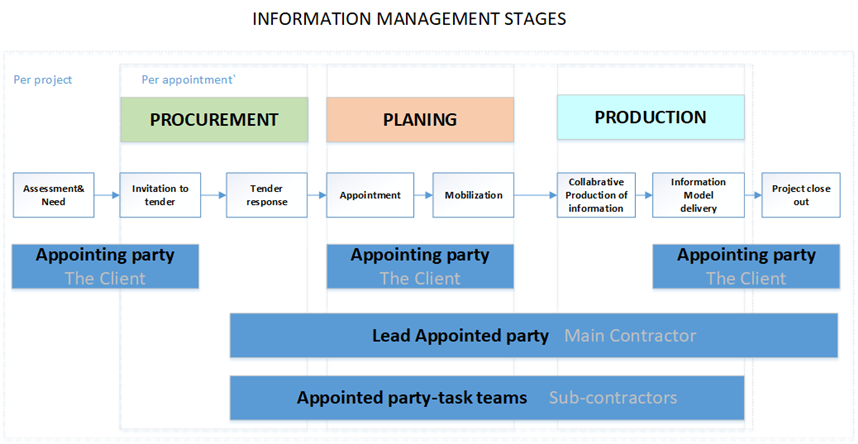
Within the ISO 19650 framework, information management is typically structured into three major stages:
- Procurement
- Planning
- Production
These stages guide the process from defining information requirements through to collaborative information creation and delivery.
Procurement Stage
Defining Information Requirements and Selecting Capable Teams
The procurement stage begins once the client has established the need for a project and identified the information required to support its delivery and long-term operation. In ISO 19650 terminology, the client acts as the Appointing Party, responsible for defining what information suppliers must deliver.
In the Elizabeth Line project, the client organisations, Crossrail Ltd and Transport for London, recognised from the outset that the railway infrastructure would require detailed digital information throughout its operational life. As a result, the project defined comprehensive Exchange Information Requirements (EIR) that specified the information deliverables expected from project participants.
These requirements included BIM models and structured asset information for a wide range of infrastructure elements, including station architecture, tunnel structures, railway systems, and mechanical and electrical equipment. The objective was not simply to construct a railway, but to create a digital representation of the infrastructure that could support long-term asset management.
Following the definition of these information requirements, the project entered the formal procurement process. During the Invitation to Tender, suppliers were required to demonstrate their capability to operate within a BIM-enabled environment. This included the ability to work within a Common Data Environment, produce structured digital models, and coordinate information across multiple disciplines.
In their Tender Response, suppliers submitted a BIM Execution Plan (BEP) outlining how they would manage project information. These plans described modelling standards, software platforms, coordination procedures, and organisational responsibilities for information delivery. Only suppliers capable of operating within this structured information management framework were selected to participate in the project.
Planning Stage
Structuring Information Production Across the Project
Once the project team had been appointed, the focus shifted from defining information requirements to planning how that information would be produced and coordinated. The planning stage ensures that all organisations participating in the project understand their responsibilities for information production and delivery.
In the Elizabeth Line programme, this planning phase was particularly important due to the scale and complexity of the project. The railway network included numerous underground stations, extensive tunnel infrastructure, and sophisticated railway systems. Multiple engineering disciplines needed to collaborate while maintaining consistent information standards.
To achieve this, the project developed structured information delivery plans in line with ISO 19650 principles. A Master Information Delivery Plan (MIDP) was established to define the overall schedule for producing and delivering project information. This plan coordinated information production across all disciplines and ensured that key deliverables were available when required for project decision-making.
Alongside the MIDP, each participating organisation developed Task Information Delivery Plans (TIDP) specifying the information they were responsible for producing. For example, architectural teams were responsible for producing station design models, structural engineers developed models of tunnels and supporting infrastructure, and railway systems engineers produced models of track systems, signalling, and associated equipment.
Through this structured planning process, the project ensured that the responsibilities for information creation were clearly defined. This allowed teams to coordinate effectively and reduced the risk of inconsistencies between different engineering disciplines.
Production Stage
Collaborative Creation and Management of Project Information
The production stage represents the active phase of project design and engineering. During this stage, project teams begin producing digital models and engineering information while collaborating across disciplines.
Within the ISO 19650 framework, this information is managed through a Common Data Environment (CDE). The CDE acts as the central digital platform where project participants can share, review, and coordinate information.
For the Elizabeth Line project, the CDE played a critical role in enabling collaboration between multiple contractors and design teams working on different parts of the railway network. Architectural, structural, mechanical, electrical, and railway systems engineers were able to access shared project information and coordinate their designs within the same digital environment.
Information produced during the project followed a structured approval workflow. Design models were initially developed internally within each organisation as Work in Progress information. Once reviewed internally, the information was shared with other disciplines to enable design coordination. Following interdisciplinary review and approval, the information was formally published for use in construction planning and engineering decision-making.
This collaborative workflow enabled engineers to coordinate complex design information across the entire railway network. For example, when designing a station environment, architectural models had to be coordinated with structural tunnel systems, mechanical ventilation infrastructure, and railway equipment installations. Managing this coordination through a shared digital environment allowed potential design conflicts to be identified and resolved before construction.
Conclusion
The ISO 19650 information management framework provides a structured approach for managing digital information in complex construction projects. By organising project delivery into procurement, planning, and production stages, the framework ensures that information is clearly defined, produced collaboratively, and delivered in a controlled and reliable manner.
The Elizabeth Line project demonstrates how these principles can be applied in practice. Through structured procurement processes, coordinated planning of information delivery, and collaborative production of digital models, the project was able to manage large volumes of engineering information across numerous organisations.
As construction projects continue to increase in scale and complexity, the ability to manage information effectively will become increasingly important. Frameworks such as ISO 19650 provide the governance structure necessary to ensure that digital information remains accurate, coordinated, and valuable throughout the lifecycle of built infrastructure.
Looking Ahead
The experience of the Crossrail (Elizabeth Line) shows how structured information management can improve coordination and long-term asset value in complex infrastructure programmes. By aligning procurement, planning, and production with the principles of ISO 19650, large multidisciplinary teams were able to collaborate through a shared digital environment and maintain reliable information flows across the project lifecycle.
However, an important question remains: how can the lessons learned from major projects like the Elizabeth Line be applied effectively to smaller construction projects across the industry?
Shahin Khalilian, PhD, MBA, MIET
Architectural Engineer | BIM & Digital Construction Researcher