


Digital construction has significantly changed how buildings are designed, coordinated and delivered. Modern projects increasingly rely on digital models and collaborative platforms to share information between disciplines.
Despite these advances, many teams still face a familiar issue: project information exists in many places, but it is not always structured, coordinated or exchanged efficiently.
Most professionals working with Building Information Modelling (BIM) have experienced this situation. A model might be technically impressive and highly detailed. However, when the project reaches key stages such as coordination, information exchange, or asset handover, gaps in the information structure often become visible.
At this point, the role of BIM standards becomes critical.
Two frameworks are particularly influential in guiding BIM information management:
- ISO 19650
- National BIM Standard – United States (NBIMS-US)
Although these frameworks are sometimes discussed as alternatives, they actually address different aspects of the BIM process. Rather than competing standards, they represent complementary approaches to managing digital information.
This article explores how combining the strengths of both frameworks can improve the reliability and usability of BIM information throughout the lifecycle of built assets.
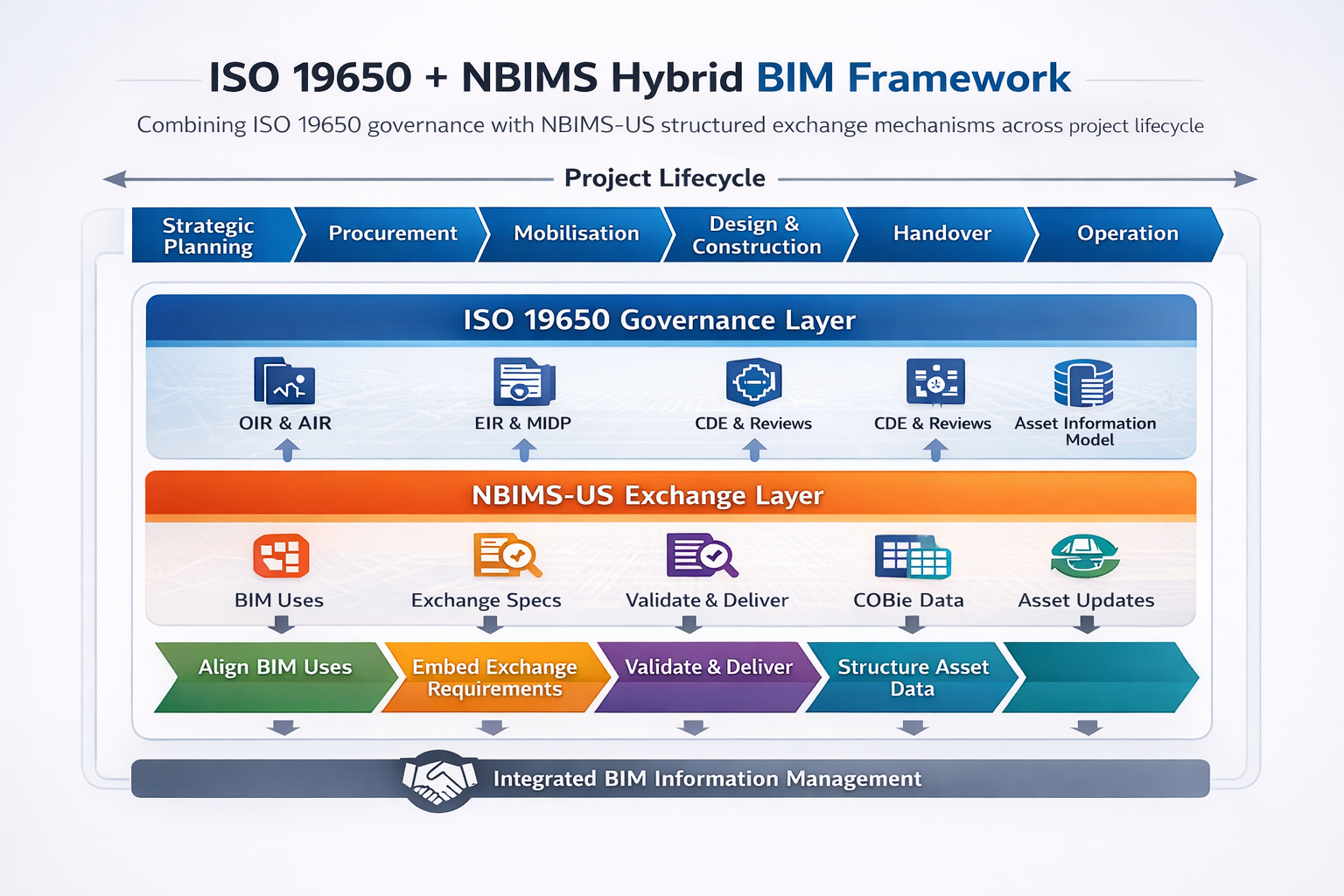
Two BIM standards with different priorities
ISO 19650 and NBIMS-US are often referenced in the same discussions about BIM standards, but their design philosophies are different.
ISO 19650 is primarily concerned with information governance. It defines processes for requesting, producing, reviewing and approving information during the lifecycle of a built asset.
NBIMS-US, on the other hand, focuses more on information structure and exchange. It introduces concepts such as BIM Uses, exchange requirements and structured data delivery.
In simple terms:
- ISO 19650 manages how information flows
- NBIMS-US helps define what information should be exchanged
The distinction becomes clearer when comparing their main characteristics.
|
Dimension |
ISO 19650 |
NBIMS-US |
|
Primary focus |
Information governance |
Structured information exchange |
|
Standard type |
International BIM standard |
United States national BIM framework |
|
Core objective |
Managing information across the asset lifecycle |
Defining BIM uses and data exchanges |
|
Key mechanisms |
OIR, AIR, EIR and CDE workflows |
BIM Uses and exchange specifications |
|
Major strength |
Coordination and governance processes |
Structured digital deliverables |
|
Main limitation |
Less focus on semantic exchange structures |
Limited lifecycle governance |
For a comprehensive understanding of BIM processes and standards, Eastman et al. (BIM Handbook) remains one of the most widely cited references in the field.
Why governance alone cannot solve the problem
Many organisations have successfully implemented workflows based on ISO 19650. The framework provides a clear structure for:
- defining information requirements
- assigning responsibilities
- controlling review and approval processes
- managing information states within a Common Data Environment (CDE)
These governance mechanisms help maintain consistency across complex projects.
However, even when governance processes are well implemented, challenges may still arise when information moves between systems or organisations.
For example:
- asset information may not be formatted correctly for facility management systems
- model data may not match the expected exchange formats
- deliverables may vary significantly between disciplines
In other words, governance controls the management of information, but it does not always define the structure of the data itself.
This is where structured exchange frameworks become important.
Why structured exchanges are equally important
NBIMS-US addresses many of these issues by focusing on how information should be structured and exchanged.
One of its most recognised components is COBie (Construction Operations Building Information Exchange), which provides a structured method for delivering asset information at project handover.
According to guidance from the National Institute of Building Sciences, structured exchange frameworks such as COBie help minimise information loss when projects transition from construction to operation.
This becomes increasingly important as the industry moves toward:
- digital twins
- automated asset management systems
- integrated lifecycle data platforms
However, structured exchanges alone cannot fully solve the problem. Without governance processes, project data can still become inconsistent, incomplete or poorly coordinated.
A hybrid perspective on BIM information management
When we examine ISO 19650 and NBIMS-US together, an interesting insight emerges.
Instead of choosing one framework over the other, it may be more productive to view them as two complementary layers within a BIM information management strategy.
In such a hybrid model:
- ISO 19650 provides the governance backbone
- NBIMS-US strengthens the structure of information exchanges
This layered approach allows governance decisions and structured deliverables to align throughout the project lifecycle.
|
Project Stage |
Governance Layer (ISO 19650) |
Exchange Layer (NBIMS-US inspired) |
Integration Benefit |
|
Strategic planning |
Organisational and asset information requirements |
BIM use definitions |
Align digital strategy |
|
Procurement |
Exchange information requirements |
Structured deliverable expectations |
Clarify data needs |
|
Mobilisation |
MIDP / TIDP planning |
BIM execution planning |
Coordinate delivery |
|
Production |
Information containers |
Model deliverables |
Improve consistency |
|
Review |
CDE approval workflow |
Exchange validation |
Strengthen data quality |
|
Handover |
Asset information model |
COBie datasets |
Reliable asset data |
|
Operation |
Lifecycle governance |
Structured asset information |
Support facility management |
Through this integration, project information becomes both well governed and technically usable.
A practical example: digital fabrication
To illustrate this concept, consider a digitally fabricated building element such as a timber staircase.
A BIM model of the staircase may contain detailed information including:
- geometry and dimensions
- material specifications
- structural constraints
- fabrication tolerances
- installation details
If the project follows ISO 19650 governance workflows, the information can be managed through defined approval stages and controlled within a Common Data Environment.
However, when the model information needs to move into digital fabrication systems, for example CNC machines or automated manufacturing platforms, the structure of the data becomes critical.
If the information is not properly structured, the fabrication team may need to reinterpret or recreate the data manually, which introduces inefficiencies and potential errors.
This example demonstrates how combining governance discipline with structured information exchange can significantly improve digital workflows.
Why this matters for engineers
For engineers, BIM managers and digital delivery teams, discussions about standards are not purely academic. They directly affect the efficiency and reliability of real projects.
Better alignment between governance frameworks and structured data exchanges could help teams:
- reduce information loss at project handover
- improve interoperability between digital systems
- support digital fabrication and automation
- strengthen asset information models
- enable more reliable lifecycle data management
As digital construction continues to evolve, project success will increasingly depend on trusted, structured information rather than isolated models.
Looking ahead
The BIM ecosystem continues to evolve as organisations adopt more data-driven approaches to project delivery and asset management.
Rather than developing entirely new standards, the industry may benefit from exploring how existing frameworks can complement each other.
ISO 19650 provides a strong governance structure for managing information across the asset lifecycle. NBIMS-US contributes valuable mechanisms for structuring digital data exchanges.
When thoughtfully combined, these frameworks can support a more complete and resilient approach to BIM information management.
Over to the EngX community
Many engineers and digital construction professionals work with BIM standards every day.
It would be interesting to hear how others approach these challenges in practice.
- Do you rely primarily on one BIM framework?
- Have you experienced difficulties aligning governance processes with data exchanges?
- Are new hybrid approaches emerging in your projects?
Sharing experiences from real projects could help the community better understand how BIM standards are evolving in practice.