


Jerry Stone gave an in-depth and thought-provoking presentation on the life and achievements of Robert Goddard at a Beds & Herts event in Futures Place on 21 April 2026.
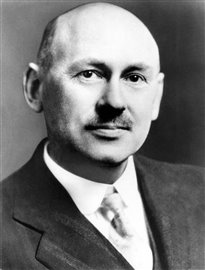 Robert Hutchings Goddard is widely regarded as the father of modern rocketry, a title earned through his visionary ideas and groundbreaking experiments that laid the foundation for space exploration. Born on October 5, 1882, in Worcester, Massachusetts, Goddard showed an early fascination with science and invention. His curiosity was strongly encouraged by his family, particularly his mother, Esther Goddard, who supported his education despite his frequent childhood illnesses.
As a young man, Goddard was inspired after reading H.G. Wells’ The War of the Worlds, which sparked his dream of space travel. He pursued physics and engineering with determination, eventually earning a PhD from Clark University. Throughout these formative years, his family - especially his devoted Aunt Effie, who provided both emotional and practical support - played an important role in sustaining him as he struggled with poor health and limited funding.
Goddard’s most famous achievement was the invention of the liquid-fuelled rocket. On March 16, 1926, he successfully launched the world’s first liquid-fuelled rocket in Auburn, Massachusetts. Though modest by today’s standards, this flight marked a historic breakthrough. Liquid fuel made rockets more powerful, controllable, and efficient, opening the door to modern spaceflight.
Despite his technical brilliance, Goddard often faced ridicule and misunderstanding. In 1920, a newspaper editorial mocked his assertion that rockets could work in space, reflecting the widespread scepticism he endured. This criticism made him cautious and private, preferring small-scale experiments to public demonstrations. During this difficult period, Goddard relied heavily on his wife, Nell Goddard, whom he married in 1924. Nell became his constant companion, assistant, and recorder, meticulously documenting his experiments and providing unwavering encouragement.
Throughout his career, Goddard earned more than 200 patents, covering concepts such as rocket stabilisation, steerable thrust, and multi-stage rockets. Many of these ideas later became fundamental to military missiles and space launch systems. Although other nations applied similar principles during World War II, Goddard did not live to see how central his work would become. He died in 1945, just as the rocket age was beginning.
Recognition for Goddard’s achievements grew significantly after his death. NASA honoured him by naming the Goddard Space Flight Center, acknowledging his indispensable role in space exploration. Behind his scientific legacy lies a quieter story of perseverance, shaped not only by intellect but also by the steadfast support of Esther, Aunt Effie, and Nell.
Robert H. Goddard’s life demonstrates that transformative scientific progress rarely happens in isolation. His success was fuelled by imagination, resilience, and the dedication of those closest to him - proving that even the boldest journeys into space often begin with strong support at home.
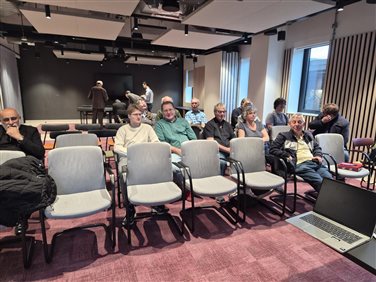
19 people joined us at the event, which was well received and generated a lively Q&A session.
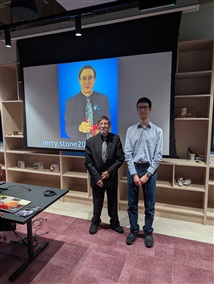

Jerry Stone and Joe Rider (volunteer)

