


As engineers, we look at the world not just as it is, but as what it could be. Personally, the evolution of materials and the advancements in engineering that enable those developments absolutely fascinate me.
My passion started young, always fascinated with the engineering of exotic metals and the concepts behind using them in innovative ways. I remember watching films and animations featuring robotics and powerful exoskeleton suits, which helped develop an already overactive imagination. The idea that we could use clever design and advanced materials to physically extend our reach and improve our resilience is a powerful motivator. This enthusiasm drives my interest in the development of new, wonderful ways that can help us grow toward unknown possibilities for humanity.
From the crushing depths of the deep ocean to the relentless vacuum of space, the limits of human technology are often defined by a single factor: the materials we use. We are entering an age where conventional alloys simply can't handle the extreme demands of our most ambitious projects.
The engineering challenges of the 21st century, clean fusion energy, hypersonic flight, and deep-sea exploration—require materials that operate at the very edge of physical possibility. The field of metallurgy is responding with a "next generation" of engineered metals and alloys designed not just to withstand harsh conditions, but to thrive in them.
Engineering for Extremes 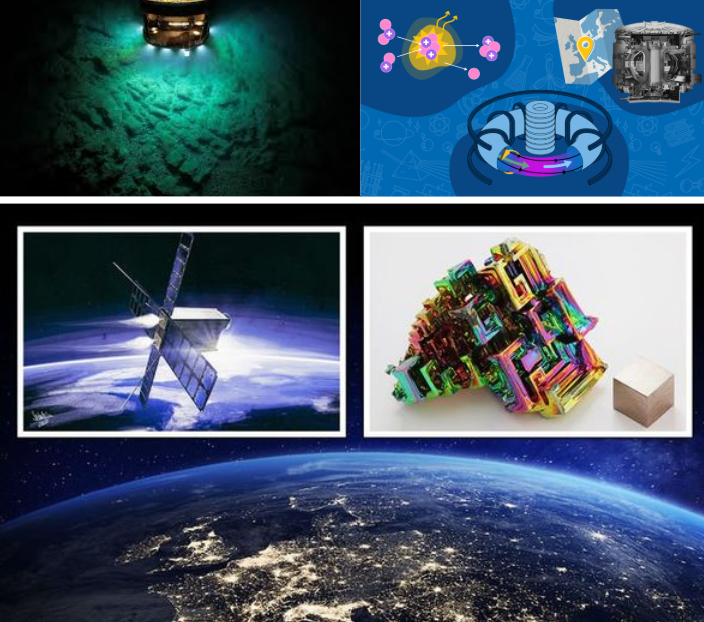
Whether we are engineering for highly corrosive environments or high-neutron flux, the solutions rely on sophisticated material science:
Energy: Harnessing the Extreme Heat and Radiation. In nuclear engineering, specifically for next-generation fission and experimental fusion reactors (like ITER), the challenge is immense. Materials must endure temperatures where standard steel would melt, all while resisting embrittlement from high-energy neutron bombardment.
Reduced Activation Ferritic/Martensitic (RAFM) Steels (e.g., EUROFER): These iron-based alloys are the leading candidates for the structural components of future fusion plants. By carefully managing their composition and avoiding elements that form long-lived isotopes, engineers ensure that components become significantly less radioactive over time, simplifying future maintenance and waste management.
Oxide Dispersion Strengthened (ODS) Alloys: These are game-changers for high-temperature applications. Incorporating nanoscale ceramic particles within a metal matrix provides superior resistance to swelling and deformation (creep), allowing systems to run hotter and more efficiently than ever before. Additive manufacturing (3D printing) is also revolutionising this field, enabling the creation of complex cooling channels within these robust materials that traditional forging methods could never achieve.
Space and Deep Sea: Surviving the Unforgiving. Space presents vast temperature swings and radiation; the deep sea presents immense pressure, saltwater and microbial corrosion.
Titanium Alloys: The go-to metal for both environments due to its extraordinary corrosion resistance and impressive strength-to-weight ratio. Recent research allowed me to uncover advanced processing techniques being maximised, such as cryo-forging of pure titanium. Creating materials that offer unprecedented combinations of strength and ductility at extremely low temperatures, ideal for cryogenic spacecraft components.High-Entropy Alloys (HEAs): These novel alloys, which are composed of four or more elements in near-equal proportions, exhibit extraordinary strength and fracture resistance across a vast temperature range. They are strong contenders for applications in everything from hypersonic aerospace vehicles to future fusion reactor linings.
The Evolution of Materials engineering & Science
The advancements mentioned above are not accidental. They are the result of an evolution in how we approach material discovery:
AI-Driven Discovery: We are using machine learning and supercomputers to simulate millions of potential alloy combinations, rapidly identifying optimal candidates long before a lab experiment begins. This speeds up R&D cycles from decades to years.
Nanotechnology: Controlling material grain structure at the nanoscale provides properties unreachable in bulk materials, enhancing strength and radiation resistance.
Conclusion: Enablers of Human Growth
Ultimately, these metallurgical advancements are the essential enablers of human progress. They provide the physical resilience necessary for us to push the boundaries of engineering and science, secure sustainable energy sources, and explore new frontiers, much like the advanced robotics and exoskeletons from the films that captured my imagination as a child. "Maybe now not so far fetched!"
As IET members especially those experienced amongst us, we are at the forefront of deploying these materials into real-world applications. The next generation of metals is quietly, and powerfully, forging the future we wish to inhabit.
I would really love to hear peoples thoughts and experience: What extreme environment application do you think will benefit most from these next-generation metals?
Please add your interesting insights, ideas and thoughts in the discussion below.
Look forward to reading them!
Thank you k