Is it common for candidates with a Level 7 qualification to apply for EngTech registration?

Hi everyone, I’m currently on a graduate scheme at a UK organisation and have around 1.7 years of experience in the railway sector.

My long-term goal is to achieve CEng registration. In the meantime, I’m wondering whether it would be beneficial to register as EngTech first as an early-career credential and as a way of demonstrating progress towards CEng.

I understand that gaining CEng will take several more years of experience, along with building up the UK-SPEC competencies, so I’m considering whether EngTech would be worthwhile during that period.

I’d really appreciate any advice or perspectives on this, as I’m keen to understand professional registration from different angles.

Thank you in advance for your help.

  • Do keep in mind that the different levels of registration are progressive and absolutely nothing wrong applying for different levels as a career progresses.  Off course lots of people wait until they believe they can demonstrate the required CEng competencies, commitment and UK&u but as a registration advisor, I see quite a few applicants moving through the levels. Its not unusual for me to support someone with an EngTech application and then they come back asking for support with an IEng application or even a CEng application. YOu don't have to do EngTech to IEng to CEng and can go from EngTech to CEng as your competencies and commitment develop. The other big benefit of progression through the registration levels is you gain experience writing applications, how to tell your career story etc. There is also the experience of the interviews too.  Lastly, we do see level 7 qualifications that have not quite developed the required competencies and commitments apply for EngTech or even IEng.

    Hope this helps. 

  • Kitson,

    As Gerard has indicated absolutely nothing wrong with making an application for EngTech then as you progress through your career and gain further competencies then apply for IEng or CEng depending on where you believe you are working at.

    I'm an assessor for EngTech applications and have see many applicants apply for EngTech at end of their industrial placement year from the academic studies or on graduating but well before they have had a long duration working for an employer.

    If you obtain and read UK-SPEC for the competency details for EngTech, believe you have sufficient evidence of being able to demonstrate examples then nothing stopping you making that EngTech application. I would also suggest unless you have a colleague or mentor that's professionally registered to give advice to you, then seek out an IET registered PRA who will give words of advice on your application.

     Regards GTB

  • I am interested in the answer to this too. In the early days of the IET when IEng was new (to them), I seem to remember they tried to sell IEng and CEng as ‘equivalent but different’ rather than a progression one to the other. I don’t think anyone fell for that and it is now widely considered to be at different levels. I am interested in how EngTech fits in, as I also see some of my early careers people going for EngTech as a pathway to IEng then CEng. However, the industrial liaison person at my company objects to those on the IEng/CEng pathway applying for EngTech, as they believe that technician is a different role to that done by those destined for IEng/CEng. Do others agree with that, or do you think that EngTech and IEng are routes to CEng?

    Do you have any views on whether this would take longer? If you apply for all three, then you would need to demonstrate how you have progressed from the last to reach the standard of the next, and if you only leave this a short time then there may be a question about why you think you have gained that competence in a short time. But if you go straight for CEng, you can do that as soon as you feel you have the required competence and level of accountability, and that may be sooner than if you went EngTech -> IEng ->CEng.

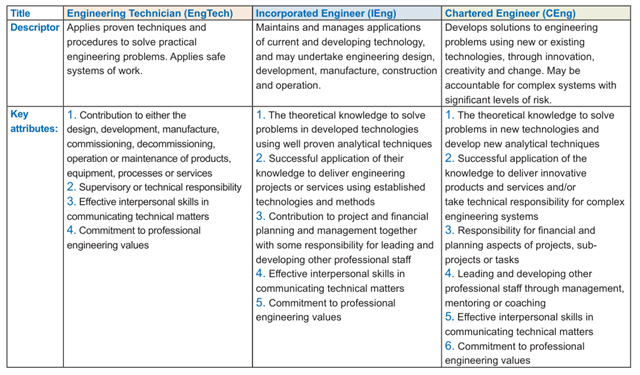
  • The Engineering Council define it like this (taken from UK-SPEC):


    It's a little simplistic and doesn't really address the reality of engineering work. The academic requirement for EngTech is L3, but that doesn't mean you can't use a L7.

    The issue I would take is that the competency descriptions for EngTech are different from IEng/CEng. IEng and CEng are very similar. Which means that you may not be able to technically evidence an EngTech competence if you are meeting the CEng one.

    The example here is the C competencies, where for EngTech you are accepting tasks from others and checking that you have the right conditions to execute the task. At CEng, its more about determining the tasks, managing the work, allocation to others.

    Its possibly worth looking at the competency definitions for EngTech/IEng/CEng and seeing where you thing you are and what gaps you have (if you haven't already done so).

    If you were only a few months away from being able to satisfy CEng, I would certainly say hold off. Because every application you make will cost you money.

  • There are so many myths out there about registration and who can and cannot apply.  Your colleague's position counts as one. There is also the one that says you need a masters to be a CEng.  There are many more which have no basis in UKSPEC. We see a lot of successful CEng applicants that started with apprenticeships etc. 

    Absolutely nothing wrong with applying for any levels of registration. I see 100s of cases every year and see people applying for Engtech that are clearly IEng or CEng or applying for IEng and they are clearly CEng etc.  Often happens where employers pay registration bounties or where they receive advice based on myths. " you can only apply for IEng in that role or that position or at that rank!"  Lost count of the number of enlisted applicants in all the branches of the forces that achieve CEng. 

    Just on your comment re the time since the last registration etc.  This is not correct. Each application should be a whole of career application. YOu can off course have different emphasis in different parts of the career history we we are not just interested in what you have achieved since the last registration. Many successful applicants for a particular level of registration are often able to demonstrate some of the competencies required for the next level and these would not be included in any gap based application. Full career histories and let the assessors decide. 

  • I assume that as a first step you have a copy of UKSpec version 4.   From little information that you give, I believe you have a BEng degree and are on a graduate scheme in the rail industry, and have 1.7 years of experience.  I may have read this wrong, but go with that for the moment.

    You will see from UKSpec you have the Underpinning Knowledge and Experience (UK&U) required for IEng.  The graduate apprenticeship should be building the competences you will need to be able to demonstrate IEng competence, and these will probably be nearly there by the time you finish the apprenticeship.  Look for opportunities to work on projects that will help you build on that experience.

    In my view it would be worth your while to hold off for the moment, judge when you meet the IEng competence and register at that level. Then develop towards CEng UK&U and build CEng competence.

    David

    Edited to correct typos

  • Level 7 is equivalent to a Masters.

    However, it is not that simple. I've had my candidates (as a PRA) go through to achieve CEng with a HNC. I've also seen IEng applications with a Level 7. I don't recall seeing an EngTech application with a Level 7, but there is always a first time.

    I've certainly seen people with EngTech that are working towards a Level 7 qualification.