Is it common for candidates with a Level 7 qualification to apply for EngTech registration?

Hi everyone, I’m currently on a graduate scheme at a UK organisation and have around 1.7 years of experience in the railway sector.

My long-term goal is to achieve CEng registration. In the meantime, I’m wondering whether it would be beneficial to register as EngTech first as an early-career credential and as a way of demonstrating progress towards CEng.

I understand that gaining CEng will take several more years of experience, along with building up the UK-SPEC competencies, so I’m considering whether EngTech would be worthwhile during that period.

I’d really appreciate any advice or perspectives on this, as I’m keen to understand professional registration from different angles.

Thank you in advance for your help.

Parents
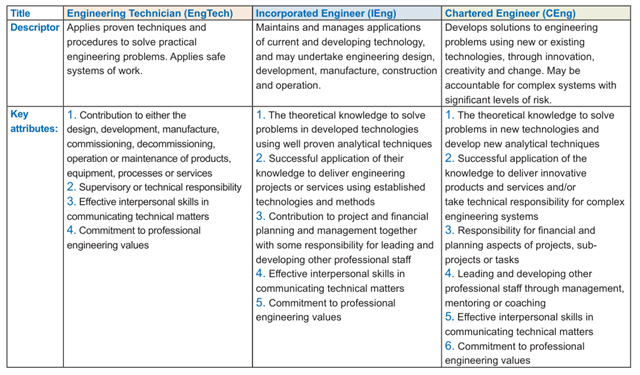
  • The Engineering Council define it like this (taken from UK-SPEC):


    It's a little simplistic and doesn't really address the reality of engineering work. The academic requirement for EngTech is L3, but that doesn't mean you can't use a L7.

    The issue I would take is that the competency descriptions for EngTech are different from IEng/CEng. IEng and CEng are very similar. Which means that you may not be able to technically evidence an EngTech competence if you are meeting the CEng one.

    The example here is the C competencies, where for EngTech you are accepting tasks from others and checking that you have the right conditions to execute the task. At CEng, its more about determining the tasks, managing the work, allocation to others.

    Its possibly worth looking at the competency definitions for EngTech/IEng/CEng and seeing where you thing you are and what gaps you have (if you haven't already done so).

    If you were only a few months away from being able to satisfy CEng, I would certainly say hold off. Because every application you make will cost you money.

Reply
  • The Engineering Council define it like this (taken from UK-SPEC):


    It's a little simplistic and doesn't really address the reality of engineering work. The academic requirement for EngTech is L3, but that doesn't mean you can't use a L7.

    The issue I would take is that the competency descriptions for EngTech are different from IEng/CEng. IEng and CEng are very similar. Which means that you may not be able to technically evidence an EngTech competence if you are meeting the CEng one.

    The example here is the C competencies, where for EngTech you are accepting tasks from others and checking that you have the right conditions to execute the task. At CEng, its more about determining the tasks, managing the work, allocation to others.

    Its possibly worth looking at the competency definitions for EngTech/IEng/CEng and seeing where you thing you are and what gaps you have (if you haven't already done so).

    If you were only a few months away from being able to satisfy CEng, I would certainly say hold off. Because every application you make will cost you money.

Children
No Data