Chartership through further learning at work, HND to IEng & CEng?

Hello all!

Bit of a wild card here.. I appreciate any one reading & commenting! I have kept certain institutions anonymous as I just want to shed light to my query.

I had interrupted my studies at a Russel Group university on a CIBSE & Part 1 RIBA accredited course due to carer responsibilities. 2 years on, I'm resuming my career and progression to IEng & CEng. I reached out to my personal tutor also the Head of "X course" to re-join & was told that I will most likely not allowed back due to the development in the industry/course material, the university's T&Cs on maximum period of completion & would have to re-enrol entirely. My physical transcripts are on hold due to administrative issues during my interruption.

Currently holding a HND/Level 5, I'm struggling to find any entry level work (relevant to IEng) let alone company training schemes/sponsorships without a Bachelors degree (& transcripts). Is this because the criteria to meet IEng is only through a Bachelors (in a relevant degree & accredited institution) after Sept 1999? Or is it because I do not hold a BEng/Level 6? If so I'm not able to be accepted onto an accredited and relevant top up course due to my transcripts (I tried  & was told by the admissions team to send a letter from my head of faculty confirming my attendance. To be then ignored by the admissions officer after relaying what I was told would suffice). Is it right to not wait x months/years till the next academic enrolment (or the mercy of an empathetic admissions officer) and to instead progress through relevant work experience & sponsorship? 

Entry roles of interest (usually BEng level): Building Physics Engineer, Sustainability consultant, Structural Engineer, Project Design Engineer, Building Services Engineer, Environmental Engineer.
Roles I am a top candidate for (HND level): CAD Technician, usually for data centres which is not relevant in the further learning at work route to IEng? 

I'm very stuck with my options at the moment as this was not part of my Net Zero initiative 10 year plan! 

I would appreciate any insight into my career progression with a HND to Chartership!

To confirm my questions are:

1) Is there a route to Chartership by a Licensed Professional Engineering Institution for engineers in the UK with a HND, 

2) How do I find a sponsor to get on the IEng ladder with a HND?

3) Can I apply to EngTech with a HND?


My sources;

From the Engineering council, www.engc.org.uk/.../incorporated-engineer-ieng

  • An HNC or HND started after Sept 1999 (but before Sept 2010 in the case of the HNC) or a Foundation Degree in engineering or technology, plus appropriate further learning to degree level

It then goes onto "Please note:

  • You can still become an IEng without these academic qualifications. Further information about the individual, work-based, assessment process can be found in UK-SPEC and from your Licensed PEI "

My Licensed PEI: CIBSE https://www.cibse.org/media/5izkxlj2/acibse-application-guidance-2021.pdf CIBR19123 Associate Application Guidance v2

"If you do not hold an exemplifying qualification for IEng, you can take the experience route as depicted below." 

"Find a sponsor who can support your application."

From my university:

Absolute maximum period for completion – Full-time

Honours Degree 6 years

"The school will then need to judge whether, in the light of these circumstances, it is possible for the student to complete their studies within a period that sufficiently ensures the currency of their knowledge, their competency and the quality of their degree. If the school believes that it is, on balance, appropriate to extend the absolute maximum for that student, they will then provide a new absolute maximum to which the student must adhere."

Parents
  • The Engineering council does not require any formal academic qualification for any registration category. But, it does require suitable underpinning knowledge and understanding (UKU) and broadly sets out equivalences for those who gain such base knowledge through an academic qualification.

    In general the institutions and academia like it that way as they can play an "each to their own" with a little bit of quality assurance thrown in. Most then have side routes that look at existing UKU but this requires you to 'present' your case with demonstrations that you know your stuff. 

    See Paul Meenan of the 'e5 group' story for inspiration

    Are you doing the courses just to get the certificate (i.e. already know the stuff)? Or is it a conscious effort to build a broader/deeper understanding around what you already know?

    You could try other colleges/universities to see if you can transfer some prior learning, or even go back to the admissions part of your former establishment (as a professional, a second opinion is valuable..)

  • Appreciate the presentation linked by Paul Meenan - I found that truly inspirational!


    With regards to:


    1) Former establishment: I've submitted an appeal to increase the absolute maximum to period of completion - unlikely to be allowed back.


    2) Apprenticeships: I've reached out to the most used teaching institution. I was told I do not meet the criteria for advanced entry onto their Building Services Design Engineering (Level 6) due to the difference in course material. I've asked for further information with regards to this as my entire degree at my former establishment was accredited by CIBSE themselves..


    3) Other universities, unlikely due to not having physical transcripts (yet). 

    To answer your question: Both, most definitely I want to make a conscious effort to build a broader/deeper understanding around what I already know (sustainable engineering in the Built Environment). On the topic of certifications - most candidates hold a degree (Bachelors or Masters) for the graduate schemes/IEng sponsorships roles I'm applying for. Then all these roles to gain UKU to meet IEng criteria require the above credentials. 

    It seems to be a closed system even though an individual doesn't require a degree for chartership. Thankfully I've caught the attention of a director whilst inquiring about apprenticeships so will see what's in store for me!

    Many thanks Mr Oakley!


  • It seems to be a closed system even though an individual doesn't require a degree for chartership.

    That's a fair point. The Engineering Council essentially defines that you need the equivalent of an accredited masters for CEng. But what makes an equivalence is a hard question. I suspect in part its due to the complexity of the assessment.

    If you have no qualifications at all, many institutions seem to go the path of having the candidate write a technical report (essentially a masters level project write-up). But you are in the position where you have a reasonable level of qualification. In fact the Engineering Council AHEP standard does define what the top-up from a HND should look like for IEng.

    One of our graduates (who has a bachelors) asked me recently whether it was better to go for a part time MSc (typically 3 years) or to just build experience. Ultimately, its not going to be a dissimilar time to build the experience, so my view was it depended if they wanted to do the MSc.

    Incidentally, in my field there is the CSEP certification, if you don't have an appropriate degree, they define the requirements as:

    • Have five (5) years systems engineering experience with a qualifying degree. If lacking a qualifying degree, the following is required: o With a non-qualifying bachelor’s degree or no degree: 10 years of engineering experience is required, of which a minimum of 5 years must be SE experience

    So, any person lacking the appropriate qualifications needs an extra 5 years of engineering experience. At least its well defined!

Reply
  • It seems to be a closed system even though an individual doesn't require a degree for chartership.

    That's a fair point. The Engineering Council essentially defines that you need the equivalent of an accredited masters for CEng. But what makes an equivalence is a hard question. I suspect in part its due to the complexity of the assessment.

    If you have no qualifications at all, many institutions seem to go the path of having the candidate write a technical report (essentially a masters level project write-up). But you are in the position where you have a reasonable level of qualification. In fact the Engineering Council AHEP standard does define what the top-up from a HND should look like for IEng.

    One of our graduates (who has a bachelors) asked me recently whether it was better to go for a part time MSc (typically 3 years) or to just build experience. Ultimately, its not going to be a dissimilar time to build the experience, so my view was it depended if they wanted to do the MSc.

    Incidentally, in my field there is the CSEP certification, if you don't have an appropriate degree, they define the requirements as:

    • Have five (5) years systems engineering experience with a qualifying degree. If lacking a qualifying degree, the following is required: o With a non-qualifying bachelor’s degree or no degree: 10 years of engineering experience is required, of which a minimum of 5 years must be SE experience

    So, any person lacking the appropriate qualifications needs an extra 5 years of engineering experience. At least its well defined!

Children
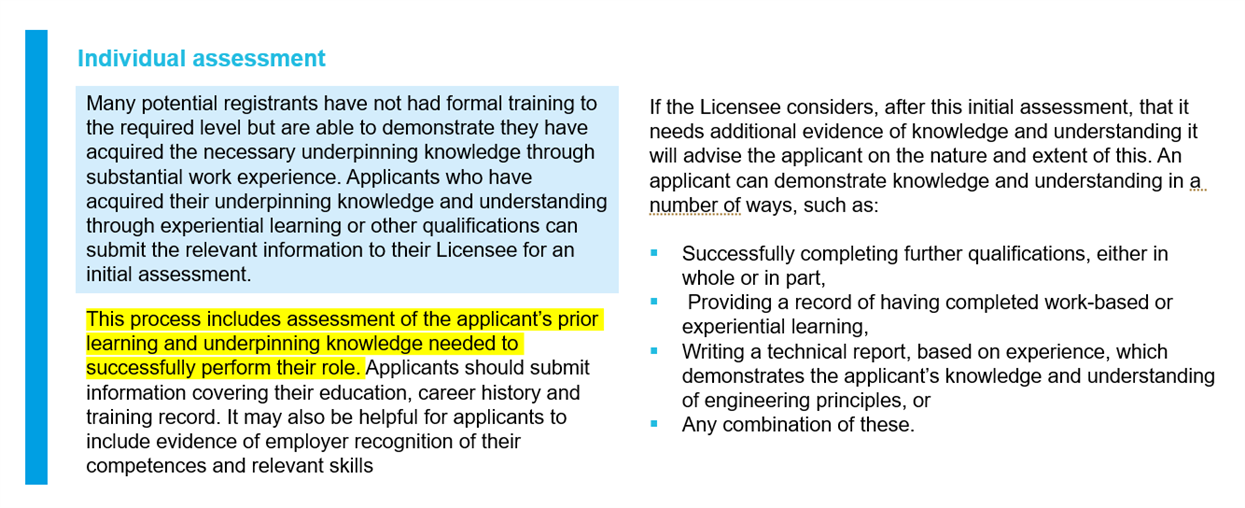
  • The engineering council does not require any equivalent to a masters for CEng.  A recognised MEng or recognised batchelors with recognised masters can be used to demonstrate UK&u but there is the IET individual route too. Over 70% of applicants to the IET adopt this non recognised route.  The requirement, as copied from V4 UKSPEC is:

  • Through the individual route you are assessing for an equivalence. Equivalence comes in many forms, which that paragraph details. It may be formal courses, but it may also be work-based and experimental learning. There are many options.

    There is a further guidance note from the Engineering Council that deals with international degree recognition and degrees from pre-UK-SPEC (like mine, which was SARTOR).

    I don't precisely know how the IET assesses UK&U, but I do know how my other institution does it. Given they are both meeting the underlying Engineering Council standards, I would suspect they are similar.

    I've been involved in more than a few assessments over the past few years through my other institution.