I’ll give you my thoughts, since no one else has “waded in” yet, with the caveat that I might be better described as “ex” rather than currently “expert”. I would expect that any limit is with the supply system capacity transformers, cables and contactors. The purpose of a star-delta starting arrangement is to limit the motor starting current in a simple and economic way. At the other extreme, I used to work on high voltage motors of several megawatts capacity, which achieved this aim by use of rotor resistance. Power was delivered direct on line, by a HV “breaker” (sometimes termed Motor Switching Device). So why do you want to use star-delta in preference to other methods? A quick google search led me here https://library.e.abb.com/public/6b4e1a3530814df0c12579bb0030e58b/1SFC132060M0201.pdf
Once you need so much power that you are looking at 3kV or more rather than 400v or 690v phase to phase (that transition is soft, but think sort of round the thousand horsepower mark) then you start to see more complex arrangements, such as rotors with switched resistors embedded, stepped series reactors (current limiting chokes that get switched out once up to speed) and so forth. Generally bigger machines have more poles but turn more slowly, and there is more space for clever tricks (and the 'just oversize it' solution becomes less sensible once the heavy cable is a dominant cost compared to a more complex starter). ~That said, note that if the supply can stand the surges, and the mechanics are rigid enough, you can still DOL start a large motor.
However, note that star-delta is falling from favour at the low power end and being replaced by electronics offering variable speed control and smooth slow start. As the electronics gets refined, costs of the method fall, and also the upper limit power level at which that becomes practical is steadily rising.
It may be that there is not a lot of simple star delta gear being installed on new kit at all in a few years time.
As with Roy, I didn't wade in as I am not sure there is an answer. There are practical limits as Roy has indicated, but Star-Delta is just one method of several reducing the starting current (along with such things as frequency control starters, auto-transformers, etc.). It is just a matter of deciding what is the most suitable arrangement (with DOL being the ideal as it is the simplest and therefore cheapest).
Most inductors are powered directly on the line, but when very large motors start this way, they cause voltage interference on the supply lines, as a result of a large current turnover.
To limit the starting current, large inductors start at reduced voltage, and then have a full supply voltage that connects as they run at near speed. Delta Starter Working Principle
This is a reduced stress-strain method. Voltage reduction during Delta Star activation is achieved by physically restoring the motor rods as shown in the figure below. During engine replacements are connected in star configuration and this reduces the voltage across each coil 3. It also reduces torque by a factor of three.
After a period of winding they are rebuilt like Delta and the engine normally runs. Star / delta starters are probably the most common low voltage switchgear. They are used in an attempt to reduce the starting current applied to the motor at start-up as a means of reducing the power interruptions and interruptions.
Traditionally in many supply areas, there will be a requirement to adjust reduced voltage output across all motors greater than 5HP (4KW). The Star / Delta (or Wye / Delta) Starter is one of the lowest cost voltage and electromechanical voltages that can be applied.
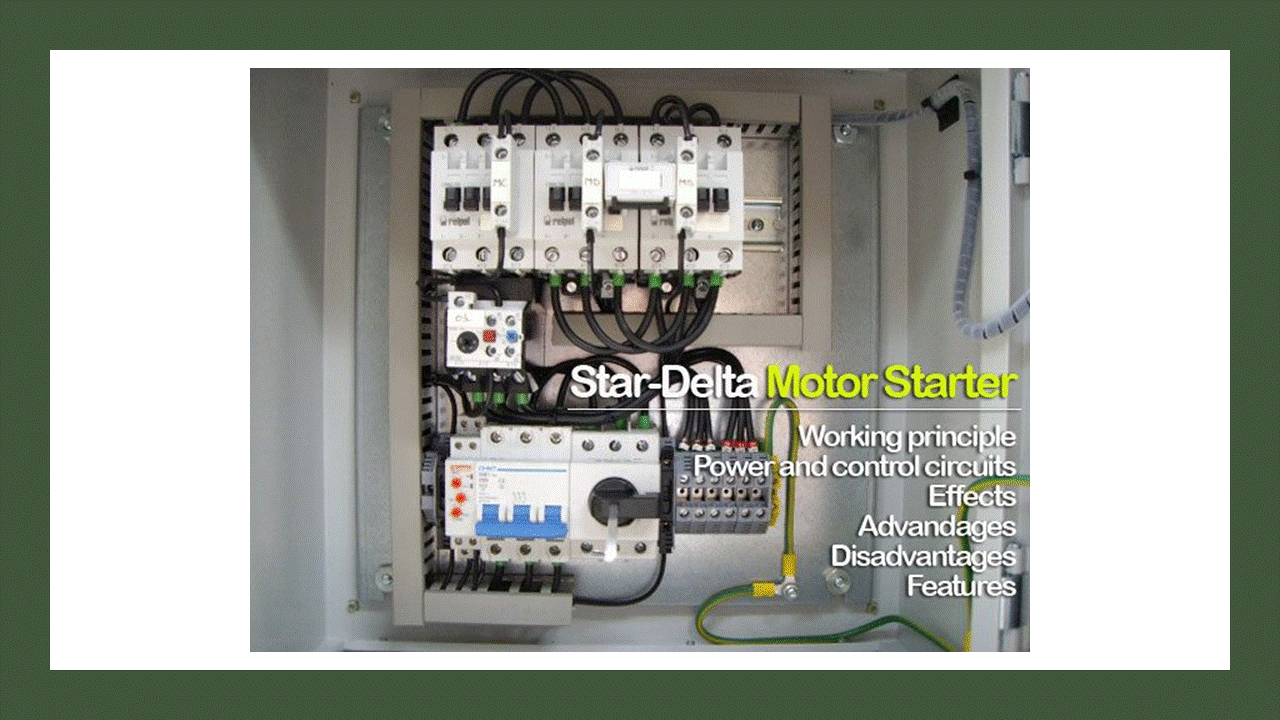
The Star / Delta Starter is made of three-touch, timer and thermal load. The contacts are smaller than the only contact used directly on the starter line as they only control winding currents. The streams through winding are 1 / root 3 (58%) of the stream in the line.
There are two close contacts during the run, often referred to as the main contractor Delta Contact. These are AC3 rated at 58% of the current engine rating. The third contact is the star contact and it only carries a current star while the engine is connected to the star.
Star Delta Starter consists of the following units
Protectors (Main, Star and Delta Contactors) 3 No (for State Opening Starter) or 4 No (Closed Transient Starter).
Relay Time (Late Pull) 1 no.
Release of three-pole thermal current 1 no.
Fuse elements or automatic cutting for the main circuit 3 Nos.
Fuse element or auto cut to control circuit 1No.
Delta Starter Power Circuit
The main circuit breaker serves as the main power supply circuit breaker that supplies power to the power circuit.
The main contact connects the reference source voltage R, Y, b to the main terminal of the motor U1, which, W1.
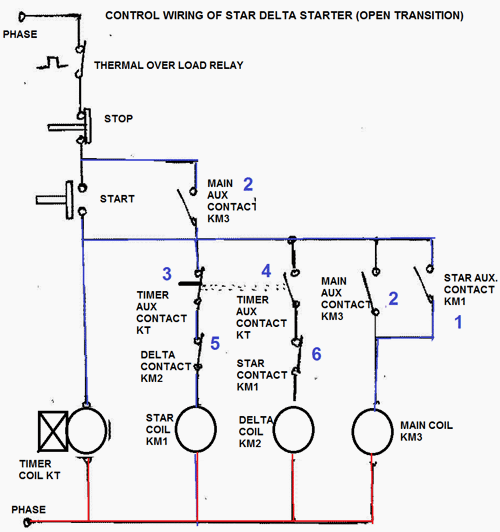
In operation, the main Contactor (KM3) and the Star Star (KM1) are initially closed, then after a period of time, the star is opened, and then the Delta Contact (KM2) is closed. The control of the contacts is by a timer (K1T) built into the starter. The star and delta are electrically desirable and mechanically integrated as well. In fact, there are four states:
The contact star is initially used as a secondary terminal of the U2, V2, W2 engine for a sequence to start during the initial stagnation of the engine. This provides one third of the current DOL motor, thus reducing the high infrared current inherent with large capacity engines at startup.
Control of the star connection Replaces the delta connection of an AC induction motor is achieved through a star delta or a wye delta control circuit. The control circuit consists of button switches, additional contacts and a timer.
Delta Starter Control Circuit (Open Pass)
I hope this helps the forum understand the system.
Thank you for your responses but I think I have answered my own question.
I was wondering where the move from star/delta crossed to auto-transformers and/or reactive starting because of the size of the contactors required then I realised that there will still be a need for a contactor to switch out the transformer or reactor anyway. So star/delta is OK as long as you have the contactors to implement it.
Does anyone know if I can get a 100kW soft-start unit that utilises single function components rather than micro-controllers or microprocessors?
As I highlighted earlier, I can't offer up to date experience, but the supplier I linked to has an extensive track record https://new.abb.com/drives/softstarters up to 2160A apparently.
In the past, microcontrollers mostly contained simple input and output mechanisms, memory and processing unit. Over the years, not only did memory increase significantly and clock speed increased, but many components that were once realized in a separate external component were added. In addition, different technologies have been added to assist the controller, and various communication interfaces. All of these are realized today on the same piece of silicon (system on chip). It comes down to reviewing many of the technologies that can be found in microcontrollers today.